‘Invasion Of The Tearling’ By Erika Johansen


9780062290410Maybe not as good as the first book in the trilogy, but still very good. The world building is nicely realized and it’s both good and important that it’s a book with a female protagonist that was written by a female author. It shouldn’t be, but I hope we can all agree that full gender equality hasn’t been reached yet, so anything that breaks up the boys club is positive.

The other week, I was visiting my new grandniece (yes, I’m old; I can already feel the icy hand of death clutching at my still, but barely beating heart; I can only pray that when the reaper comes for me, he finds wearing nothing but a pair of ruby encrusted spurs and listening to Jefferson Airplane’s classic album, Surrealistic Pillow), and my nephew-in-law showed me one of the books the infant had been given. It was an ABCs of famous American women and ‘U’ was for Ursula K. Le Guin. I explained that she was a famous and great feminist writer, best (though not exclusively) known for writing very thoughtful fantasy and science fiction.

That has nothing to do with The Invasion of the Tearling, but feminism in the genre had been on mind and that’s why.

We are in a fantasy world, with an invasion and a young queen, but the most interesting part are visions/flashbacks to how people from ‘our’ world wound up in this fantasy landscape. There’s a messianic revolutionary named William Tear and a world of corporate control created by a former president – a far right ideologue. It’s tempting to read Donald Trump into him, but he’s actually more of a Reagan-era figure. More Christian right than meandering, narcissistic fascism. The revolutionary movement grew out of the Occupy movement and it does feel real enough, but the Calvinistic, ‘chosen ones’ nature of the people who will escape to the new world (better world, they call it) is disquieting. There’s a single mention that they are not actually moving in place, but in time (to the future? the past?).

Our heroine fends off the evil queen (actually, she gets a three year truce), but quite clearly releases some more horrible evil into the world, so there’s that. I’ll check the library to see if they have the third book available.

 

Shin Godzilla


godzilla-resurgence-trailer-ticketsThe latest Godzilla movie from Toho is showing only irregularly here in Washington, DC – one night here, another night there. I saw it Tuesday night at the E Street Cinema (still the best movie theater in DC).

You can’t compare it to the recent, American Godzilla. Though that was a good movie, it was also, primarily, a monster movie. So what you say? How are the Toho movies and all their kaiju movies they inspired not monster movies? Serious? Are you stupid? Are you a Trump voter? Are you that stupid?

Ok, ok. Calm down. I get you.

But the Toho productions have always been, even at their silliest, informed by political concerns in a way that the American movies have not.

Shin Godzilla takes that to a whole new level. Even more than usual, Godzilla himself plays a relatively small role and has limited screen time. What’s more, during much of his screen time, he is sleeping (he sleeps standing up, in case you were curious).

Most of the movie consists of high level meetings of government officials and their aides. And it’s exciting. I kid you not. Even though they’re just meetings, it is amazingly fast paced. There are plenty of moments of humor and of the director and screenwriter rolling their eyes at bureaucracy and some high level bumbling. The Prime Minister and later the acting Prime Minister come in for some gentle mockery, but never does the movie disrespect the ability of political actors to accomplish things.

In fact, the final message of the movie (delivered with little subtlety in the final scenes) is the need for vigorous politicians to chart an independent path for Japan in a part of the world being rapidly dominated by concerns about China and North Korea, as well as US responses to those concerns.

So, go see it.

Emmanuel Ax, Beethoven, Shakespeare


Last week, I cashed in one of my birthday presents – two tickets to see Emmanuel Ax play Beethoven’s First Piano Concerto at the Kennedy Center, followed by a Shakespearean themed program.

This was my second time hearing Ax play and, of course, he’s good; and he really seemed to enjoy playing such a youthful piece. I’m not a music expert and can’t even play the triangle, but it did seem to me that he had some rough moments during the first movement, but then really hit his stride, especially of the middle movement.

When they have stars like this, I wish they wouldn’t put them first, because, after hearing a great pianist play Beethoven, pretty much whatever follows is going to disappoint. I like Berlioz, but if one of his pieces immediately follows Bach’s Passion of Saint Matthew, well… it’s going to be a bit of a letdown, isn’t it?

The three pieces that followed were Erich Korngold’s Much Ado About Nothing Suite, Richard Strauss’ Macbeth, and Antonin Dvorak’s Othello Overture. I liked Dvorak the best, but the Korngold was fun. Also, I found out that Korngold wrote the scores to two of my favorite Errol Flynn swashbucklers: Captain Blood and The Adventures of Robin Hood!

One of the cool things they did was have two actors who feature a lot locally come out and perform bits from the relevant Shakespeare. I lost the paper that told me who they were, but the man was someone I had seen in many, many plays at the Folger Shakespeare Library (off the top of my head, I’ve seen him in District MerchantsTwevlth NightRosencrantz and Guildenstern Are Dead, and Mary Stuart. He got a great presence and a delicate comic touch that works even better, because he himself is such a big guy.

What We Can Learn From Poets (According To Cicero)


The Eleventh Son: A Novel Of Martial Arts And Tangled Love


Eleventh Son is one of the few (that I have seen) twentieth century wuxia novels translated into English. You see, while my better half was out of town, taking care of family for almost six months, I was able to indulge all my dark Netflix desires: Family Guy, Voltron, and kung fu movies.

I knew that, for example, the great (and also sui generis) Crouching Tiger, Hidden Dragon was based on one of a series of novels. But I had also assumed it was from the nineteenth century or earlier, but it was actually from the mid-twentieth century. So I decided to search for a professionally translated version of a wuxia novel from that period and among the few I uncovered was… The Eleventh Son.

The style of writing (at least in translation) is so plain and chopped that it’s almost a short hand. It’s like someone wrote a novel in something between a caricature and loving embrace of the AP stylebook.

The story is of a famed bandit Xiao Shiyi Lang who finds himself rescuing and mutually falling for a (married and pregnant) Shen Bijun (whose husband is himself a world renowned martial artist). In between are fights and twists and all that and then it ends on a ridiculous cliffhanger. Actually, the whole plot doesn’t hang to together very well (an episode trapped in a dollhouse is just pointless) and the ‘big boss’ appears out of nowhere, narratively speaking.

I gather that a television series was made based on this and I suppose that might be better. Even though it was written and published as a novel, you can think of it as a screen treatment or libretto. If you read an opera libretto, you’ll find it to be various combinations of ridiculous, nonsensical, melodramatic, sappy, and downright stupid. But watch an opera live… well that’s something else.

‘The Riddle-Master Of Hed’ By Patricia McKillip


9780441005963This is actually a trilogy, but when I was younger, I read the first book, but a good bit of it, I didn’t quite follow, though the opening stuck with me. Then, my mother sent me up a box of my books from her home and, among them, was an aging paperback copy of the first book, which I re-read while visiting a good friend in Chicago.

As it turns out, the only way to really read it now is to buy a reprint in an omnibus volume. Of course, I’m writing this because I’ve finally finished said volume.

McKillip is lovely, delicate writer, with a soft touch that is similar to Ursula K. LeGuin. I don’t think it would surprise any reader of Riddle-Master that it feels very similar in tone to the Earthsea novels (including being more than a little feminist, even though the hero of Riddle-Master is male – though so was the protagonist of two of three original Earthsea novels).

The story, which gets too complicated to really summarize here, struggles after the first book. Things don’t feel properly explained and everything rushes towards to a conclusion that, while not exactly deus ex machina, does not feel properly earned.

The coolest idea, undoubtedly, are the importance of riddles to the culture of the world. When the story begins, magic is gone – or, at least, wizards are gone. But a connection to that former world is maintained through the study of ancient lore. These ‘riddles’ are almost never actually riddles, but more like trivia from antiquity. The theme of these riddles as being vital secrets for understanding one’s self, one’s world, and one’s predicament is consistent throughout and I never ceased to find the concept rewarding.

What I most took away is a desire to re-read another one of her books, The Forgotten Beasts of Eld. I think I was living in Florida when I read it. I remember being in my mother’s car and reading it after she had bought it for me at a used bookstore.

Wordsworth


Wordsworth is one of my ‘go to’ writers. If you’re going on a trip and you’re not sure what to bring, you can always bring a selected poems by Willy, because you can read him again and again and he’ll never let you down (Wuthering Heights is another one that I can read and, as soon as I’ve finished it, immediately start reading again; I once read it twice in one day).

But, I’m really only a fan of his longer poems. Sure, Intimations with its ‘Splendor in the grass’ gets me going, but overall, it’s the long poems: The PreludeThe ExcursionThe Recluse. And you’ll notice that those are all, for lack of a better descriptor, semi-autobiographical pastoral poems. His long historical poems feel like rather dull epics to me and most of the shorter ones don’t have that slow burning, hypnotic pull. The Prelude is a darn long poem. It’s not Proust long, but it does have that same sort of gentle pacing that pulls you in over the course of time until you’ve entered a sort of literary ‘fugue’ state.

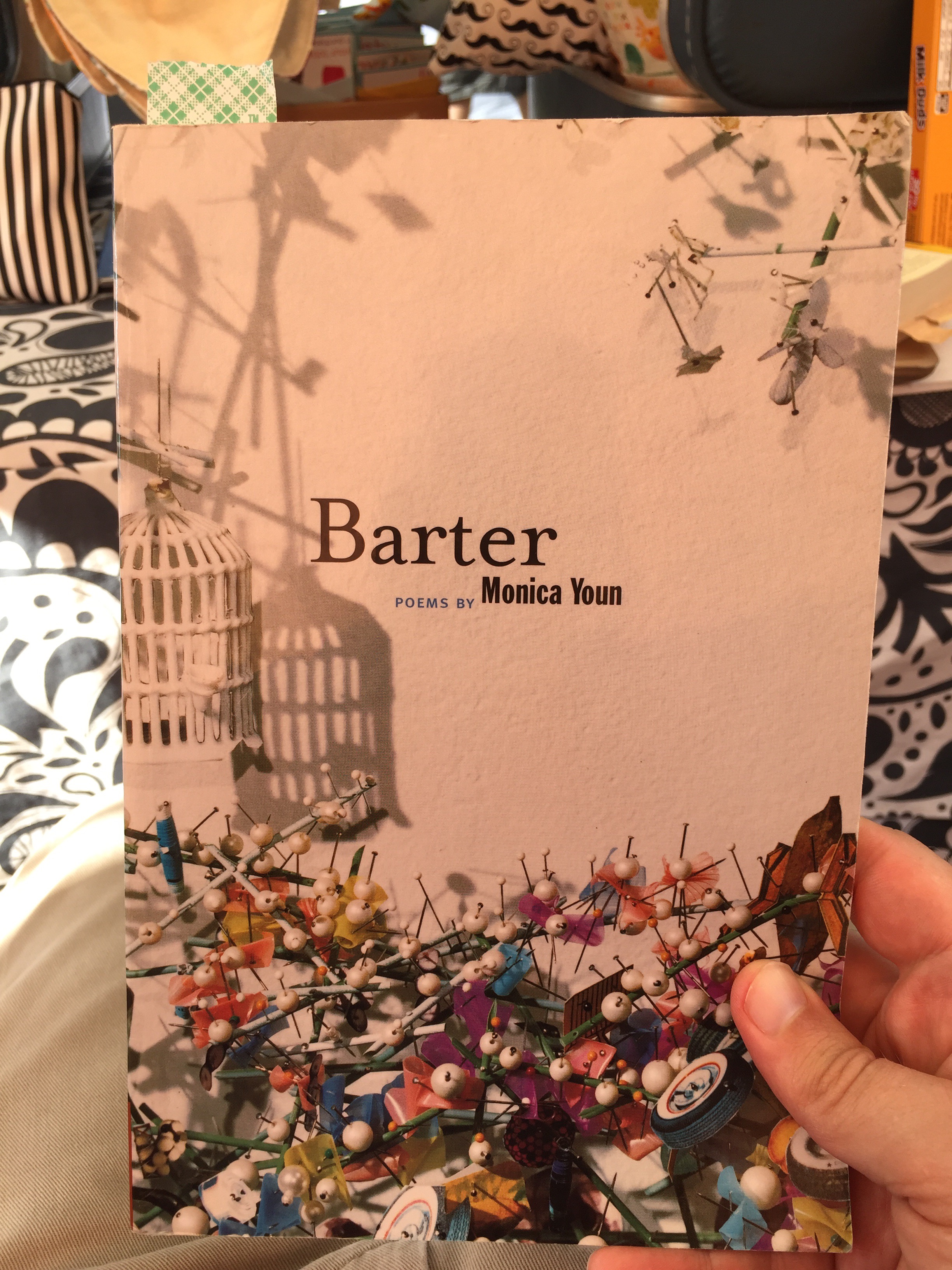
‘Barter’ By Monica Youn


I bought Monica Youn’s Barter at a used bookstore, which I don’t normally like to do, when it comes to living poets, because I like for poets to profit (financially) from their labors, but the book was on my list and there it was at Capitol Hill Bookstore, so I got it.

Barter is a dark book. The objectification and commodification of women’s bodies (and maybe, especially, the bodies of Asian women, but I can’t really be sure); immigrant bodies are also a recurring theme, albeit rather elliptically. Discomfort and disjunction. Life as trauma, perhaps. But not as being determined by traumatic experiences, so much as life being inherently so. Maybe. I don’t know. And much of this in the nominal form of ekphrastic poetry.

Derivation, or
The Unexamined Life

remorse: to be bitten
again. remonstrance.

to be displayed again;
shown again; arms

pulled back, head
following, how you

gloat, my reflection
smeared in the moonlight

window: why won’t
you look at yourself?


Maria Edgeworth, William Wordsworth & David Ricardo


I read this little piece on William Wordsworth’s visit to Ireland and the extent to which he was influenced by what he saw there (both in terms of the political and ecological content of his poems). It also noted his encounter with Maria Edgeworth, the author of Castle Rackrent.

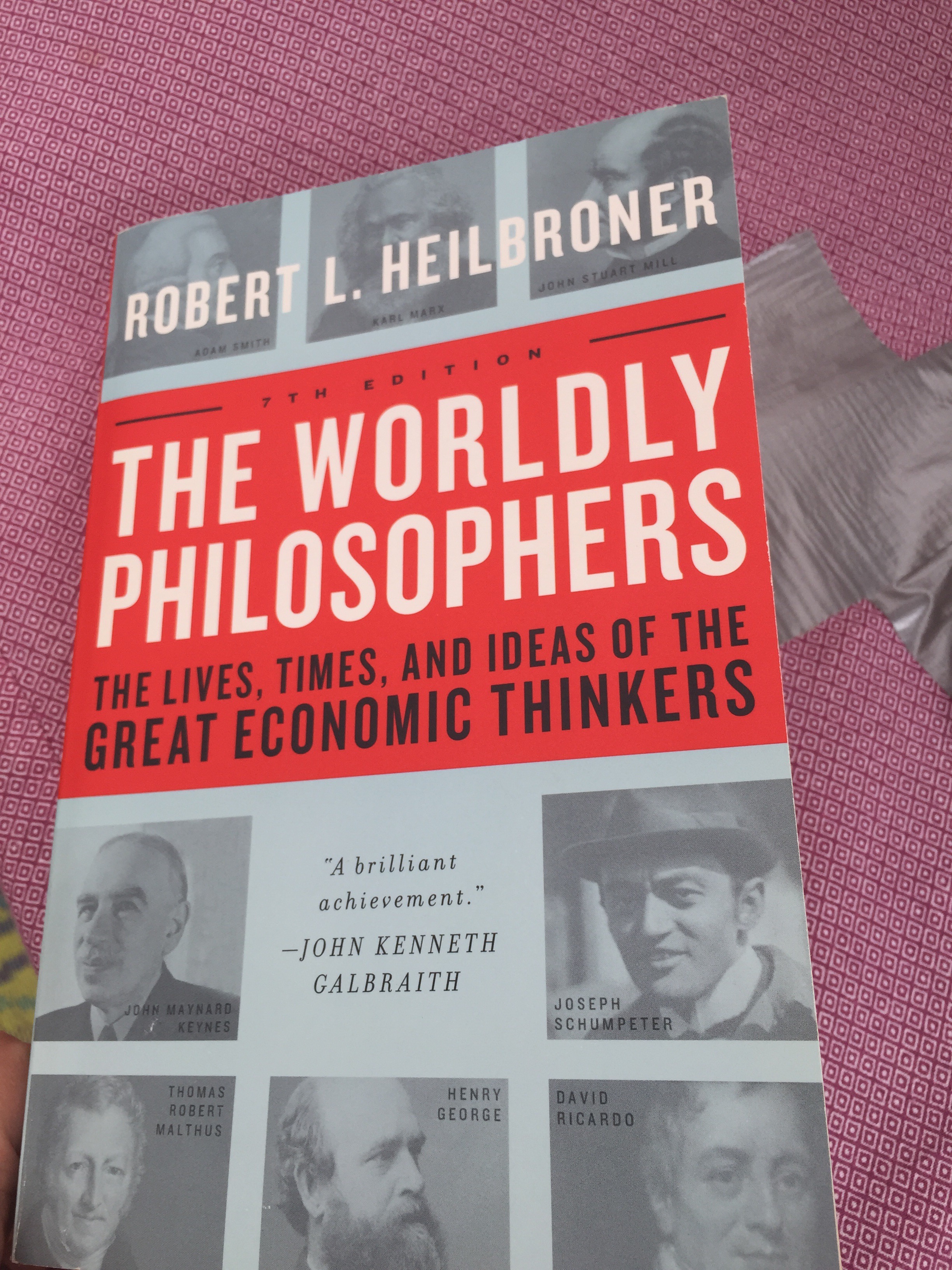
Later, I was re-reading my favorite bit of a beloved book, The Worldly Philosophers. My favorite bit of that book (after the description of Thorstein Veblen washing dishes with a garden hose) is the section on Thomas Malthus and David Ricardo in the late eighteenth and early nineteenth centuries. In that section, it notes the correspondence (and influence) one Maria Edgeworth had on Ricardo.

When I saw the Edgeworth name on page 85, I wondered, could that be the same one? Flipping over the page, when I saw Castle Rackrent mentioned, I obviously knew it was.

That’s it. Just a fun little thing. But you should definitely read The Worldly Philosophers. I actually had it in my bag because I have been intending, for some time, to loan it to a friend who going to be studying business. My father once semi-famously said that one should never confuse a business degree with an education. I thought that a book about influential economists might split the difference a little bit. So I had it in my bag, in case I should run into him.

Fifty Years Ago Today, The First Episode of ‘Star Trek’ Aired


I took that picture of Captain James Tiberius Kirk’s uniform at the Smithsonian’s Air and Space Museum on the Mall. And no, I’m not going to get into a discussion about Kirk’s middle name. But I should note that this is a uniform worn by Chris Pine, not by the eternally awesome William Shatner, though, after watching Star Trek: Beyond, which was the best of the ‘new’ Star Trek‘s and, dare I say, in the top fifty percent of all Star Trek movies, not to mention a rollicking good time, I now have a much better appreciation of Pine as Kirk, or how he has grown into the role. Real Star Trek fans will also have realized that Shatner could never have fit into that uniform, even at his youthful and swashbuckling best.

But that original series was just… awesome. And Wrath of Khan was one of the best movies of all time (I haven’t forgiven the first reboot movie from trivializing the motives that drove Kirk to cheat on the Kobayashi Maru simulator; the reboot made it a sort of joke, but in Khan, Kirk admitted that the simulation, which was intended to be training for how to deal with failure, triggered in him a deep feeling, beyond just being unable to accept no-win situations, but a terrible fear of failure).

So, not exactly happy birthday. But happy something. And thank you, Gene Roddenberry.