Happy Independent Bookstore Day!


Kensington Row Bookshop

A few highly recommended local bookstores (with the exception of some university bookstores that are run by Barnes & Noble, there are no chain bookstores in DC) around the area that you might want to consider visiting in honor of Independent Bookstore Day. If you live in the area. If you don’t live in the area… well, use your phone. You can do all sorts of things with your phone these days. Google something. Or Yelp it. Don’t make this my problem.

Politics & Prose: Kind of the godfather of local indie bookstores. It’s got a really nice poetry section; second only to Bridgestreet Books, in that respect. Also, go downstairs and check out the discounted books – walk down and make a sharp left.

Bridge Street Books: I already mentioned the poetry section, which is both large and well-curated (with an eye towards promoting contemporary and conceptual poetry). It’s also really big on leftist/critical theory type stuff, filling it’s current affairs, lit crit, philosophy, and politics shelves with books in that vein. Curation, really, is the key to what makes this place great.

Kramerbooks: It’s not my favorite, in terms of the selection (not a small selection, necessarily, just not always my cup of tea), but… c’mon. This place is an institution. Gotta love it.

Busyboys & Poets: Up there with Kramerbooks and P&P in its locally iconic status. Lots of stuff on grassroots organizing, race, immigration, economics, etc. Not just liberal, but activist in nature. Technically, it’s run by Politics & Prose. For years, it was run by an awesome nonprofit called Teaching for Change and I didn’t realize that had changed until I looked up the website for the bookstore. Now I’m feeling kind of bummed out.

Capitol Hill Books: This is my neighborhood bookstore. Quintessential, piles of books in danger of collapsing on the perusers. Funky and friendly. But don’t piss off the owner.

East City Bookshop: A relatively new bookstore with some really comfy places. A little mainstream for my taste, but some excellent curation in its small poetry section.

Upshur Street Books: This place is out of the way for me, but it’s worked really hard to be both a neighborhood and citywide cultural touchstone. A focus on works by writers of color and great symbiosis with the bar next door, which regularly holds book/author themed happy hours.  Selection is small, though.

Second Story Books: It’s almost big enough to get lost in and has lots of really (and sometimes pricey-ish) old tomes, as well as offering legitimately rare, antiquarian books.

Kensington Row Bookshop: Not actually in the District, but in the cool little antique row area of Kensington, Maryland. Lots of events and a great focus on kids.
Orwell & Hitchens In Iraq


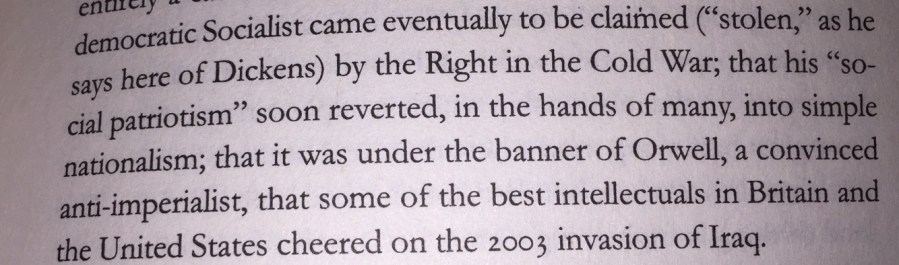
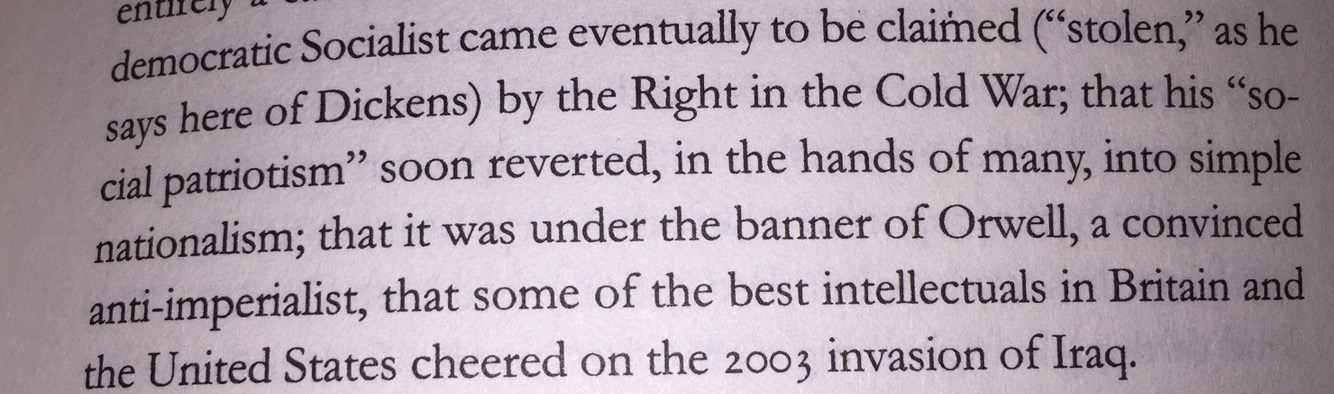
It does feel like that last clause is directed squarely at the late leftist cum hawk, Christopher Hitchens, who loved Orwell so much that he wrote a book about why he was so important.

Poetry Month, 2017


Chosen, they say, because ‘April is the cruelest month.’

I have been remiss this year. Not that I really do that much to celebrate it. I’m actually an introverted kind of fellow. In my professional life, I can be as hail-fellow-well-met as the next flak, but in my personal life, I am something else. And poetry is part of my personal life. And I’ve been sick, I’ve been busy, I’ve been traveling, I’ve been dealing with urgent personal matters, and then I look up and April is almost over and National Poetry Month with it.

‘For this revolt of thine, methinks, is like another fall of man.’

If don’t celebrate National Poetry Month, what does that say?

I’ve read a good deal of poetry, though I haven’t finished any new collections. I brought a selection of books by the sometimes crazed nineteenth century English pastoral poet, John Clare, with me on a trip. I rediscovered my copy of the partly Kenneth Rexroth edited Women Poets of Japan (which  contains, I have heard, at least one poem by a fictional Japanese women who is actually Rexroth himself, which feels more problematic than it used to). I read the latest edition of Poetry (the magazine). I read a bit from that strange, Japanese collection, Cat Town.

Maybe this was month for turning inside one’s self. Which, while valid, is poor timing.

Reading Print


Last Sunday was my day to sit down and read the print publications that I subscribe to. Mostly because I was sick and couldn’t go outside because the allergies would have, in my weakened state, killed me (though it killed me inside to miss, for the second year in a row, after having attended for eight years in a row, Shakespeare’s Birthday Bash at the Folger Shakespeare Library).

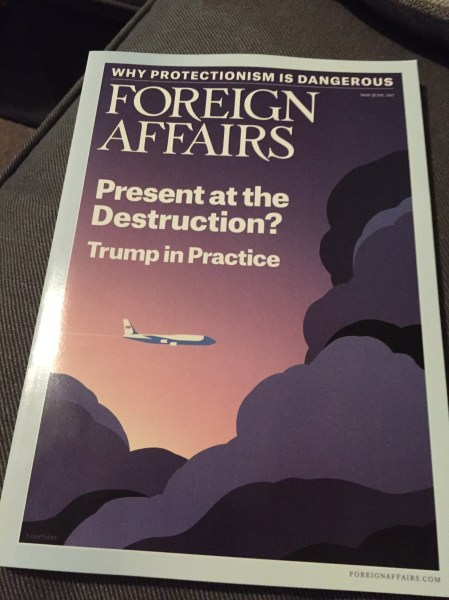
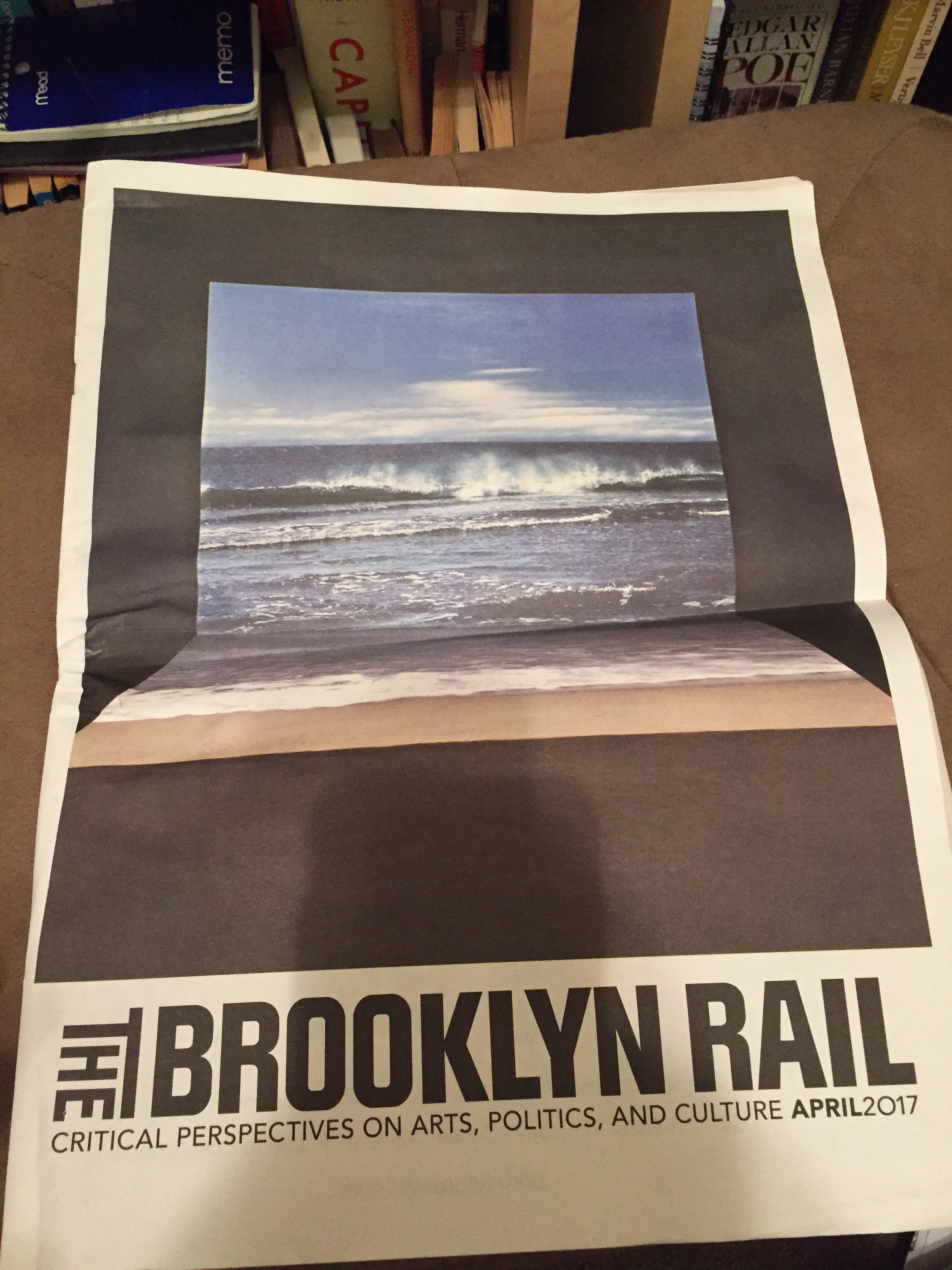
I actually subscribe to a decent number of print publications. I get the Sunday Washington Post (this was a Living Social deal, which I mostly purchased to get online access to the paper), Foreign Affairs (which is a gift from my father), Poetry (I think I saw this deal on facebook – one year of Poetry for an absurdly low price), and Brooklyn Rail (a tabloid format monthly, mostly about art and culture in Brooklyn, which I got as part of the deal with Poetry). I’m also getting the New York Review of Books (which I got for $10; let me repeat that: $10!!!!), but that hasn’t started arriving yet.

The Sun Also Rises has a scene where the narrator/protagonist is deciding which of the two bullfighting newspapers to which he subscribes to read first. They would have the same news, he acknowledged, but one tended to have slightly better writing. Notably, he did not say that he wouldn’t read them both, in the end (and I tend to think that he would read them both).

My mother once gave me a short story to read. I think it was by Saki. One of the characters was English member of the upper class who had gone bankrupt and so joined the army, which got him posted to a tropical village (Saki was born in Burma, so I’m going to guess that’s where it was). Once a year, he took his leave and went back to London and hung out with the wealthy friends of his former life and, most importantly, for my current purposes, he would purchase a year’s worth of the ‘papers,’ which he would read back in (Burma?) at the rate of one a day, one year after their initial publication.

Both of which literary references are to say that I love the ritual of reading magazines and papers.

Donald, Aldous & George


There have been a few essays lately that argue that we were all blinded by the Cold War-infused popularity of 1984 that we missed the real threat, which more resembled the soporific entertainments of Brave New World, because it was the mindless, meaningless, fact-free Huxleyian discourse of Fox News, et al, that led to Trump. Because it’s all just spectacle (hints of Bataille, eh?), the results can be argued to be effectively meaningless, but what matter is something, anything different to shake things up and make things less boring (also a contrarian response to measured stoicism of ‘No Drama Obama?’).

But now that he’s president, let’s take a moment to raise our glasses to Orwell.

No, I don’t think he’s going to lead America to an authoritarian dystopia driven by an ideology-free ideology (which means, if he does, I’ll be one of those excoriated in future histories for not having recognized the danger posed by an authoritarian, racist, anti-semitic, delusional, narcissist rising to the presidency… which does sound pretty bad, when you say it out loud).

But when you read how large numbers of Trump supporters think he’s accomplished a great many actual things in this, the first 90-odd days of his presidency, when so far, his only tangible accomplishment was nominating Neal Gorsuch for the Supreme Court (his confirmation was solely down to the hard work of Mitch McConnell and his selection was done by those most uber-establishment of establishment folks at the Heritage Foundation). Call ’em alternative facts, call ’em lies, call ’em spin, call ’em what you will, but it all comes down to ‘it just ain’t so.’

And I don’t think that many of those supporters are unaware that he hasn’t actually accomplished, in any real sense, well, anything. We are all guilty, I suspect, of some kinds of antinomial thinking, but this is more of the willful ignorance than Kant’s antimonies. And Winston always wondered if most people actually believed or just accepted because it was easier to go along with those who did truly believe (which, again, bodes poorly for how people like me will be characterized in future histories).

But no, I’m still not predicting the end of American democracy. Neoliberal twit that he can be, I still hope that Fukayama’s predictions of an enduring liberal order are correct, in broad strokes. Maybe, on an intellectual level, I’m just hedging my bets here.

Reassurance


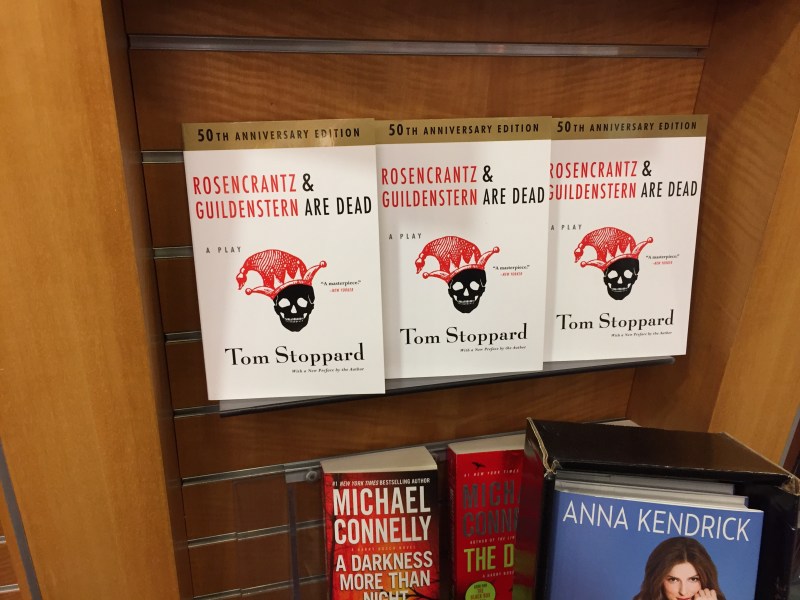
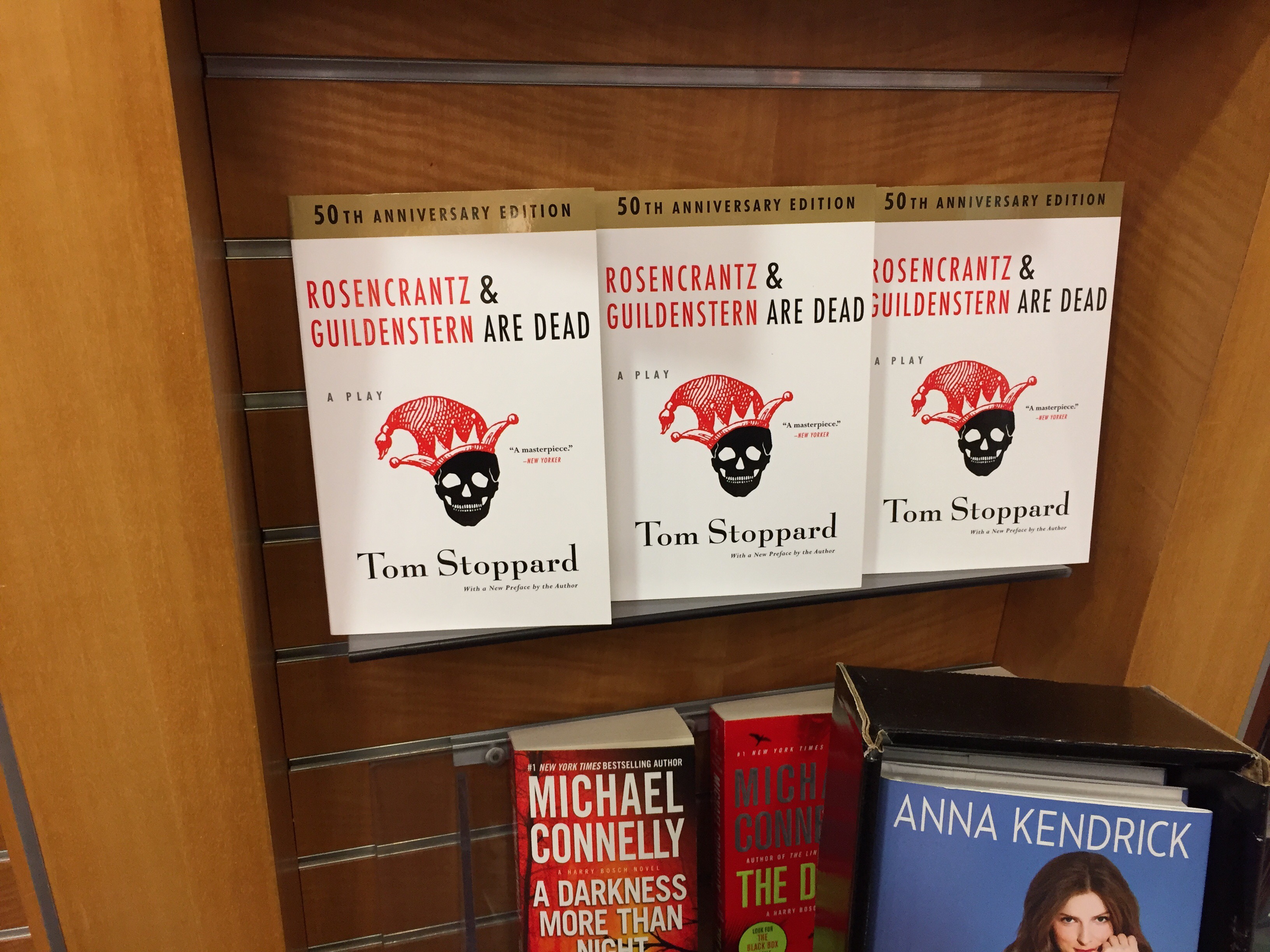
Just when you think that America is now defined by the fact that thirty-five percent of us still think that Trump is not too stupid to be president, you see something like this in an airport bookstore.

Recent Reading


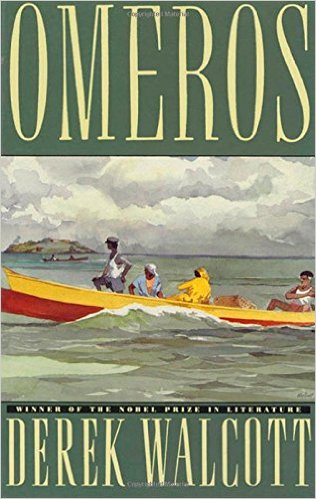
Because Derek Walcott died, I started carrying Omeros in by satchel and reading from it, though not, necessarily, reading the book length (history? digression? epic) poem on the Caribbean in systematic fashion.

I finished Patrick Modiano’s In the Cafe of Lost Youth, my first stab at the Nobel Prize winner (as was Walcott, by the way). Similar to the next book on the list, I felt an immediate stab of disappointment at the ending, but then came around to it (coming around more fervently, though, than with the next book). The ending seemed too abrupt and unearned, but I came around to an understanding that the book itself was about the unknowability of others.
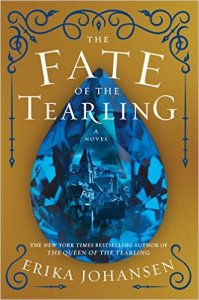
I finished the final book of the Tearling trilogy, Fate of the Tearling. I’m still not sure if this isn’t actually a young adult book. I’m still not sure if that statement says more about me than about young adult literature. But actually, I’m pretty sure that it says more about me. And, even more than it says more about me, it says a lot about the fantasy genre (and not in an entirely good way, however much I love it). I came around to the deux ex machina ending, but that didn’t make it earned and the book lost much of the goodwill earned from the first two, but credit where credit is due: this was a genuinely feminist series, with serious advocacy for birth control and female sexual agency. The final book also become decidedly anti-religious. Earlier books had posited the fantasy world’s church leaders as enemies, but now it got pretty anti-religious. Meh. Not going to argue that point.
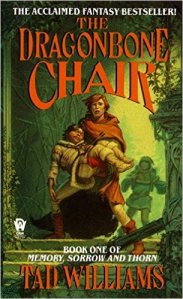
Finally, I really loved The Dragonbone Chair, the first book in a series I had long heard about (and mentioned as a precursor to Martin’s Song of Fire and Ice, though this series has more magic in it, though it’s not necessarily hugely heavy on magic). Tad Williams hooked me pretty quickly (though he also takes his time, with something like half the book taken up with careful world building, done through the eyes of an awkward kitchen boy in his early adolescence) and as soon as I was done, I immediately downloaded the second book (sadly, not available at the library). My one quibble is that some of the world building uses some lazy thievery from the ‘real’ world. The great king, whose death opens the way for the turmoil that makes up the plot, is Prester John. Some of the cultures and their naming customs are too obviously taken from Western Europe. Not a major issue (and the world itself is quite unique), but just felt lazy.
It’s A Brave New World, As They Say (I Think That My Father Used To Say That, Even Though He Was Never A Particular Fan Of Aldous Huxley; For Myself, I Think That ‘Crome Yellow’ Is An Underrated Novel If You Want To Read Something By Him That’s Not, You Know, ‘Brave New World’)


Perhaps it is because I (and other residents of the District and, indeed, almost everyone in America) have been protected by what has become a comforting layer of incompetence that covers everything he does like a bulletproof vest whose actual purpose is to protect everyone around the wearer.

Or maybe it’s because he’s never here and is busy inflicting himself on the patrons Palm Beach County’s Mar-A-Lago retreat for the super wealthy.

More likely though, I have been deluding myself.

After all, I have spent my career trying to make things better for this country. More specifically, I have spent more than a half decade helping to make tangible improvements in the lives of several groups working people in the DMV (that’s DC, Maryland, and Virginia). And this administration really has no time for that kind of thing. Insofar as they have an interest, it is in seeing that kind of work stopped.

Because his comforting incompetence has stalled so many of his priorities (so many of them hilariously and depressingly opposite from those he campaigned on), I haven’t had to think too much about the ways they would devastate the lives of my friends, my family, my neighbors, etc.

I assume the United States of America will survive this. It seems an article of faith. We survived a Civil War. We survived moral blights like chattel slavery, Japanese internment, and a mixture of accidentally and deliberately genoicidal actions towards native peoples, and while we didn’t come out as well as we might have hoped, we did come out a little better, surely. Of course, that ‘we’ is a white people ‘we.’ A reminder of an easily slippery slope. unless you somehow think American Indians came out better for my ancestors arriving and eventually founding this country, in which case, you are too stupid for me to even bother trying to sell you a bridge or mineral rights of a magazine subscription.

That easy slope is why he is so dangerous, too, right?

And maybe I’ll be fine, because I’m white and male and straight. And maybe my person of color better half will be fine because she will be protected by my beneficent aura of whiteness.

Or maybe we are all simply f–ked.

Choral Works At The National Cathedral


First of all, I was glad to see that nets were gone at the Washington National Cathedral. For a long time, post-earthquake (which was in 2011 or 2012, I think), there nets strung up inside the Cathedral to protect visitors and worshipers from falling bits of cathedral. While appreciated, from a safety perspective, it took away a bit from the sense of awe, grandeur, and general aesthetics.

The last time I saw a concert here, it was period pieces from the 17th and 18th centuries, composed or performed for the French court (and played using period pieces). The music was beautiful, but the acoustics just swallowed the orchestra’s sound (maybe it was the nets).

This time, the sound just soared wonderfully. It was the cathedral’s resident chorus, plus New York Polyphony (an all male vocal quartet), a guest soprano soloist, strings (roughly the size of chamber music orchestra, which is to say, larger than a quarter, but smaller than a full orchestra), and the cathedral’s own organ.

The selections were actually dominated (marginally) by either pieces by contemporary composers or else by pieces arranged by contemporary composers. With a few, arguable, exceptions, they were religious works – often liturgical. I say arguably, because one of the works set some stanzas by Whitman to music and, especially in America, Whitman could be considered to be almost religious.

That said, there wasn’t as much variety among the pieces as I might have liked. At a certain point, one Ave Maria starts to sound like another. That being the case, I could make the argument that they might have been better off taking a longer piece by someone like Tallis and playing that as the entirety of either the pre- or post-intermission half.

Reading


I’m always reading several books at a time. Sometimes, too many. They pile up beside the bed in the dozens (to the consternation of my better half).

But I like to vary my reading based on moods (though lately, they have all been linked by classical Greece and Rome). I have a copy of some works of Cicero nearby and I finished On Duties but can’t seem to get into On Friendship nor On Old Age, but they’re all in the same tome and I feel like I should just finish the physical book.

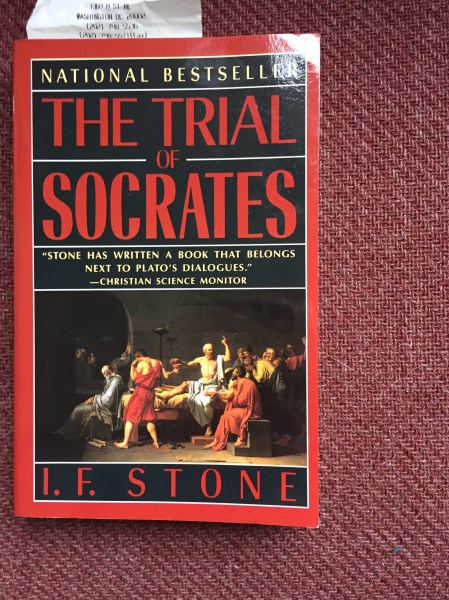
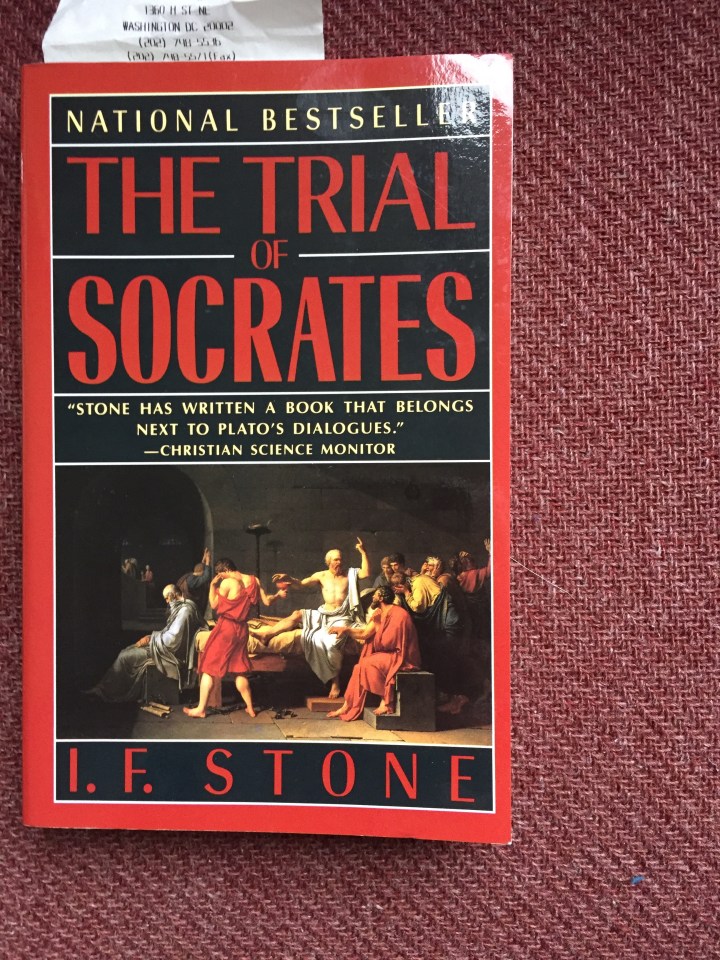
I just finished reading though Stone’s The Trial of Socrates (not in the least because it vocalizes some of my nagging complaints about the Socrates of the Platonic dialogues, namely, that he’s a bit of a flat track bully; it’s also got some wonderful sounding close reading of the original Greek texts; I saw wonderful sounding because I don’t read Ancient Greek and have, really, no idea if his translations and interpretations of individual words is better or worse than others). If I have one criticism, it’s that he closes weakly, by going into a discussion of the etymology of terms for ‘freedom of speech.’ Not that it’s not interesting, but like the ending of Smith’s Theory of Moral Sentiments, it brings the (for lack of a better term) ‘narrative’ momentum to a crashing halt.

I finished the second volume of the sci-fi/space opera quartet, The Hyperion Cantos (the names of this one is The Fall of Hyperion). It’s not nearly so pretentious as the word ‘cantos’ implies. I’d compare it to some of Samuel Delaney’s wild space operas, but less formally complex and also less lyrical (even though the reconstructed personality of John Keats is a major character in The Fall of Hyperion). Shouldn’t keep you away from these books, if you like good sci fi. It’s a well thought out, well realized universe with some excellent literary flourishes.

Sally Wen Mao’s Mad Honey Symposium lies beside my bed and the title would have drawn me in, even if the poetry weren’t excellent (which it is).