Mallarme & Cabernet Franc


My father and I took a trip out to the Shenandoah Mountains to (somewhat belatedly) celebrate his birthday.

Besides the mountain vistas, the main attractions were a fantastic (mostly) used bookstore called Royal Oak Bookshop and the Fox Meadow Winery, or rather the fantastic views of the mountains from its patio.

While sitting on that patio deck with my father, I sipped a solid (if unspectaculer) Cabernet Franc (though, in fairness, while the Cabernet Franc varietal seems particularly well suited to the terroir of the Shenandoah Valley, I can’t think of anyone who say it rises to spectacular heights with any frequency) and read Stephane Mallarme.

It seemed a perfect moment. A full, relaxing, and uncomplicated wine to go hand in hand with a full, relaxing, and very complicated poet.

Mallarme was one of those poets I had read a little of, but not deeply, but very much wished to.

In this particular collection (Selected Poems, purchased, naturally, at the above mentioned Royal Oak Bookshop) was a poem entitled L’après-midi d’un faune.

A month or two earlier, I attended a small concert where they played a Debussy piece entitled Prélude à l’après-midi d’un faune. The musicians described it as having been written for a dramatic presentation of a poem by a then famous poet. The poem and poet, I was assured, were little read and with good reason. It was typically bad and boring nineteenth century poem and we, the audience, need not worry ourselves, for the only thing left of value from that artistic moment was the music.

What absolute poppycock!

Now that I know it is by Mallarme, I rightly incensed. Mallarme and his poems are still rightly read and rightly respected and that poem is quite good.

In continued rambling, the Royal Oak is a fantastic bookstore. The owner takes care to keep a broad and good selection of books. Yes, he stocks some trash – including many of those old sci fi pulps I love so much – but also clearly works to keep good and interesting books in stock. You will find some treasures, if you care to look (and you won’t have to look that hard to find them, either).

Fox Meadow Winery is a typical Virginia winery. The vines are pretty young and the wines not very complex.

The tasting covered the following:

2010 FMV Le Renard Gris – This is the bottle I bought to bring back. Not my favorite, but my partner prefers sweeter wines and I really can’t stand them. This one seemed like a good value and sweet enough for her palate and still dry enough for mine – as you might expect from a blend of (among others) pinot grigio and chardonnay.

2010 FMW Barrel Fermented Chardonnay – I’ve got to say, this was not a very chardonnay-ish chardonnay. In fact, I couldn’t get any of the classic chardonnay mineral-ish flavor until the finish. Nothing in the middle at all. Interesting for all the wrong reasons.

2011 Riesling – If you love sweet rieslings, you’ll love this. I don’t love sweet rieslings, but my partner would have loved it. However, as noted, I opted for something she and I could (I hope) enjoy together.

2009 FMW Syrah – They offered a lot of descriptives for this one, but I swear, most of the time, I could barely taste a thing. There was no “there” there.

2009 FMW Cabernet Franc – This is what I enjoyed on the patio. A relaxing and enjoyable wine. I would have gotten it except it simply wasn’t worth $27 a bottle. But, I was very much tempted. It is a great full bodied, dry red that also manages works well in summer.

2009 Le Renard Rouge – My absolute favorite, but I just wasn’t prepared to spend $32 on it, especially since my better half would not have appreciated it. But it really was the best wine they had and I can recommend it.

E-Book Typography


James Felici’s piece, The State of E-Book Typography, brings into sharp relief some of the obstacles standing between e-books fully participating in literature at its highest and best level.

Essentially, reading on a screen – especially a computer (include tablet) screen, but also an e-reader – is always (using current technology) going to be less readable than even the cheapest printed dime store pulp.

Felici makes the distinction between readability and legibility. Legibility being the reason that most folks (including myself when I’m reading my Nook at Eastern Market or on the subway or on the National Mall) use the sort of font size on their e-readers that, in a traditionally printed book, would be associated with large print editions for the vision impaired. Just the other day, I had to increasee the font size I was using to read Melmoth the Wanderer, an earlier nineteenth gothic novel, on my Nook while riding the Metro here in DC.

But that doesn’t help, he says, the readability, which is limited by the pixelated technology used to create the words on the screen.

And though there some fonts that are better than others (Verdana, Tahoma, Georgia, Cambria) for use when reading on computers or screens, the limitations remain.

As a result we still read 25% more slowly on e-readers than on traditional books.

I also think of the writers, designers, and typographers who choose the font used in their books so carefully.

Especially poets, who are already crippled in their ability to transmit the true quality of their work in an e-reader because of how the devices lay out the lines. In a literary art form that is so much connected to its appearance on the page, the inability to even truly control the font size seems like salt in the wound, insult to injury, or whatever metaphor you prefer.

I’ll let Felici finish up this thought:

The problem today is that after 500 years of evolution, the “printed” word has taken a step backward in quality. According to “The New York Times,” electronic publishers are commissioning shorter books because their readers find it too tiring to take on longer works. Ever since I started writing for online magazines I’ve been obliged to write shorter pieces than in the past because editors tell me that online readers simply won’t finish longer articles. With today’s technologies, reading is simply more of a chore than it’s been in the past. Access to reading material is amazingly easy — a revolution, in fact — but reading is more than just taking in information, and the aesthetics of text presentation involves more than just making type pretty. It means making type functional as well.

Poetry In Your Pocket Day


I missed ‘Poetry in your Pocket’ Day – when you’re supposed to keep some poetry with you, to read or share with others as the situation warrants. And for most of that day, I didn’t actually have any poetry in my pocket (unless you count the poem I was working on in the little notebook in my jacket poet, which I don’t, because I was hardly ready to share it at that point), though the day before, I had been carrying some Mallarme around with me.

Weekend Reading – Imagist Journals


Damien Hirst represents something that will stop e-books from destroying the world, or something like that.

The Modernist Journals Project tackles the Imagists.

These are some awesome fountain pens.

How Can We Not Want To Do This Anymore?


Look at this video of a book being created! Naturally, it’s from England, not America.

Just a reminder of the tactile and generally fully sensual beauty of a book…

Recommended Reading For National Poetry Month


The Fox Chase Review has some recommended reading for National Poetry Month.

It’s pretty challenging list, so maybe not for beginners – I mean, it recommends Ron Silliman’s The Alphabet.

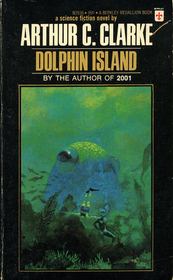
Dolphin Island


Somewhere, on some blog, written by some person – I saw a recommendation (of sorts) for Arthur C. Clarke’s Dolphin Island. I think I was googling for recommendations for science fiction books to read.

So when I saw Dolphin Island on the shelves of Royal Oak Bookshop, I picked it up (it was just $1 – the prices at that place are fantastically generous).

The book seems pretty far distant what I remember on that blog. I seem to remember it being described as a bit more apocalyptic.

Instead, it’s a gentle novel for young adults.

Which is fine. I gave it to my mother to give to a twelve year old of her acquaintance who has developed an interest in science fiction.

The really big things in this novel are picked and quickly dropped, unresolved. For example, the crashed alien space ship that’s leaking radiation and whose location is only known to the ancient storyteller caste of dolphin society. The effort broker some kind of truce between killer whales and their occasional prey, dolphins. Call me crazy, but when these things are brought up in novel (particularly a fairly straightforward one – I’ll admit to having slightly different standards for Thomas Pynchon writings), I sort of expect some kind of, well, anything. A resolution, maybe? Some kind of answer (were they nice aliens?)?

Thursday Staff Meeting – The Man, The Myth, The Marx


Myths about Marx.

Poets against austerity.

Article that uses Damien Hirst as a means to criticize modern art.

Midweek Staff Meeting – All About Conceptual Poetry


Conceptual literature in the wild.

Lyric conceptualism, a manifesto in progress.

The Amazon Monopoly


This editorial (which I came across on Twitter) incensed me to no end.

The author, who has had at least one novel published by Amazon, says:

…I’ve long been curious about why so many people are frightened of a potential future Amazon monopoly while simultaneously so sanguine about the real existing monopoly run by New York’s so-called Big Six.

Well, perhaps I could answer that for you…

Because a market dominated by six companies is not actually a monopoly. ‘Mono’ comes from the ancient Greek and means ‘one’ or ‘alone.’ And if you’re curious the ‘poly’ comes from the Greek word for ‘to sell.’

‘Mono.’ One. Not six.

And the concern about Amazon is not them challenging some entrenched group on a single ground, but their strategy of total consolidation.

They are attempting to dominate the publishing market and if they push out those fuddy duddy big six publishers, then they will dominate every aspect of the literary industry.

The problem with monopolies is that they are relatively immune from free market, consumer pressures. If you use their product, you have to use them.

Amazon’s efforts to consolidate every part of the literary industry – the actual production of both physical and e-books and the means of distribution of both physical and e-books – are building towards a situation where someone wishing to read to read must go through them and, if they choose to read, abide by whatever prices or stipulations they make. And that’s a freaking problem.