TOUT VA BIEN By Suzanne Stein – AT THE MOVIES


AT THE MOVIES (this section’s titled was not boldface type) mimics title cards (I’m sure they have other uses, but I think of them as the title cards showing dialogue in silent movies).

There are classical references to the myth of Orpheus, Eurydice, and their trip to the underworld and also to Jean Cocteau (there is a ‘character’ named Heurtebise, after a character in a Cocteau film, but like much of this, I don’t know what the references are supposed to accomplish).

Overall, it’s not bad. The problem is that Anne Carson has done it all and generally done it better.

In terms of integrating classical myths into contemporarily relevant poetry, read Autobiography of Red.

For this conceit of films and title cards? Carson did a series of poems called TV Men (I particularly remember her TV Men: Artaud, utilizing the brilliant, tragic, mad figure of Antonin Artaud).

There is a running theme about death and (lack of) existence. Conceptual poetry seems almost invariably to be ontological poetry (sometime epistemological, but more often ontological) and this does implicitly ask the implied questions in that model and does so in a fashion that is interesting and well done. But neither interesting nor well done enough, I fear.

What Is Poetry About? Bill Cosby Will Tell You!


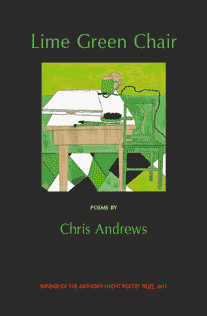
Lime Green Chair


The second line of the first poem (The Mist Lifts) indulges in the words ‘higgeldy-piggeldy.’

That’s an expression of whimsy, but a special kind of whimsy.

A sing-song mood of dark, Dickensian whimsy (think of the lingering descriptions of the yellow fog from the opening passages of Bleak House).

Even though the poems make frequent use of surrealistic association games, their influence is kept low key and does not interfere with the anachronistic avalanche of faint and constant archaicisms (see what I did there? that’s called ‘alliteration’).

The book is divided into three parts and part I and II are by far the best, because they make use of a sonnet-like form. While not rhymed (at least, not in any traditional sense), they have a musicality and the use of a thirteen line and then and eight line stanza clearly references the sonnet.

The middle section consists of longer poems, each longer than a page and most running on for three pages or more. They are broken up into stanzas, but the music is diminished by the lack of order the sonnet-esque form imposed.

But the stuff that works… really works. I saw last year’s winner, too, and was singularly unimpressed. Not so this year. Andrews is someone whose second collection I would buy, no question, just to see what he does next.

Comic Book Store Day


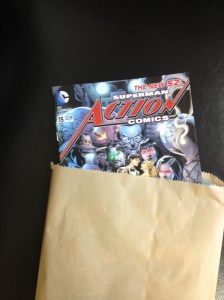
photoSo, yesterday, I went into the comic store to buy the latest comics. Most comic book titles come out monthly, but staggered, so that every week several different titles have their latest editions come out. It’s a ritual I have never participated in before, though I’ve seen it well documented on The Big Bang Theory (and also well mocked; though how that show is actually less than kind to nerds while pretending to be nerd-centric is a whole ‘nother thing altogether).

I went during lunch, and even though Beyond Comics (the comic book store just around the corner from my office) only opened a little over an hour earlier, there was a decent crowd of shoppers and browsers (including, thankfully, a couple my age and one gentleman who looked to be in his late forties).

Yesterday was Action Comics, the original Superman title. I bought #15, along with Aquaman #14. The kind lady behind the counter put my comics into a flat paper bag, as if they were pornography, and I left.

Not much happened, but it felt fun. Knowing what I was looking for and getting the Action Comic title fresh of the presses, at it were (today is the first day it was available). I felt like a true nerd, and since I am a nerd, that felt pretty good.

I will say, that I’m findng Action Comics, overall, a little hard to follow. The New 52 titles are a reboot, but some knowledge of what has happened in the last twenty years helps and just don’t know a whole lot about that. The artwork has a nice, old fashioned feel to it. Sort of a Jack Kirby, silver era feel to it, which I like.

Aquaman has too many people joking about the uselessness of Aquaman (even when he saves the eastern seaboard from an invasion of deep sea, humanoid angler fish), but the artwork is very, very good. The whole thing has a sticky, Lovecraftian feel to it (I gather that the New 52 Swamp Thing and Animal Man titles also have that organic, alien, decaying thing going, but I’m sorry, I’m not going to start reading anymore titles).


tumblr_ldo6dkBC2v1qzupj0o1_500

TOUT VA BIEN by Suzanne Stein – TOUT VA BIEN


The third section of TOUT VA BIEN is also called TOUT VA BIEN.

To be quite frank, it’s less interesting than the first two sections. It opens with some prose (I wouldn’t call them prose poems, just prose) and then movies onto some conceptual poetry about conceptual poetry. Which I don’t object to in general, but everything rather reads like a lesser version of Vanessa Place’s much talked about little blue book, Notes on Conceptualisms.

The writing is good, but if I’m honest, reading this section didn’t make me want to read more Stein, it made me want to go back and re-read Notes on Conceptualisms.

The Earth Dies Screaming


A Sport and a Pastime


A Sport and a PastimeIt’s one of those books that slip a bit under the radar, but that if you talk to the right people, is one of those ‘must reads’ (I should note that it’s a particularly masculine ‘must read;’ not that it’s a macho book, but it’s very much from a male point of view, with the female being a mysterious cipher, for the characters more so than for the reader).

It’s also a bit of a writer’s book. The narrator is a a photographer, but that artistic career is clearly a stand-in for ‘writer.’ It also engages in a number of literary strategies, mainly around narrative reliability.

To get the basics out of the way, a young man named Phillip Dean, a Yale dropout of a well-to-d0, cultured family (his father is a drama critic) goes to southern France, meets a beautiful young girl and the novel chronicles their love affair. The affair is primarily sexual in some ways, but the young people in question don’t seem to think so, naturally misreading the glow of eroticism and mutual desire for love (or else a jaded reader like myself cannot recognize true, though youthfully impulsive, love when he sees it, which is hardly out of the question).

The interesting stuff involves the narrator. He is older than the ‘main character.’ The preface, by Reynolds Price, says that the narrator is thirty-four years old, but I don’t recall where that number (0r a birth year that would make it possibly to figure his age out) was noted. To me, he sounded older – closer to middle age.

He acknowledges that he wasn’t there for 90% of what he writes about. Perhaps Dean recounted it to him, but it is repeatedly suggested that the young love is a creation of the narrator – the brave self that the narrator is too cowardly to be. The lover, the risk taker, the great mind – everything that his Prufrockian chronicler wants to be but is not.

The book is best known for its treatment and depiction of sex. Their is a certain gauzy, dream-like quality, which fits with the narrator’s relationship to the material (the whole thing is a sort of fantasy for him and even if Dean is ‘real,’ the narrator is certainly filling in numerous gaps with own extrapolations). There is a mention of a ‘sopping cunt’ and fairly frequent use of the word ‘prick,’ but it’s hardly graphic or pornographic. It is, rather, a good description of two relatively unafraid lovers exploring each other sexually. Also, a (shall we call it) tasteful description of anal sex that manages to avoid using the phrases ‘anal sex’ and ‘sodomy’ or any other precise descriptor of the act and yet which still manages to be frank about it.

Finally, I suspect my father would really like this book. I may loan him my copy.
Star Trek: Into Darkness


Star Trek Into Darkness

Sunday Paper – Big Brother Is Reading You


Your e-reader is spying on you.

Matrix Press.

Followed by Goliard Press.