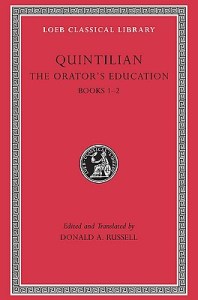
‘The Orator’s Education, Books 1-2’ By Quintilian


Orator's EducationI have mostly loved The Orator’s Education, as much for its insights into the Roman culture of its time as anything else – off handed remarks about gladiatorial styles, discussions that introduced me to how much constant interchange there was between Latin and Greek (with Latin even stealing letters from the Greek – I had had no idea what a state of perpetual transition Latin was in; such a difference from its current status as a ‘dead language’), remarks that showed how little formalized spelling and grammar could be, and more.

When Quintilian talks of ‘orators,’ he is, in the greater part, speaking of what we would call lawyers. Apparently, the pleading of cases was less a legalistic endeavor than it was a dramatic and rhetorical one. While legal procedurals on television make it seem like that’s still the case, believe me when I tell you that modern trials are almost always boring to watch and the average lawyer is not particularly eloquent.

At one point, Quintilian defends oratory against the claim that it cannot be an art because no art seeks to demolish itself (presumably, referring to how opposing orators will seek to demolish each other’s arguments). Leaving aside his actual refutation, what a different view of art! Now, we accept fairly readily the idea that an art is usually something in a state of constant oedipal rebellion.

He talks about three kinds of art: theoretical, practical, and poetic.

Theoretical arts include ancient astronomy, according to the author, and are what we might think of as scientific research, where the end is not a ‘thing,’ but understanding of the of the subject of study.

Practical arts are not things like carpentry, but rather actions. The example he gives is dance, where the end result is not a thing, but a properly completed action (oratory is this kind of art, he says)

Poetical arts are those which end with a work that can be seen, like a painting. I think this is awesome, because he uses the word ‘poetical’ to describe the most practical (in modern terms) of arts – that which ends in something. Gave me a smile.

Weekend Reading – Potluck


The only reason for putting ‘potluck’ in the title is that today is the annual office holiday potluck party. You’re not invited. Probably. Unless you work with me. Which you probably don’t. Statistically, it’s very unlikely.

The pro-capitalist, anti-communist origins of MFA programs in creative writing.

It’s time for those end of year, ‘best of’ lists. And some of them are about poetry! Not lists by me, though. Not that I haven’t read a lot of poetry this year, because I have, at least compared to the average person, who probably reads none in a year, but more that I’m still catching up on the greatest hits of the nineteenth century (it might have been last year that I read him, but you should totally check out the mostly crazy, but sweet English pastoral poet, John Clare). Fortunately, The Guardian, over in merry old England, actually pays attention to poetry. So they did a top ten list that is probably worth looking over.

The poet on art.

Duels


 While (re)reading Remembrance of Things Past, I’ve noted that the narrator (who has not yet been named but who will eventually be named Marcel) has mentioned having fought several duels over the Dreyfus Case. If you don’t know what the Dreyfus Case, I can’t help you except to say read a book and also to say that this isn’t a small part of history and you can see a historical precedent for the virulent, genocidal anti-semitism of the Holocaust and its enablers.

But what struck me is how the duels themselves are glossed over. Until I remembered that, at this time, a duel was typically a fairly harmless affair. Usually, two gentlemen the would show up at the appointed place and time and fire their pistols harmlessly into the air, having proved their courage by appearing. Only rarely would the parties aim at each other or use swords (which would necessitate an exchange or two until first blood was drawn, at least).

So, the duels were not described because the real danger would have been catching a cold in the early morning air.

Weekend Reading – The Making Of Schiller


photoFriedrich Schiller’s strange education at a military academy that promoted poetry, rhetoric and Enlightenment principles. Also, caning.

This does not actually reassure me. It’s more like the second coming of Rod McKuen.

So, while poetry only bookstores aren’t exactly blossoming everywhere, there are a lot more than there were just a few years ago (when it was really just Grolier’s in Cambridge and Innisfree in Boulder) And while it might be an exaggeration to call them wildly profitable, they clearly can be economically viable.

The unrecognized republic of Zaqistan.

In search of the new flâneur.

.

Weekend Reading – Don’t Start What You Can’t Finish


Palmyra
Palmyra

Finishing a book every time, after having started it, makes you a better person.

What responsibility do editors have in creating greater equity in literature and publishing? And the answer is not, ‘don’t worry about it – they should only publish good stuff, rather than engage in some kind editorial affirmative action’ because, unless you believe that 90% of all good writing is done by white, heterosexual men (and if you believe that, you are probably some heinous combination of racist/misogynist/homophobic and I really don’t care what you think, you intolerant snot), that attitude just isn’t doing it.

Best and worst coffeeshops to get your done in, according to the DCist. Myself, I’m a fan of Port City Java (though it doesn’t have wi-fi on weekends) and while Port City didn’t make the top five, it was repeatedly mentioned for qualities like ‘comfy couches’ and ‘availability of seating.’ So… lots of love from me and some love from DCist for Port City. As it should be, I suppose.

Arming Middle Eastern antiquities lovers with ‘rescue archaeology’ strategies.


I Have No Title To Put Here


The Portuguese have an untranslatable word for the ineffable nostalgia of something that has passed away and perhaps never was: saudade.

Later, I came across another reference to a similar concept (also in a Paris Review article):

Hiraeth.

It’s pronounced “here-eyeth” (roll the “r”) and it’s a Welsh word. It has no exact cognate in English. The best we can do is “homesickness,” but that’s like the difference between hardwood and laminate. Homesickness is hiraeth-lite.

It’s a feeling I know well and which English lacks a good word for (and I’m not sure stealing from Portugal or Wales will resolve that lack).

When I read The Sun Also Rises, I was overwhelmed with a homesickness for a place and time I never knew, a mythical 1920s of high modernism. Of course, I was also a teenager, so I didn’t properly understand the sarcasm, satire, and self-loathing that drove the novel, or else I should not have felt saudade nor hiraeth.

More saudade, I suspect. Hiraeth is something more for my mother, a southerner who will never, despite her accent, fit properly in the South (with its desperate poverty and structural racism and the veneer which covers it up and makes believe we have moved past it in much of the ‘New South’), nor feel at home anywhere else (perhaps not surprising that she settled into Florida, which is neither here nor there).

I wonder if they are all myths. I think perhaps I have even lived through such times myself, but they are invariably disappointing to live through and unnoticed by the participants, who are merely getting by like everyone else and wishing to have been alive in the New York of the Abstract Expressionists or the Bay Area of the San Francisco Renaissance or even the pastoral delights of the Transcendentalists of the 1840s.

Monday Morning Staff Meeting – History


edbfdf99-69d8-41a4-a566-53a753748a74-2060x1236

Ancient Rome is relevant. Ancient Rome is not relevant.

What could we learn from the Britain’s Marxists?

Understanding national identity through poetry.

John Updike, the poet.

Buddha’s excluded middle.

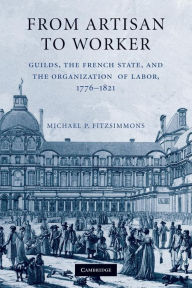
‘From Artisan to Worker: Guilds, the French State, and the Organization of Labor, 1776-1821’ By Michael Fitzsimmons


Artisan to WorkerA caveat here: Fitzsimmons was one of my professors in college.

I had to get my reader card for the Library of Congress to find a copy of this book (it’s irritatingly difficult and expensive to get copies of academic works) and, of course, I had to read it in one of the Library’s reading rooms (not the cool one, but a smaller one, but closer to the stacks where this book was stored, so delivery was faster).

One of the less written about consequences of the French Revolution was the dissolution of the guilds and worker managed corporate entities (though, not all workers – just ‘masters,’ as opposed to apprentices). Without overromanticizing the guild structure, it’s hard not to view this as a loss for working people. He never uses the words, but in the titular move from ‘artisan’ to ‘worker,’ it’s hard not to think of Marx’s famous alienation of man from the product of his own work.

An early anecdote about a man who tried to get around the guild system in the expansion of his wallpaper manufacturing business is illustrative of what would be lost without guilds. Jean-Baptiste Reveillon wanted to streamline and unite all aspects of production, from papermaking to printing – and to do so outside of the guild structure. He succeeded, at least for a while, and at the height of his success, he used his wealth to push for a decrease in the daily minimum wage to something roughly equivalent to the cost of a loaf of bread.

A few little bits that struck me:

Paris is the center of France in a way that is not true of many of other countries’ capitals and largest cities. In my own experience, Bangkok might be an exception.

Even as early as the Bourbon Restoration, the Chamber of Commerce opposed the concept of organized workers.

For better or for worse, mechanization would proceed unimpeded by guilds or regulations, generating greater social injustice than the system of corporations had engendered…

Note: in this case, corporation is meant in a different sense than in modern English and refers to various guilds and professional/worker associations.

texts&beheadings/ElizabethR


BAM_image300As part of a series of plays by and/or about women that is currently appearing throughout the city, the Folger Shakespeare Library put on texts&beheadings/ElizabethR.

It’s far better than the title, which sounds like it was written by someone who’d just read of tone essays of by second rate Derrida disciples.

On stage are four ‘Elizabeths,’ each representing, in part, different periods of her life, but mostly different aspects of her life. For example, the last one to be featured (in what the cast declared to be Movement 4), mostly focused on her strident anger at attempts to marginalize her or threaten her reign or right to rule.

Each of the four movements featured one actress whose ‘lines’ were almost exclusively from the writings on Queen Elizabeth herself – from her prayers, her letters, her poetry, and her speeches to Parliament. The other three would speak more colloquially, providing background and context.

It was absolutely gripping and compelling and it seems petty to criticize, but I will anyway. One actress had a strong accent (Spanish, I think), which detracted, for me, from her portrayal as that quintessentially English figure. On a more existential level, as fantastic as it was, what was the purpose? What were we intended to learn or walk from it with? I’m not clear.

But still. A Shakespeare theater was the perfect outlet for this, because any production of Shakespeare invariably is at least partly about showing this centuries old writer, this man of his times, wrote works that are relevant and timely/timeless. If this play (performance? production? it’s not exactly a play, is it?) had a purpose, at least part is showing how Queen Elizabeth’s existential, feminist struggles for power, for the right to power, and for the right to determination are as timeless and timely as they are of their time.

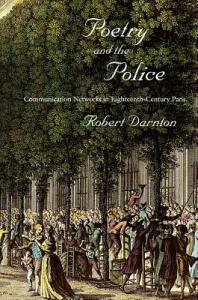
Poetry And The Police: Communications Networks In Eighteenth-Century Paris


Poetry and the PoliceI had been looking forward to this read for a while. It had been on my personal ‘must read’ list for a couple of years. You can probably guess where I’m going with this: I was a little disappointed.

Part of it is my selfness as a lover of poetry and Darnton gives little shift to the importance of poetry in and of itself.

I suppose I should summarize a little. In 1749, the police went a little crazy trying to track down the origins of some satirical poems mocking King Louis XV (and some of his ministers; his mistress, the famed Madame Pompadour [her maiden name is ‘Poisson,’ French for fish and some of the songs used that fact and… let’s just jokes about fish and the smell of a woman’s privates go way back]; and the King’s apparent cowardice in sending Bonnie Prince Charlie to die at the hands of the English). The tale goes over how very strata of society intersected with these satirical poems, usually set to popular music of the day.

But I wanted to know more about the poetry itself, its writing, and its writers. Surely it means something that poetry, literature was considered a threat. 

Also, the style of the writing of the book was a little undergraduate.