Finished ‘Tinker Tailor Soldier Spy’


Last Thursday, we watched the final two episodes of the 1979 BBC miniseries, Tinker Tailor Soldier Spy.

It was a disappointingly small crowd that made it to the final one and through all three nights of it. I loved being able to see it again and the expectation of Thursday nights and Alec Guiness’ avuncular depiction of George Smiley.

I asked the fellow who had organized all this if he would be attempting to show Smiley’s People at a later date. While noncommittal, he left it open as a possibility (‘I have it,’ he said – meaning the DVDs).

I supposed that I could have just tracked down and ordered DVDs myself, but the experience of watching it on a larger screen and with a group and making it an ‘event’ was undeniably part of the pleasure.

More ‘Tinker Tailor Soldier Spy’


So, I watched episodes three and four at the Hill Center on Thursday.

With Netflix and a million television stations and streaming things, it’s easy to forget the pleasure of watching something with other people in a theater-like environment. I had a wonderful experience several years when we saw Casablanca on the big screen in a crowded theater. And don’t even get me started on watching The Rocky Horror Picture Show outside of its natural habitat – a midnight movie theater.

There is something about the shared experience that connects you with strangers.

And did you know that Patrick Stewart was in the old BBC series? Yup. He plays uber spymaster Karla, head of ‘Moscow Center.’ He has no dialogue. None. But he’s very good. He keeps totally impassive, ignoring Alec Guiness’ Smiley, but then showing delicate touches to indicate that he was actually filing away everything Smiley said – and also taking the lighter (if you haven’t read the book or seen this or the more recent, you will have no idea what I’m talking about and I’m not going to explain it to you – either read the book, see the movie, or just cheat and google it). He was only in his late thirties, but already completely bald on top. Not even a wisp, really. And already his hair with iron gray with some touches of black. He has a very distinctive (though also handsome) skull.

‘Tinker Tailor Soldier Spy’ At The Hill Center


Last Thursday, the Hill Center showed the first two episodes of the 1978 BBC miniseries, Tinker Tailor Soldier Spy.

I read the book once, years ago. And I did see this miniseries, though many years ago and not at an age old enough to entirely understand. And I loved the recent movie.

But this is the difference between a 2+ hour movie and a six episode series. Rather like comparing the Keira Knightley Pride Prejudice with the Jennifer Ehle and Colin Firth epics. The first one had its not insignificant charms, but they’re such different animals, it’s wrong to compare.

The host of this showing told us a lovely little gobbet about the production. He said that Alec Guinness was not very good at memorizing his lines and he sat down with the screenwriter and John Le Carre to systematically reduce the number of his lines.

The main joys are seeing things without the shorthand. The movies depend on narrative shorthand, but this can take it’s time. It’s not a long novel, so by making a 5 hour or so long version, the production team is able to less dense in the information it imparts in every scene and to dish it out very slowly and build characters over greater time. Again, less shorthand.

Anyway… episodes three and four will be shown Thursday. I’ll be there.

‘The Fellowship Of The Ring’


I was seized by a desire to re-watch Fellowship of the Ring for the first time in some years. Possibility out of a sense of disappointment with how Peter Jackson has taken my beloved children’s book, The Hobbit, and made it unnecessarily epic in scale.

There is a wonderful book of historiography called Inventing the Middle Ages. It is a series of portraits of prominent medievalists and how they combined to shape our idea of the what the middle ages was. Was it a time of darkness? Of surprising richness? Was it a time of kings? Or of commoners.

Among the portraits was one of J.R.R. Tolkien. It acknowledged his work in translating and examining Anglo-Saxon epics like The Pearl and The Green Knight. But it also looked at Middle Earth and how it captured a very important aspect of the time, which was the great journeys taken by so many ‘little people’ – commoners and peasants – over great distances. Pilgrimages across continents and journeys like the Crusades even.

While not mentioned, for me, also, it was a differing idea of love. Courtly love was a later invention, something from the middle ages, but not from the early middle ages that Tolkien studied. Love was the love between friends.

My mother and I have differing favorite moments from the first movie, but with similar meaning.

Mine is early in the movie, when Frodo tells Merry and Pippin that he has to get to the town of Bree, after it has become clear that something big, bad, and scary is nearby and hunting them. Merry’s response is to say, ‘Right – Buckleberry Ferry.’

He doesn’t ask why or what the heck is going on. He responds in instant solidarity to a fellow ‘little person’ who is being threatened by the big forces of the world. He never asks himself if he will help or how much help he will offer – only what the best thing for his fellow man (well, Hobbit).

My mother likes towards the end, when Frodo tells Sam, ‘I’m going alone,’ and Sam replies, ‘I know you are and I’m going with you.’ Again, the absolute solidarity of ordinary people to accomplish great, yet little noticed things in the face of world changing events they can barely understand and hardly even see.


IMG_8352.JPG

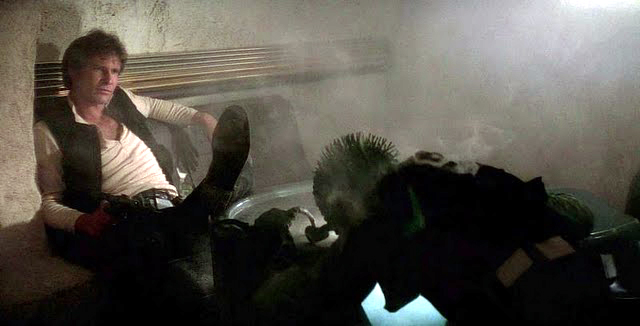
You’re So Stupid, You Probably Think Greedo Shot First


han-solo-greedo

Pickup On South Street


We came home from a memorial service for a friend’s mother. It was sad, but also… I don’t know the word. Not joyful, or happy, nor even comforting. Wordsworth said it best (as is not uncommon): We will grieve not, rather find/Strength in what remains behind;/In the primal sympathy/Which having been must ever be

Which is a way of saying, it was nice to see colleagues from Eastern Market in an environment detached from economics and think about love and marriage and family and ties and not how the customers are biting that day.

So why is this post named after a classic film noir (maybe the classic film noir; Double Indemnity, Out of the Past, and Touch of Evil might be better movies, but Pickup most truly like a platonic ideal of noir)?

Because, after coming home, having ramen, and doing some work, I flipped through the television and there it was, from 10pm until 11:30pm on Turner Classic Movies. I couldn’t resist.

Even my better half  liked it! Actually, she likes old movies, but not inbetween movies. Movies from 1970-1994 really don’t interest her. To her, those are ‘old movies.’ An actual old movie? She likes those.

And the tight documentation of the seedy side? The close analysis of a pickpocket’s technique, an information broker’s one room dump and sad front selling ‘personality ties?’ Awesome. The blousy woman who only likes guys who beat her up? Umm… not awesome, but it added a real sense of menace to a movie from a time when kisses couldn’t be more than 2 seconds long, ‘sex’ could not be named, and blood was pretty rare. And Richard Widmark as the pickpocket. Handsome, but with an evil looking forehead (you’ll just have to see it to understand what I mean) and with a strange sense of pride, confidence, and badass-ness for a three time loser who’s the least violent kind of criminal (he picks pocket, covering his actions up with a copy of the New York Times). The missus saw it, too: he was hot. In the middle of the red scare, he didn’t care whether the communists got the secrets or not. He only got mad when one of them beat up the girl worse than he had (yes; the ‘good guy’ also smacked the girl around, just not so badly and he didn’t shoot her afterwards).

What am I saying? I don’t know. But what a great freakin’ movie.
‘The Fall Of America: Poems Of These States 1965-1971’ By Allen Ginsberg


9780872860636Ginsberg, I would argue, wrote two great poems (Howl and Kaddish), one good poem (America) and then a bunch of other stuff.

Is that unfair? He was the outstanding public figure of a movement that was hugely influential and played and outsized role in the creation of a certain idea of the artist. The idea of the artist as shaman, perhaps. Yet his own work was, I can’t help but feel, a chronicle of diminishing marginal returns.

I can’t remember if this scene was in the book, but in the movie Trainspotting, Sick Boy uses the career of Sean Connery to illustrate a point about the tragic, downhill slope of life. Connery was James Bond and then everything else he did, if you’re honest about, Sick Boy argued, was ‘shite.’

America, despite moments of brilliance, is Ginsberg’s Untouchables. Sure, Connery won a best supporting actor Oscar for it, but really, does it hold a candle to having been the indelible presence he was as Bond? Bond, in this case, being a stand-in for Howl and Kaddish.

As a result, I had a huge problem getting into this little book. I’d re-read Howl and Kaddish and was struck by their power – a power that I’d forgotten. Now, I wish I had stopped there. Unlike the others, this one appears more deeply unstructured – a sham Whitmanesque, propulsive journey (and definitely with Whitman’s signature form – the long lines interspersed with deep indentations), but without Whitman’s careful (if exuberant) craftsmanship.

‘The Usual Suspects’ Revisited


I rewatched The Usual Suspects for the first time in many years. Still a great movie. Still the only worthwhile thing Stephen Baldwin has ever done.

My better half guessed the big reveal pretty early (much earlier than I ever did), but still had that moment when she realized that, of everything we had seen, only the very beginning and the very end could be known to be ‘true’ within the context of the movie.

I had forgotten how gorgeously shot and composed everything was. Also, the antithesis of the ‘Bourne’ style of jumpy, fast cut and sped action sequences that make it difficult to understand the geographic relationship between characters (Nolan’s Batman movies, particularly his first two, are egregious examples of poor editing of action sequences, leaving them almost completely incomprehensible). Even in the final action sequence in the claustrophobic confines of the freighter, the spatiality of the characters is clear. In some ways, that’s the point: by making the location and actions of the characters cinematically clear, it heightens the shock when you realize that it is very likely that almost none of it ever happened. Everybody is visible, comprehensible, and ‘real.’

West End Cinema


thI knew it existed, but there’s a significantly closer art house cinema, so I’d never been, until I got it into my head that I would see Snowpiercer while my better half was away. Just on the edge of Foggy Bottom, before you cross the bridge into Georgetown, it’s a tiny theater with three tiny screens. I saw Snowpiercer on a screen perhaps ten feet wide on a chair that, despite being a fancy folding chair, with a cup holder and thick padding and everything, was still a folding chair. But’s a lovely experience for particular kind of bohemian-hipster quaint experience seeker. Also, Snowpiercer is awesome. A beautifully cramped actioner with a pretty brutal portrayal of economic inequality taken to extremes, plus a global warming message, as well.

I had a soda, popcorn, and junior mints. They also had beer and wine and cocktails, but, honestly, it was a four o’clock movie and I hadn’t eaten anything all day, so alcohol sounded like a recipe for a bad movie.