 According to these folks, here are some of the best and brightest poets writing today.
Mid Week Staff Meeting – Walking In Los Angeles
 No surprise to see that this is in LA’s Silver Lake neighborhood (Silver Lake is that town’s hipster central).
Thursday Staff Meeting – The Art World That Was
Weekend Reading – Living The Swinging Single Life In DC
 Forty percent of Washington, DC households have just one occupant.
Tuesday Morning Staff Meeting – Book Publishing In The Modern World. Also, Happy Valentine’s Day.
Thursday Morning Staff Meeting – The Typosphere
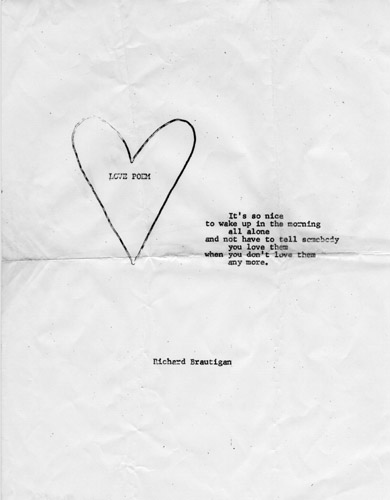
Richard Brautigan Poem From 1967
Sunday Book Review – Is There No More Bad Poetry?
Tuesday Morning Staff Meeting – Amazon Is Coming For Your Children
“We’re in Amazon’s sights and they’re going to kill us.”
Will the Kindle wreck book markets overseas?
Overseas bookstores try to adjust.
Indie bookstores should stop trying to compete with Amazon (but no one is saying they should quit).
Parking tickets are almost as bad in Los Angeles as they are in DC.
The Sorrows Of Young Werther
 Some time ago, at a library book sale near my apartment, I purchased a copy of Goethe’s The Sorrows of Young Werther, the quintessential book of the sensitive young man and the unobtainable woman.
It’s a short book and a swift read, but for the modern reader, it takes some getting used to. Werther is a one of the most emblematic products of German romanticism, of sturm und drang (storm and stress). Consequently, the raging, unconcealed emotionality of Werther, which seems overwrought and a little embarrassing to the modern reader, was far less so a couple of centuries ago (though the other characters make it clear that they find Werther a little over the top). And I’m not so young as I used to be (though younger than I will be) and am a little removed from the inner sensations that roiled me at age nineteen or twenty or even twenty-five.
Werther is a little disturbing to read. You can see the coming storm and no one seems to be doing anything about it. Certainly Werther has little idea of what’s going on (as evidenced by his apparent social faux pas while serving as the personal secretary to a high ranking official while trying to forget his unrequited love).
Charlotte, to the outside eye, seems as a far more predatory character than Werther views her. Encouraging affections she knows she cannot return and always doing just enough to keep the young man hanging on. And her poor husband Albert, who both pities and is terribly frustrated by Werther’s ignorant innocence and who knows he is being victimized by a form of emotional cuckolding.
And when poor Werther tries to kill himself and fails, only to die slowly and, frankly, embarrassingly, over the course of several days.
Which is genius of the novel, in the way it subverts expectations. Werther fails to manage a beautiful, moving death, like the famous statue of the poet Shelley. An epistolary novel, Goethe suffuses the reader with the urge to write back to Werther and call him a foolish a prat. Werther writes of himself as a romantic hero and the when we see the plot through Werther’s eyes, we can see where he’s going with it, but Goethe repeatedly smacks us about with his foolishness.
But Goethe also told his secretary, ‘It must be bad, if not everybody was to have a time in his life, when he felt as though Werther had been written exclusively for him.’
A very true statement, but one that also makes me somewhat sad. What would it have been like if I had read Werther when I was nineteen or twenty? How would it’s meaning have changed? Surely, it would have been different. And Goethe wrote it as a twenty-four year old. How wrong am I to impose the world view of someone whose age is as close to fifty as it is to twenty-four?
This is undoubtedly a book that should be read by young men.
Not to long ago, I wrote a post about books one ought to read before one is thirty, which prompted a nice little back and forth with a friend (and a crackerjack labor communicator, I should add). One issue that came up, and which my mother also kindly pointed out, was that my list could be viewed as a list for young men rather than young people. Does Werther fall into that category?
And isn’t Werther primarily for very young men? Not just under thirty, but an adolescent or someone in their early twenties?
A few years ago, my nephew started burying himself in books that were both challenging and also intended to challenge dominant worldviews, but I suspect that, before he was nineteen or twenty, this wasn’t the case.
It’s been something I’ve mourned that young people aren’t reading the great works of/for rebellious youth these days. Of course, this may all just a version of old man griping, that what really bothers me is that young people aren’t behaving like I behaved nor doing the things I think they should be doing.
But damn, it was fun huddling over coffee in Denny’s and whispering about the copy of The Anarchist Cookbook that one of us had acquired and wondering if it were true that bookstores reported to the FBI the names of anyone who ordered one (and it wasn’t on the shelves in the bookstore in Countryside Mall, I can promise you that). Or reading aloud from the sideways copy of Naked Lunch. Or comparing notes on Nietzsche. Or giggling over Fear and Loathing in Las Vegas.
My own ‘rebellious youth’ reading was still far from adequate. I’m fast approaching forty and haven’t ever read Howard Zinn’s A People’s History of the United States, the bible and textbook of the historically minded leftist. And, as I’ve said, only now have I read Goethe’s classic novel for tormented young men in love.
We are all failures, in our way, are we not?
P.S. – To compensate for my andro-centric reading list, here’s an article on a writer known for her influence over young women.
 the coffee philosopher