August Kleinzahler At The Hill Center


9780374529413A surprisingly engaging and enjoyable poet to listen to and the usual moderate of these conversations – the Washington Post‘s Ron Charles – stayed out of the way more often the usual, perhaps because the sanguine Kleinzahler was more willing than the melancholy Hirsch and the phlegmatic Szymbist to take control of the conversation (did you see what I did there with the four humours of medieval medicine?).

In his introduction, Charles noted that the poet, despite being famous for chronicling bars and diners and working class communities, was not a Bukowski. But the impression he gave was of a Robert Pinsky writing a Charles Bukowski. Does that make sense? Probably not. Well, I’m not going to explain.

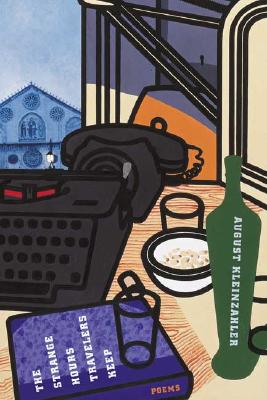
The poet signed for me The Strange Hours Travelers Keep – which both delightfully named and has a wonderful cover. He aspires to Whitman’s continent spanning enthusiasm, but there is something narrower about him. The title comes from a line of William Carlos Williams and there is something of Spring & All in Kleinzahler (who is also a New Jersey poet). He wears his learning more broadly than Bukowski (again, like Williams), but has something of Bukowski’s resentment. Williams felt resentment, too, mainly for feeling left out of the conversation in favor of folks like Eliot and Pound, but this is a different kind of resentment. Something closer, indeed, the Bukowski. But more sober and plastered over with a fine appreciation of Milton.

There is a touch of misogyny to some of these poems – a ‘character’ in a poem calling Alma Mahler a ‘slut’ or a poem about a female poet who turned cruel eviscerations of her parents and the symbolic emasculation of a husband or lover into poetical success (defined, in this case, as grants, prizes, and choice campus appointments). I couldn’t call this trend pervasive or a trend, but just frequent enough to make me uncomfortable.

Kleinzahler has these wonderful exceptions to his high culture Whitman-ism. A lot of them have this delicious French influence, particularly the Surrealists (mainly Breton), though with too much conscious logic to is zig sagging motions to be truly Surrealist (and we are talking the actual movement; not ‘surrealist’ as short hand for ‘weird’), and also bits of Antonin Artaud’s structured madness. A lengthy prose poem, not suited to excerptation, I’m afraid, but that I highly recommend and which is well worth the price of the book: The History of Western Music: Chapter 4

The best poem that is also great distillation of his more usual style is the sad and melancholy portrait of faux-genteel poverty and terrifying loneliness, The Single Gentleman’s Chow Mein.

That his poems don’t take well to being shown in excerpts is a testament to how well they cohere, even when they appear random (that touch of Surrealism) or stream of consciousness.

Watching ‘Henry V’


I came across this article on watching an understudy play Henry V at the Folger production of Henry V from a season or two ago. As it happens, I saw that same production and also saw it with the understudy.

The early reviews had raved about the original actor and his commanding performance. The article writer was very hard on the understudy (though it should be said, I am pretty sure that the performance I saw was neither of the ones she saw). I actually liked him, though, and for many of the reasons that she did not.

I do not think it is set in stone that Henry is a confident king when the play begins; that he had exorcised all his demons in the previous, relevant plays (Henry IV, Parts  I and II). I liked this uncertain king. A running theme in many Shakespeare plays is the conflict between the medieval and the modern. Romeo is conflicted by the medieval requirement for retribution and modern ideas of order (and also marrying for love, but that’s another topic). Hamlet is the quintessential character caught by that conflict: the warlike, medieval man that is the ghost of his father versus a Hamlet that needs to understand why and who questions ideas of valor and vengeance.

Why can’t Henry V be similarly conflicted? On the edge of the renaissance and the end of the high middle ages, is it such an outlandish interpretation that he could question his own fitness to be a medieval man of action?


IMG_8323.JPG


IMG_8322.JPG


IMG_8321.JPG

44 Great American Bookstores


I am a sucker for ‘listicles’ like this one of 44 ‘Great American Bookstores.’ Not in the least, because I do a fair amount of ‘bookstore tourism.’ Seeking out the best bookstores in any city I visit is always a priority.

I’ve visited nine from this list: #1, #3, #10, #14, #16, #19, #23, #24, and #33.

#1 is Prairie Lights in Iowa City, Iowa. I worked in Iowa in 2002 and as I was leaving the state, I stopped in Iowa City to visit this particular bookstore.

#3 is John K King Used and Rare Books. I visited that one recently when I fortuitously passed it by on my way from my sleazy motel to the location of a conference I was attending in downtown Detroit. Four stories of books in a former glove factory. Yup. Awesome.

#10 and #14 are Maple Street Books and Faulkner House Books, both in New Orleans. I stopped in on separate visits to New Orleans. Maple Street was just good luck that my friend and I were walking about and we saw it and I can never resist going into a bookstore. If I recall, Faulkner House Books was a little disappointing. Too many Anne Rice novels scattered about the place.

#16 I didn’t think much of at the time. Dog Eared Books is in San Francisco and I used to go there a bit for work and visit friends when I was LA. I was just wandering and came upon it.

#19 is my beloved Skylight Books, which must be the greatest bookstore in the country. Seriously.

#23, Symposium Books, I went to while I was in Rhode Island. It’s near the Rhode Island School of Design and has an amazing selection of books on art theory and crit.

#24 is DC’s own Politica & Prose. You and I already know how awesome that place is.

#33 is McNally Jackson in New York City, which I visited, but, honestly, I didn’t think much of at the time. It was a good bookstore, but it didn’t stick out in my mind.

I’m wondering how it is that I’ve never been to #28, Atomic Books in Baltimore. Sounds amazing!


‘Orthodoxy’ By G.K. Chesterton


OrthodoxyThis was recommended to me by the Franciscan father who gave me my first confession. A comparatively non-dogmatic (‘dogma’ in the theological sense, not in the derogatory sense) argument and explanation for the reasonableness of the Christianity, written in a pleasantly conversational, yet aggressive tone.

My mother is the big mystery fan, so maybe I’ll ask her if she’s read any of Chesterton’s ‘Father Brown’ mystery stories.

He wrote Orthodoxy in 1908 – before he converted to Catholicism. The style isn’t exactly that of the great nineteenth century essayists, but still in the tradition and, shall we say… nineteenth century adjacent.

Early on, there was a great bit about poets that I posted a while back – check it out here.

What I loved most is how liberal Chesterton is – and liberal in a very modern, progressive sense. There is a great bit about original sin urging us to constantly strive and engage in and support very progressive policies for the poor. Honestly, I don’t know what this book isn’t as famous for being a liberal polemic as it is for being a Christian apologetic.

However, I do wonder whether the priest knew that Chesterton was still Anglican when he wrote this book? Not that it matters. By ‘orthodoxy,’ he meant adhering to the Apostles’ Creed, which is something that the Anglican, Episcopal, Catholic, and no doubt many other churches share.


How I, As A Political Consultant, View Election Day


10155164_842851352401936_8514712545237197838_n

‘The Shadow Of Sirius’ By W.S. Merwin


9781556593109The Shadow of Sirius perfectly encapsulates what there is to love about Merwin and what is so frustrating about Merwin. It is one of his most accomplishments, but there is such a sameness to all of his poetry. It’s a little petty to complain, because it is such wonderful poetry, but just adding some old age (a different approach to memory and mortality) doesn’t change the fact that Merwin has been stylistically the same for over forty years. And while much of The Shadow of Sirius may be technically better than them, I still say that Merwin has been repeating shadows (pun intended) of those wonderful, powerful poems from The Lice (1968, I believe) and Carrier of Ladders (1970, I believe).

In the poem Escape Artist, writes: When they arrange the cages/for experiments/they have long known/that there is no magic/in foxes at any time

The poem is (at least partly; ostensibly) about raising animals for their fur and also for experimentation. The Merwin of The Lice would have been more engaged on the issue, but this Merwin meanders off into a gentle melancholy. Merwin was rarely fierce, but not always so passive.

But credit where credit due – I loved this short poem:

The Curlew 

When the moon has gone I fly on alone
into this night where I have never been

the eggshell of dark before and after
in its height I am older and younger

than all that I have come to and beheld
and carry still untouched across the cold.


That poem has some wonderful touches of surrealism and tweaks the Merwin style with hints of an almost rhyme scheme (semi-heroic couplets?). I would have been happy had there been more of that and less of the rest.