Madness, Rack, And Honey


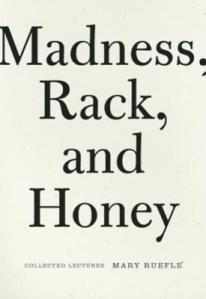
Madness, Rack, and Honey

First things first: kudos to Mary Ruefle for using the Oxford comma in her title! I love that little comma. If you are a semi-regular reader of these semi-daily musings, you have probably already noticed that I use it myself. Generally, I like commas. Aesthetically speaking.

Ruefle is a poet, but Madness, Rack, And Honey is a collection of essays. I’m not a huge fan of her poetry, if I am being completely honest, but this book has been staring at my from the shelves of the poetry section in downtown DC’s Barnes & Noble for some time. Eventually, I submitted.

Ok then. It’s a good book, but it’s got its highlights and lowlights. The essays on ‘Secrets’ and ‘Fear’ are definite highlights. The inquisition about secrets and poetry, with some references to Jesus thrown in, is amazing. Similarly, the lecture on fear and poetry is great. Does fear inspire a poet? Stop a poet? Are you afraid when you’re writing or when you’re not? Is writing scary? Is being a poet scary or does it relieve fear? Is fear the source of knowledge, as Nietzsche claims?

But the ending drags, with a serious of unsystematic brief essays and ‘gobbets’ that add to something closer to laziness than insight.

The Last Day Of #PoetryMonth


So, National Poetry Month, also known as ‘April,’ ends today. So read a poem. April was chosen because of Eliot’s The Wasteland. So you could read that. Or read some Robert Frost (but read him carefully; to paraphrase Inigo Montoya, he doesn’t mean what you think he means). Or Whitman. C’mon. Whitman is, like, totally All-American, you know? There’s even some Whitman written over the escalator at the Q Street entrance to the Dupont Circle Metro Station. Or, you know… the internet. It’s everywhere. So check some out, but take your time reading it. Read it slowly and try to actually see something in it.

And, by the way, you could even read some tomorrow, as well as reading some today. Even though May is not Poetry Month, I check with an attorney and it’s totally okay to read poetry in May. Or June. Do you see where I’m going with this?

That is all.

Catholic Labor


Through the combination of social and economic change, trade union organizations experience greater difficulty in carrying out their task of representing the interests of workers… The repeated calls issued within the Church’s social doctrine, beginning with Rerum Novarum, for the promotion of workers’ associations that can defend their rights must therefore be honoured today even more than in the past…
 
Benedict XVI, Caritas in Veritate

A Theology Of Secrets


Jesus answered him, I spake openly to the world; I ever taught in the synagogue, and in the temple, whither the Jews always resort; and in secret have I said nothing. Why askest thou me? ask them which heard me, what I have said unto them: behold, they know what I said.

John 18:20-21

‘In secret have I said nothing.’ To modern ears, that is the phrasing of a question: In secret, have I said nothing?

It’s not a question, but what if it is? Did secret words pass between Jesus and his Father?

The esoteric tradition has deep roots in Christian tradition. Is what he said aloud and which can be repeated by the listening, madding crowd also a kind of secret, because there is a secret meaning that is not shared widely?

And his priests are instructed to carry all of our most terrible secrets – carry our secrets to their graves. In a sense, all secrets are shared only with God, so a priest is an eavesdropper burdened with secrets between the sinner and God.


It is a myth that the Chinese character for ‘crisis’ is danger + opportunity. Only the ‘danger’ is true.

I Love This Building


Art Deco

My route to and from work takes me past an Art Deco building on 11th St SE, just south of Pennsylvania Ave. I love it. It’s totally out of character (most of the structures on that block and, indeed, throughout the Hill neighborhood, were built between 1900-1930 and are most certainly not Art Deco).

It’s just so unique and eye catching and unexpected and it’s one of the highlights of my commute (arguably the only highlight).

Apparently, it was built in 1932 and was originally a funeral home. Now, it’s an apartment building. Wouldn’t it be great to live in that building? At least, wouldn’t it be great if you were in your twenties or early thirties (and maybe you are)?


‘The Wise Man’s Fear’


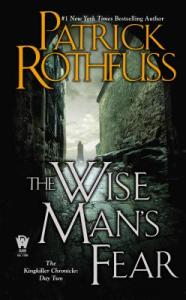
9780756407919I read The Name of the Wind, I enjoyed it, so I went to the library to check out the sequel, which, except for being ridiculously long (look, people, not even Tolkien needed so many pages; you don’t need to write  door stop every freaking time), was generally better than the first book.

The main character, Kvothe, when we first hear about, is a legend who has done legendarily awesome things. Unfortunately, most of the first book was about him in school, which… I mean, that’s okay, and everything, but I really wanted to read about mythic adventures of this other, older Kvothe.

This book is still mostly about that younger Kvothe, but at least we get some hints of the future Kvothe, the super awesome magician.

But I have to go back to a point I’ve been harping on lately. All you fans of these books and of Harry Potter, did you know that someone who is a much better writer than either Rothfuss or Rowling wrote a book about the schooling and rise to greatness of a young magician, from childhood all the way to early manhood that is not only much better, but is also just a couple of hundred pages long? That’s right! You could have gotten an improved experience in only a fraction of the time and at a fraction of the cost! It’s called A Wizard of Earthsea and even if you read all the sequels (I think there are three), the total number of pages would be less than a single one of those Harry Potter free weights. And, not to belabor the point, but you would be reading books that are much, much better.

Okay, I’ll get off my high horse now.

‘The Rise And Fall Of The Man Of Letters: English Literary Life Since 1800’ By John Gross


9781566630009Firstly, so glad that I read this book. Incredibly interesting and shines a light on a fascinating aspect of literary history. This book is not about the Charles Dickens of the world. It is about the editors and publishers who published Dickens’ novels in serial form in Victorian magazines and papers. It is about the critics who shaped the tastes of the reading public. In a book like this, the towering figures are men like Matthew Arnold, not Tennyson.

But… the early stages are a lot more interesting. Matthew Arnold, Thomas Carlyle, and Charles Lamb. The milieu of Gissing’s New Grub Street. I was reminded of the frenetic literary world that I read about in Balzac’s  Lost Illusions. But as it got more contemporary, it got less appealing to me. And, unfortunately, I took a long time to read this book. Not for lack of interest, but because, for some reason, it became a fall back book. I would take it with me and read bits of it on the metro or while waiting for a doctor or, yes, in the bathroom. I didn’t sit down and plow through it in a brief period. Which means, that my memory of the best bits is fuzzier than my memory of the other bits.

But don’t let me turn you off from this – I can guarantee that you’ve never read this side of English literary history.

Union Yes! (Says The Catholic Church)


Through the combination of social and economic change, trade union organizations experience greater difficulty in carrying out their task of representing the interests of workers… The repeated calls issued within the Church’s social doctrine, beginning with Rerum Novarum, for the promotion of workers’ associations that can defend their rights must therefore be honoured today even more than in the past…

Benedict XVI, Caritas in Veritate

Shakespeare’s Birthday Bash At The Folger


Sunday was one of my favorite days of the year: the day when the Folger Shakespeare Library opens up its backrooms to the public and serves up cake and swordfighting in honor of Shakespeare’s birthday.

We brought two boys with us – our friends’ children, age 7 and 10 (perfect ages to appreciate the offerings).

I love sitting in the library, listening to classical quartet (this time, it was two violins, cello, and flute) and then going and looking at some of the paintings. The Folger has a wonderful collection of art about Shakespeare, like paintings of scenes from his plays or portraits of Shakespearean actors, as well as portraits of Shakespeare himself (mostly posthumously painted). Their crowning glory is a portrait of Queen Elizabeth (the ‘Seive’) and one of her one-time favorite, Robert Dudley (which was, sadly, not on display).

The fight director for the Folger gave a couple of presentations on historical fighting techniques, with references to Shakespeare. Of course, the boys were rapt.

A couple of notable things stuck out with me. Firstly, that swashbuckling used to be a sort of insult. A swashbuckler didn’t know how to fight. A ‘swashing’ blow was a reflexive swing which, if it landed on a buckler, made a lot sound and fury, signifying nothing (do you see what I did there?).

Secondly, in Romeo and Juliet, they keep asking Mercutio if he’s hurt, because they cannot tell. Mercutio was stabbed with a continental rapier, which creates a small wound – what would now be called a sucking chest wound. While terrible internal injuries have been suffered, it won’t actually bleed. Romeo literally cannot see a wound, so doesn’t know that Mercutio has been dealt a fatal blow.

Thirdly, he noted a scene in Julius Caesar where Caesar exits the stage to take care of some bureaucratic matter and then the conspirators enter the stage and engage in some silly dialogue about whether some person giving them the eye means that they’ve been uncovered. He said that was not something to build tension – there’s already plenty of tension and, arguably, the scene actually deflates some of the tension. No, it is entirely intended to give the actor playing Caeasar time to attach some Elizabeth special effects – namely a bladder filled with blood – around his chest. And when, having done the deed, the conspirators decide to get their hands bloody and walk the streets to show they are not ashamed or hiding their action, it was actually a stagecrafty way to help mop up the blood on the stage.

Finally, there was a roundabout argument for gun control. Shakespeare lived in the first age when the growing middle class would walk to streets with swords – that they often weren’t trained to use. Fights were more deadly, as a consequence. He argued that Shakespeare was constantly commenting on the culture of weapons and violence. At the end of Romeo and Juliet, an entire younger generation of two families have been killed as a consequence of escalations resulting from a culture of weapons and violence. Literally, it snowballs from anger at Romeo crashing a party held by a rival family and ends with a trail of corpses.