‘Sometimes An Art: Nine Essays On History’ By Bernard Bailyn


Bailyn was an influential scholar of American history who died recently. He was old school and, while the first essay in this collection is, in part about the horrors and evils of the slave trade, it’s safe to say he was more of the great man school of history, which, in practice, leads to more discussions of dead white men, than not. This is only a slight criticism, so long as others are taking up the slack.

However, it was disturbing to read his essay on the late nineteenth and early twentieth century historians who reinvigorated study of colonial loyalists during the Revolutionary War and missing the strong strand of racism which united them.

His cause isn’t helped by a congratulatory prose style that is both flavorless and slightly condescending. Don’t get me wrong, I will be breaking down and buying on his full length histories, but this, the only volume by him in the DC Public Library system, is a poor argument for his importance as an historian of America.

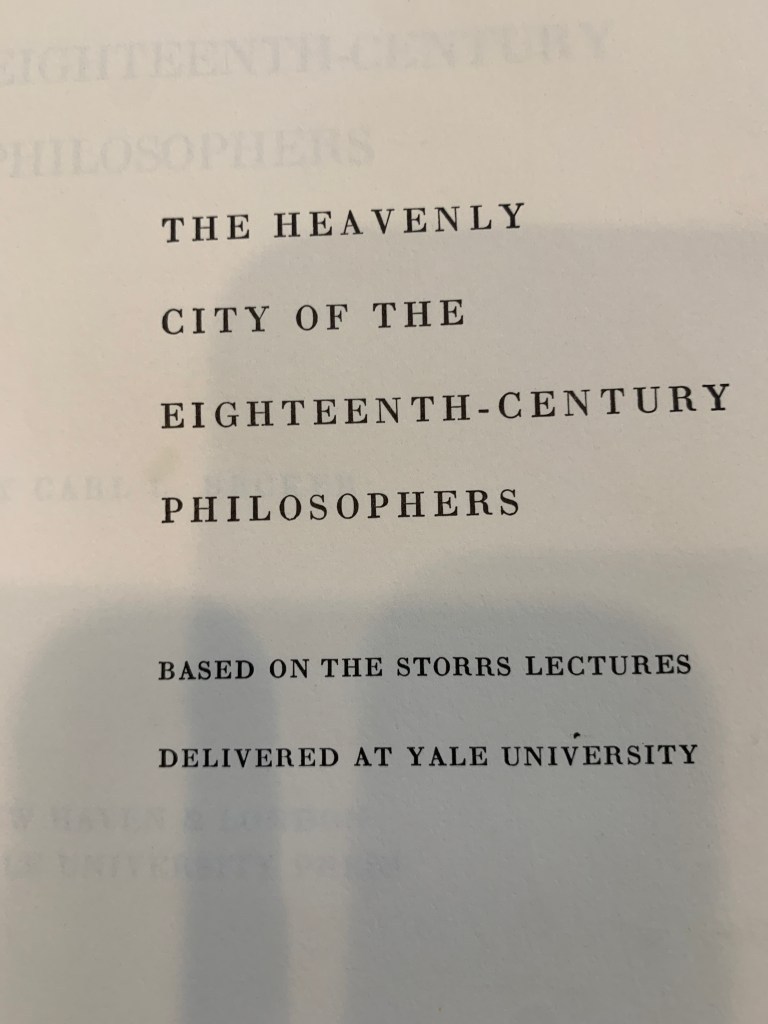
‘The Heavenly City Of The Eighteenth-Century Philosophers’ By Carl L. Becker


How did have I not read Becker before? He has the classic style of the great, witty, learned, essayists of the nineteenth century. This book reads like a sequence of connected essays, which, effectively, they are, being based on a series of lectures he gave. Becker’s name appeared before me while reading Garry Wills’ Inventing America; while arguing against Locke’s influence and for that of the figures of the Scottish Enlightenment, mainly Reid and Hutcheson (I hadn’t realized this was controversial).

Primarily about the francophone philosophes (francophone rather than French, so as to include Rousseau), with frequent attempts to loop in the Enlightenment figures of the American founding and into the Scottish Enlightenment, it makes eighteenth century philosophy a fascinating, discursive read, which is an apt metaphor for it.

Sadly, for me, he fails to stick the landing. First published in 1932, he waxes unhappily about Bolshevism and the socio-political tumult of nineteenth century Europe. While I don’t necessarily mind (if also don’t necessarily agree) with his grumpy reactionary-ism, he doesn’t connect it to his lyrical discourse on the eighteenth century philosophers, except perhaps to say, that was good and these are bad.

Inventing America


I loved this book, but mostly because it made me want to read other books. I’ve started reading Carl Becker, because Wills mentions him. I definitely need to read more Scottish Enlightenment (Hume, Home, Hutcheson, etc).

However, the argument itself seems… unnecessary today. That the Scottish Enlightenment was the critical intellectual yeast of the Founding documents does not seem controversial today, nor does relegating Locke slightly (though not so much as Wills does; he tries to dispel any idea of Locke’s political writings being an influence on Jefferson’s Declaration, which smacks of a lady protesting overly vigorously). He also leans heavily on finding references to Francis Hutcheson (followed by Kames, Hume, Smith, and only rarely Reid).

Wills writes that Lord Kames was Jefferson’s intellectual hero. Of course, Kames, Christian name, Henry Home, was David Hume’s uncle (Hume changed his name so that the spelling matched the phonetics) and Jefferson notably raged against Hume.

He spends as much time emphasizing the Declaration was not seen as a momentous documents at the time it was signed, only later becoming so (in part, through Jefferson’s own efforts to elevate it), as he does on the specific influences that this book is supposed to address. C’est malls vie, I guess.

I did learn things, though, or at least gain new perspectives. He provides new lenses through which to view Jefferson’s famed Head and Heart letter, provided by Scottish sentimental (which doesn’t mean what you think it means) moralism and Laurence Sterne. Incidentally, though I mostly fall into the camp of those who feel that the recipient of that letter and Jefferson did have a sexual relationship, though the letter suggests to me that our third president was an awkward lover.

The Secret Talker


Fascinating, beautiful, intricate, but did not quite cohere.

The protagonist’s slow release is information and growing willingness to implicate herself and expose herself as more flawed and cruel than I would have guessed at the beginning. Also, her friend and sometimes confidante is deliciously wicked and rapacious!

Written in the early aughts (I hate that term), the technology is a little old fashioned sounding today. But the failure for me is that the final reveal left too many questions, including, how the heck did this person craft their identity, in a purely practical sense (you’ll have to read to understand what I mean).

Agony and Eloquence: John Adams, Thomas Jefferson, And A World Of Revolution


Another book about the relationship between Jefferson and Adams; less formally innovative than the other, but a nice, brisk read, nonetheless. Some odd choices though. It focused less on than the bitter divide that kept them apart for over a decade and more on the things that connected them. For about half the book, it seemed to be using their differing views of the French Revolution as the lens through which to view these two men, but then it seemed to forget about it. Which was weird, because it spent at least fifty pages discussing important figures within the French Revolution. Was that just padding?

Also, kind of amazed how historians (mostly white, male historians) are still tip toeing around Sally Hemings. It was a terrible, terrible thing he did, because her age and lack of freedom meant she could not consent and wildly hypocritical. But he did good, too, and it need not be interred with his bones, and Antony might say, it we acknowledge his deep sins.

Betrayal: The Final Act Of The Trump Show


At this point, there’s not much new compared to the coverage of the book and other reporting… but, good heavens, what a lot of crazy people. Vice President Pence comes across as… sort of good? Even if he waited until the very last moment to say, enough is enough, can we please stop destroying the Constitution and American democracy?

The role of John McEntee, a Trumpy, horndog who was put in charge of Stalinist purges, was interesting. I’d heard of him, but the salacious tidbits, like hiring attractive, twenty year old female Instagram ‘influencers’ alongside hardworking, loyal young men who also weren’t competition for any sexual conquests McEntee felt like embarking on.

Read more

‘Mortality’ By Christopher Hitchens


Of necessity, his last book (though I suppose a collection of miscellany could still, and perhaps already has, come out; but that wouldn’t have been written last).

Am amazing stylist and, equally or more important, a master of his craft. There are plenty of talented writers who never properly learned their craft and any decent reader can quickly discern the difference.

Mortality is not an example of Hitchens the craftsman.

Read more

War For Eternity: Inside Bannon’s Far-Right Circle Of Global Power Brokers


So, there’s this insane right wing, slightly racist philosophy called Traditionalism. When capitalized, it means something very specific, more than a little occult, and deeply weird.

It’s non-fiction, but most resembles Umberto Eco’s great novel of occult paranoia, Foucault’s Pendulum. Listening to Teitelbaum’s breathless accounts of conversations with right wing esotericians, I keep thinking of Eco’s narrator and his encounters with important seeming occult thinkers.

This is also because, even though Teitelbaum repeatedly presents himself as a scholar (specializing, apparently, in right wing ethnomusicology, which doesn’t sound like a real thing), he doesn’t write as on. One review said he seemed a bit star struck by Bannon, but beyond that, the book is more of a mostly chronological account of his descent into crazy town, with Bannon as his Gandalf (a wise man who tends to disappear and then reappear, offering wise words). I also pick up hints of Bernard Henri-Levy, in it. The globetrotting name dropping and the self-importance of it all.

He acknowledges the book was rushed and it has a breathless quality, like he’s embarked on a mystery he must solve : Tinker, Tailor, Soldier, Traditionalist. He uncovers clues, only to find that it wasn’t clue, only the self-important ramblings of a minor figure that no one cared about. It also has a chronological quality; it is more or less directed by the timeline of his interviews with Steve Bannon.

I learned that the godfather of traditionalism is the French philosopher, René Guénon. I have somewhere his book, The Multiple States of Being, which I haven’t read. It was given to me by an acquaintance; later, I figured out that giving me that book was his way of expressing his romantic feelings for me. Having learned from this book that Guénon helped found a neo-fascist movement makes that seem an odd choice, but I’ll give that acquaintance the benefit of the doubt.

However, my main takeaway from this book is this: Bannon and I used to frequent the same metaphysical bookstore in Los Angeles: The Bodhi Tree. Did I ever see him? Maybe. Would I have recognized another shaggy, middle-aged white dude as the future political strategist for the apocalypse? Meh.

The Rise And Fall Of Classical Greece


Despite the Gibbonesque title, this is a not traditional history of classical Greece. It aspires to be more data driven, though spiced with classical learning. Sort of like a Jared Diamond who didn’t reach for tendentious assumptions with uncomfortable racial overtones.

An early example was identifying that, even though ‘Greece’ expanded to many places in the Mediterranean beyond Greece, the distinctly Greek city states (did you know that plural of polis is poleis, because I didn’t) were located in a narrow climate band that featured relatively mild winters and not too much rainfall. While the first seems natural, the latter is counterintuitive, but it seems the liked dry summers, despite the potential benefits to agriculture.

So, I was enjoying this right?

Well, kind of. I actually didn’t finish it. I don’t have limitless reading time and, frankly, I decided to allocate it elsewhere after getting about 100 pages into it. I prefer cultural history to economic history. If I read about classical Greece, I want more Empedocles and Pericles and less olive oil output. Just a personal preference, but that doesn’t mean I don’t think this book is worth your time, though, should you be so inclined.

The Mysterious Affair At Styles


My second Agatha Christie book within recent memory (my mother had some many around the house, that I feel certain I read some growing up) and the first mystery she ever wrote.

The last one I read was all about motive. Her most famous creation, Hercule Poirot, spent much of the book criticizing a police detective who spent a lot of time examining physical evidence, while Poirot shrugged his shoulders, said, meh, who care, motive is everything.

In this one… well, motive was pretty obvious, in the end, and it was all about physical evidence (though, sometimes, also about the absence of something), with the mustachioed Belgian even sending some samples of cocoa away to be analyzed.

I am too lazy to look for it, but I read a very nice article about Christie that posited a unifying feature in her work: a great belief in the evil of mankind. And, well, you can really see it here.

A lot of disagreeable people, including a thin-skinned, self-righteous, and not very bright narrator (though, in his defense, Poirot seemed to constantly making fun of him and disagreeably and spitefully withholding information).