White Privilege


I was having drinks with a married couple who were both old friends (though I’d met the wife first). We had all visited Thailand earlier in the year. She had a complaint that my own better half once echoed. Everyone was looking at her husband. Like my better half, she was Southeast Asian. Like me, he was white. He protested that he hadn’t noticed any such thing, which, to her eyes, beggared belief. But I understood.

I also had a bit of a revelation. Why didn’t we notice (assuming it was actually happening)? Because, as white, heterosexual males, we always feel normal. The culture we live in reinforces that we are the norm. We set the norms. Even though we may be the only white guys for miles, wandering through a sea of capital-O ‘Other,’ we don’t feel out place. We never truly feel like the ‘Other.’ Even in a place where, by all rights and logic, we are the ‘Other.’ We didn’t notice any staring because, why would people stare? We always belong.

If you take it to absurd extremes, yes, you can find situations where we don’t belong. The classic/infamous/terrible cult classic, Cannibal Holocaust, for example. We, as white heterosexual males would feel a sense of not belonging in a situation where our party was being eaten by Amazonian cannibals. But even then, could we truly know what it is like to be ‘Other.’

Our better halves noticed the staring. Why? Because, as part of the ‘Other’ in America, they are attuned to it. To the reactions of the defining cultural group. Whether the reactions are good or bad is almost beside the point.

So this is part of white privilege. It is something that, no matter how enlightened or tolerant (which, when you think about, is a terrible word; ‘tolerant;’ how good of me to be ‘tolerant’ of others; how very… white of me) I feel I am (and, let’s be honest, in the eyes of the ‘Other,’ I may not appear so wonderful as I do to myself), I have not escaped, that maybe will never escape, and which will always be a wall between myself and true understanding of the challenge of being a person of color (in this case, but feel free to add in ‘woman,’ ‘LGBTQ,’ etc) in a society still defined by white privilege.

Fiscal Conservative, Social Liberal


Whenever I hear that phrase, I cringe, because it’s a favorite phrase of upper middle class, white liberals who have fallen for both a false idea of fiscal conservatism and a shallow conception of social liberalism.

The social liberalism is generally a vague mixture of support of abortion rights, environmental protection, and LGBTQ rights. The fiscal conservatism is usually some vague platitudes about living within our means, not wanting to pay taxes, and perhaps some Pete Peterson-esque BS about cutting Social Security or Medicare and/or the ‘fixing’ the federal debt.

Here is an example my objections, which show why this stance is almost always BS.

For example, on LGBTQ issues, the support is frequently around marriage equality (though it is less vital since the Supreme Court made it the law of land). All well and good, of course, but an issue that costs far more precious blood and treasure is the issue of the still high rates of homelessness, drug addiction, abuse, and suicide among LGBTQ youth. They don’t brunch and their issues cannot be solved with a court ruling. In fact, what they need is to loosen that belt and invest in social services and programs that cost, you know, money.

The fiscal conservatism is almost always a false economy. Cutting social services and depriving America of the talents and future contributions of those young people is a long term cost. In the medium term, the higher rates of STIs and the connection between drug addiction and crime have considerable costs in blood and treasure.

The thing is, we, as a country, always wind up paying for these things. Just as when conservatives pissed and moaned and cried about healthcare reform. We can’t afford it, they said. It will be too expensive, they said. Mindbogglingly ignorant. Can’t afford it? We are already paying for it. Literally. Money is fungible. America pays X amount per year for healthcare. We already pay for healthcare, as a nation. We are just doing it ineffectively. In fact, we even pay more than that X would suggest, because we are also paying in reduced wages.

That goes for most of this stuff. In fact, it’s very much like your mother told you when you were a kid: take care of it now, or else it will be worse later. Take your medicine and pay upfront for social services for those kids, or else pay later and pay more. Set up a rational healthcare system that controls costs or else don’t and pay more later, one way or another.

Fiscal conservatism is actually about not wanting to pay now. Not wanting to pay now, also benefiting from the fact that, in America, poor people will pay a higher relative share of those future costs than you.

Other phrases I hate include, ‘I vote the person, not the party’ and ‘I’m just telling it like it is.’

In the first phrase, nine times out of ten, that’s just to provide an independent veneer, because the person who said that invariably votes for the candidate of a single party (usually Republican, because most Democrats aren’t so ashamed of their affiliation) in 99% of elections.

In the second case, the phrase almost always follows a statement which was some combination of pointlessly hurtful and/or racist.

The Social Contract


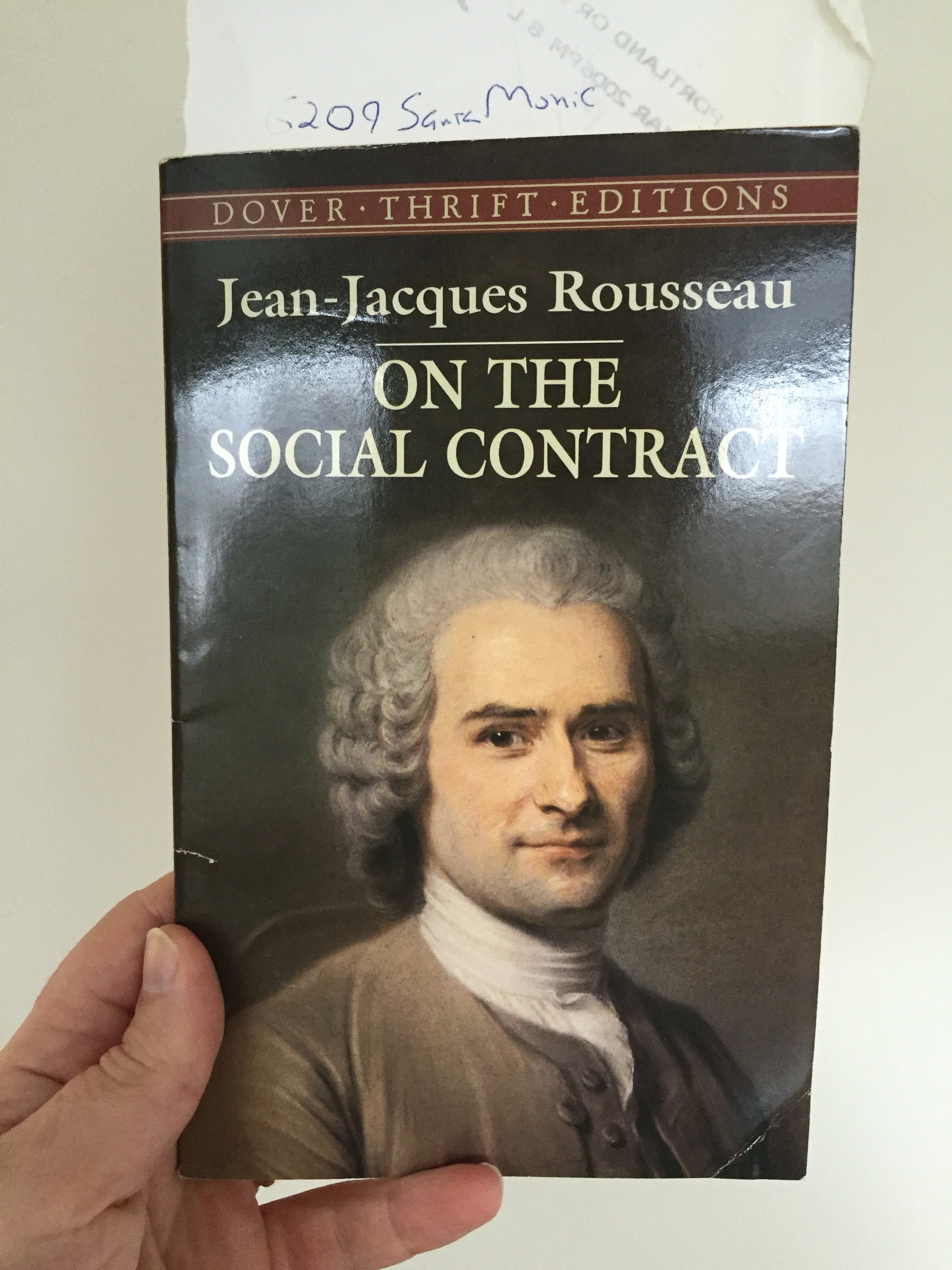
  I’m not going to explain Rousseau’s Social Contract. Frankly, if you’re reading this, you can look up what better folks than I have to say about the Swiss philosopher meant or should have meant or maybe meant. Also, you probably have access to a public library. And if that public library is poorly stocked in terms of Enlightenment philosophy and commentary, there are university libraries. Maybe you can’t check out a book, but there is pretty much no barrier to simply going inside and spending a few hours reading up on the subject.

What struck me was how some of his remarks are quite prophetic in their implicit criticism of some of the structural problems affecting the American (and global) economy.

Very early on, he criticizes what today we might call rentier capitalism. In The Social Contract, he is speaking purely about land (possession of agricultural still being the avenue towards wealth and the source of the aristocracy’s wealth), but the idea is easily transferable to modern financial instruments.

Possession of land, he says, must, in part, be justified by ‘labor and cultivation.’ Modern financial instruments do little to actually invest in production or innovation or much of anything (if I buy AT&T stock, AT&T does not suddenly have extra capital to expand broadband access; rather, I have simply given money to the someone who used to own the stock). In other words, they do not participate in ‘labor and cultivation.’

Later, he also explicitly attacks finance directly, as a destructive force that drives government away from the business of public service and which replaces ‘community’ (though he references the city-state, which shouldn’t be taken too literally, but rather as a reference to Greek philosophy and an idealized, Athenian-style polis) with money.

On economic inequality:

It is precisely because the force of circumstances tends continually to destroy equality that the force of legislation should always tend to its maintenance.

His distinction between ‘will’ and ‘force’ are in the context of the difference between the legislative and executive branches, which is less interesting and, in one sense, posits ‘will’ as the act of legislation and ‘force’ as the act of execution of said legislation (later, he also says that separation of the legislative and executive is necessary in a democracy). But he is pretty explicit that will is a moral cause (using ’cause’ in a loose, but not too loose, philosophical sense).

He gets what Machiavelli was trying to do in The Prince. Ostensibly writing for a prince, but actually writing for a future, restored republic.

Rather interestingly, he notes that, sometimes, slavery was a necessity for a form of democracy. He notes that widespread use of slaves in ancient Sparta might have been what allowed Spartan citizens to be free to participate in the government and direction of their city.

It’s interesting because, more and more, it is clear that American democracy was built on the economic back of slavery – that only the economic benefits (benefits for the white, male elite who created American democracy) of slavery allowed for the existence of America, both intellectually and practically.

The old copy of the book that I read had a slip of paper in it (actually, a piece torn from an envelope), with an address in my writing to the Open Fist Theatre Company in Los Angeles. It’s not far from my old apartment in Hollywood, though I don’t remember going there.

Blood, Sparrows And Sparrows


9781935536499Another book by another poet I’d read about and seen recommended. I was in Politics & Prose, dropping off an order (they stock Lil’ Fishy onesies, if you’re looking for a cool present or outfit for an infant) and couldn’t help going to the poetry section and there, as if by some random magic, it was. Honestly, the odds of any particular book poetry, much less one you are looking for that is not by someone dead or someone named ‘Collins’ or ‘Merwin,’ are not that great, so this probably counts as a minor miracle. I saw minor, because I doubt the particular influence of the hand of God in this. So maybe not so much a miracle, at all, as a cool coincidence.

Even though I’m writing this later, I actually bought this not more than a few days after reading Cathy Linh Che’s Split. When I first leafed through some poems, I was actually a little disappointed and thought that I’d made a bit of a mistake. So I set it down and picked it up something like a week later.

During that week, it improved considerably. No, it didn’t hit me the way Split did, but neither of them hit me the way William Wordsworth’s Prelude did, so maybe that kind of apples to oranges comparison is not useful (though recurring themes of abuse make the two more recent collections more similar than, say, anything Wordsworth wrote).

Visceral and formally varied, stanzas and line indentations give some nice visual shape to the poems, though never at the expense of the words. She’s got a nice sense of humor and sneaking spirituality (rather like someone who has left a church as an adult, but was taken every Sunday as a child, so has the liturgies stamped on her brain).

‘Iraqi Nights’ & Al-Mutanabbi Street Starts Here


On a Wednesday, I saw Dunya Mikhail at the Hill Center, where she was interviewed/conversed with the Post‘s Ron Charles. Sadly, it was the most disappointing of these events that I’ve attended. Whether it was the language barrier (Arabic being her first language and the one she writes in) or something else, the conversation never quite took off. Ron couldn’t seem to get an extended reaction nor dialogue out of her. It didn’t help that she wasn’t very familiar with the English language translations of her poetry that Ron was reading from.

I read her collection, Iraqi Nights and enjoyed it, but didn’t love it. The idea that this was a poetic take Iraq’s travails through the lens of The Arabian Nights never quite came through and some of the poems bordered on being just pithy lines.

On the following Saturday, I dragged a semi-reluctant friend for an event honoring the ninth anniversary of the bombing of Al-Mutanabbi Street, Baghdad’s ‘Street of Booksellers.’ Poets and musicians, including Dunya Mikhail, were there.

Unfortunately, there was a solid forty-five minutes of self-congratulatory back slapping by some white people that was just… too much.

This is Washington, DC and the year 2016 and we don’t need to be told that Bush’s invasions were colossally incompetent, misguided, and deceitful farces not worth the tiniest amount of the blood and treasure they cost. If you really want to drive this idea home, though, the best way would be to get out of the way and let the Iraqi artists speak through their works.

The last part of the event was a musical performance that sounded almost liturgical in chant-like signing accompanied by an oud and a piano (and wind chimes), but I left early, not because the music wasn’t wonderful (it was), but because those ridiculous opening ceremonies/lectures/chidings/backslappings had left a wound that festered and drove me out.

Fortunately, I did get to see a short video while I was still there – a video the showed the pointlessness of the opening lectures by older white people. It was a simple video. Some footage of the street, including archival footage from before the bombing, but mostly it was just focused on a man who owned a cafe on the street and had lost four of his five sons and one grandson in the bombing. Absolutely heartbreaking, especially once you realized that when he was talking about his son missing a leg, he wasn’t saying that his son was now crippled. He was saying that they couldn’t find all of his son’s body parts. When a man is telling you that story, you don’t need an anti-war lecture.

Slow Burn To A Big Payoff


That title is kind of a bait and switch. I saw Only Yestersday the other day. It was a slow movie, that seemed to drag, but then when the ending came, my eyes started getting teary (my friend, who joined me, admitted that he also got watery-eyed). Bouncing between a young woman named Taeko taking a working vacation in rural Japan (she goes to her sister’s husband’s family to help pick and process some crops) where she engages in a chaste courtship with a youthful organic farmer and the memories of her fifth grade self.

There is a famous scene with a pineapple (google it, people), but also so much more. It’s episodic, but the episodes all illustrate the mystery of being young. A father’s actions seem random to her; one moment magnanimous and another, mysteriously cruel.

And it’s not initially clear how the contemporary and the memories relate and, even in the end, it’s not an easy connection (the audience doesn’t gasp, and say, oh, she’s fulfilling her youthful dream of being an actress, for example) nor a pat one. They are in oblique dialogue, rather direct correspondence.

Little effort is made to make the life of farming nor the life of an eleven year old interesting to the modern viewer. It’s not boring, per se, but artificial drama is avoided. So, as I said, it seemed to drag, but that was all part of a wonderful plan, it seemed, because, at the end, when the memories flood back in a positive way and she made her decision, it inspired those wonderful ‘happy cry’ feelings.

A Philosophical Inquiry Into The Origin Of Our Ideas Of The Sublime and Beautiful


 I was just doing my lonely wandering thing and slipped into that old favorite, Capitol Hill Books, and sort of casually looked for something to spend my store credit on. There were one or two books of poetry (I can’t even remember which ones) and a couple of sci fi/fantasy novels that caught my eye, but not enough to pick up, but rather than keep in the back of my head while I looked for something better.

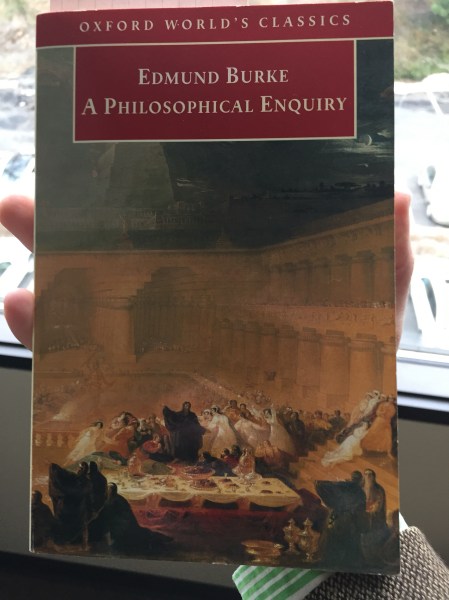
Somehow, while drifting over the philosophy shelves, my eye was caught by a faded Oxford edition whose spine had the inadequate title A Philosophical Inquiry. I picked it up because I figured this had to be an eighteenth or early nineteenth century something or other. Well, you can obviously tell what it turned out to be.

I have a little selection of random Burkean stuff (letters, speeches, essays, and excerpts), but have long been curious about this early and atypical seeming work. I know that he published it as a sort of offering to provide him entry into London’s literary and intellectual society.

I’m simultaneously making my very slow way through the work that Adam Smith considered his magnum opus and lasting claim to fame. Hint: it’s not Wealth of Nations.

Ok, it’s his Theory of Moral Sentiments.

While, having not finished it, I should probably not make too many claims for my understanding of it, but the idea seems to be a combination of a sort of innate (biological? evolutionary?) a priori moral sense that is defined in relation to others, in a natural tendency to seek the moral approbation of others and follow a sort of moral peer pressure.

While not the most interesting bit of Burke’s book, his idea of ‘taste’ strikes me as downright Smithian (Smithite?). In some senses, beauty and appreciation of the aesthetic good is innate, but it is also guided by educated taste makers who help develop a sort of cultural peer pressure, similar to the broader peer pressure Smith seems to stipulate and motivating moral behavior (or moral sentiments, as he would put it in his classic, eighteenth century fashion).

His answer as to the origins of the sublime are surprisingly psychological. The sublime comes from negative emotions. Even though we usually experience the sublime in something beautiful, the source of its sublimity is not its beauty, per se, but it’s connections to pain and fear.

One example is charging bull. A bull quietly chewing cud is not sublime. A bull hitched to a plow and helping till a field is useful, but not sublime. An angry bull charging at you can be sublime, however, because you can be struck by its size (reminding you of your own smallness in the universe) and ferocity and the fear inspired can be sublime.

Part of this is because pain is greater than pleasure, illustrated, he argues by the fact that we will do more to avoid pain than we will the achieve pleasure, which is also why he believe that the sublime must have its origins in pain.

For some reason, this little bit struck me. An example of how the painful end of the spectrum lends itself to the sublime. Also, what an absolutely amazing depiction of Stonehenge. Alone, that passage is worth the price of admission (‘Nay, the rudeness of the work increases this cause of grandeur, as it excludes the idea of art, and contrivance;’).

IMG_5725

The word ‘aweful’ appears, a reminder of the actual root of ‘awful,’ which has been reduced from causing a terrible awe to a rather minor nastiness.

At times, Burke seems to take a sort of sadistic glee in the ‘painful’ origins of the sublime, which also helps, stylistically speaking, to compensate for his tendency to engage in something very close to an eighteenth century equivalent to listicles (there are a lot of very short sections, like the one pictured, that can get very repetitive and which do not all seem to add very much to the topic).

At one point, he rather succinctly sums up one of his important premises: For sublime objects are vast in their dimensions, beautiful ones comparatively small…

The association with ‘vastness,’ is really, I would say, an association with (terror or awe inducing) infinite (he uses the term ‘artificial infinite’ to capture this idea), whereas he views beauty as small and precious (in both senses of the word). Because the more powerful sublime has its… not origins, but, to use a term Burke himself uses to describe it, its foundations in pain and fear. Beauty, meanwhile, has its less powerful foundations in pleasure and positive emotions.

He ends with about a dozen pages on words, including poetry. By words, he means a bit of linguistic theory and classical rhetoric. It’s all interesting enough, but he never really explains what it has to do with the sublime nor with the beautiful.

If I can find it, I need to find that old selection of Burke’s writings and try and look for parallels. While I’m sure that this is an outlier in terms of his output – he was a politician and orator, not a philosopher – surely there must be hints of some of his ideas and prejudices underlying his other writings and positions.
 

Power & Pathos & Trios


Next weekend, I’ll start working for my better half for the foreseeable future, which made using Sunday well more than usually important. At the National Gallery of Art, an exhibit called Power and Pathos: Bronze Sculpture of the Hellenistic World was going to be winding down and having blithely ignored numerous opportunities to see it, today (or, rather, that day) needed to be the day.

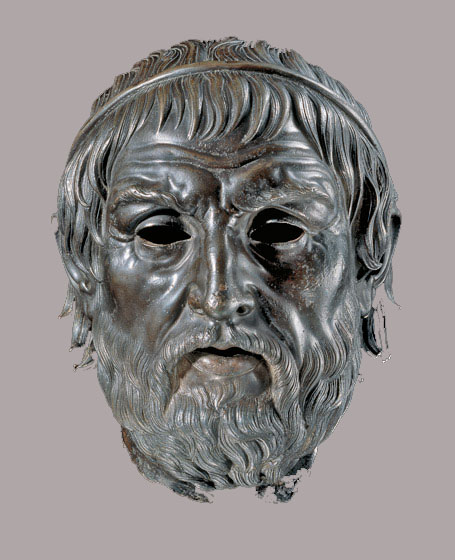
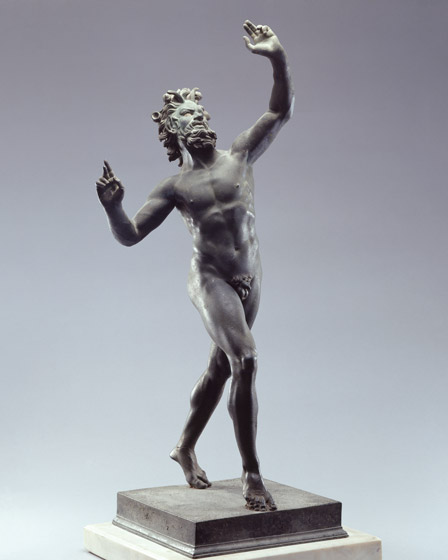
00309897001_HI’m sorry, but I was disappointed. There were some wonderful pieces (a weary Herakles leaning on his club and the head of a poet), but only one that was truly powerful (a statue of the god Pan) and more than a few ‘meh’ pieces and, certainly, I didn’t feel much power nor pathos (besides alliteration, what was the ‘pathos’ supposed to be?).

You still try to get a nugget of something interesting from any exhibit and for me, that was the head of a poet. It was labelled a poet because his hair was longish and his beard full and those were the signs of a poet. philosopher, or intellectual (and, in the late ancient world covered by this period, an intellectual would frequently also be a philosopher and poet; there wasn’t so much parsingDancing-Faun of the difference back then). The idea was that they were less influenced by vanities, so let their hairs grow out. So, the idea of the shaggy poet or thinker wasn’t an invention of Parisian bohemians, nor Greenwich Village poets, nor any other group from the last two thousand years, but dates all the way back to ancient Greece.

After finishing the exhibit, I kept wandering around the museum, stopping in some galleries to look at some nineteenth century landscapes. I walked towards one of the atriums when a woman walked in front of me, handed me a program and asked me if I was here for the concert.

Naturally, I said, yes.

Apparently, the National Gallery of Art had spent the previous two days doing several concerts a day in order to complete a cycle, as it were, of Beethoven’s trios. This particular concert would be his final string trios (which were actually early works; he moved on to string quartets after composing these).

The first one was a string trio in G Major and the players ended the trio so abruptly that we (the audience) was stunned into sudden and sustained applause. It was a very odd moment, as if a long silence had been ended by an invisible man suddenly clapping in our ear. We kept to our feet not because the performance was good (though it was), but because shock impelled us.

The second trio, in D Major, had a menuetto as its penultimate movement and I just loved it. Beethoven should have done more dances.

The third, in his famed C Minor key, was surprisingly upbeat for a chamber piece in a minor key.

The acoustics felt good, which is not always the case in there. The sound was clear and very, very bright, with the inevitable echo being an inconsequential factor.

Just an awesome coincidence that I walked in on it.

‘Split’ By Cathy Linh Che


SplitSomewhere I had read about this book and added it to my online wishlist on the Barnes and Noble website (which I use as a way to store books I want to read or feel I should read; sometimes I buy them from Barnes and Noble, sometimes from other bookstores, and sometimes I check them out from the library; this one, as I will specify in more detail momentarily, I bought at a Barnes and Noble). Traffic was bad the other day, due to horrible rain and the inability of many local drivers to drive in… weather.

Barnes and Noble seemed like a good place to kill an hour and wait for things to ease up. I looked at some lit mags, some sci fi, and, of course, the poetry section. And there I saw Che’s book. Honestly, I had never expected to randomly see it in a chain bookstore. Bridgestreet Books, maybe, but that’s it. But there it was.

Naturally, I bought it.

And I took it to the little cafe and ordered a snack and some herbal tea (I’m getting old, because I think that it’s not a good idea to drink caffeine in the evening; I miss the younger me, who drank coffee all night with his friends, talking politics, poetry, and philosophy).

Split blew me away. Heartbreaking (sexual abuse by a family member is a repeated subject, as well as other kinds of loss of innocence, including those from her parents’ status and immigrants and refugees; also, oddly, cameras – the mechanical nature of a physical camera – makes more than a few appearances) in it’s narratives and marvelously crafted. Tending towards short couplets and three line stanzas (triplets?) with some indentations to keep the reader on his/her toes, but also with prose and prose-like poems and other forms.

Here’s a little bit from Pomegranate:

In the Underworld
I starve a season
while the world wilts

into the ghost
of a summer backyard.
My hunger open and raw.

I had a little trouble picking something, because her poems are just a little too long to quote in their entirety and don’t lend themselves to excerptation.

Parades & Upshur Street Books


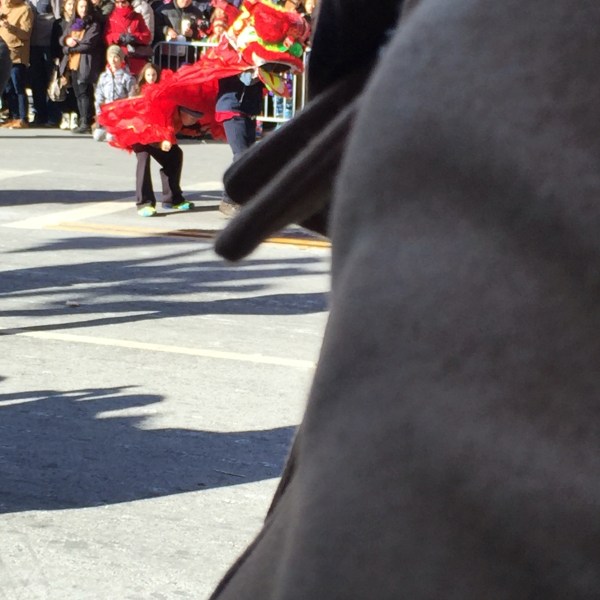
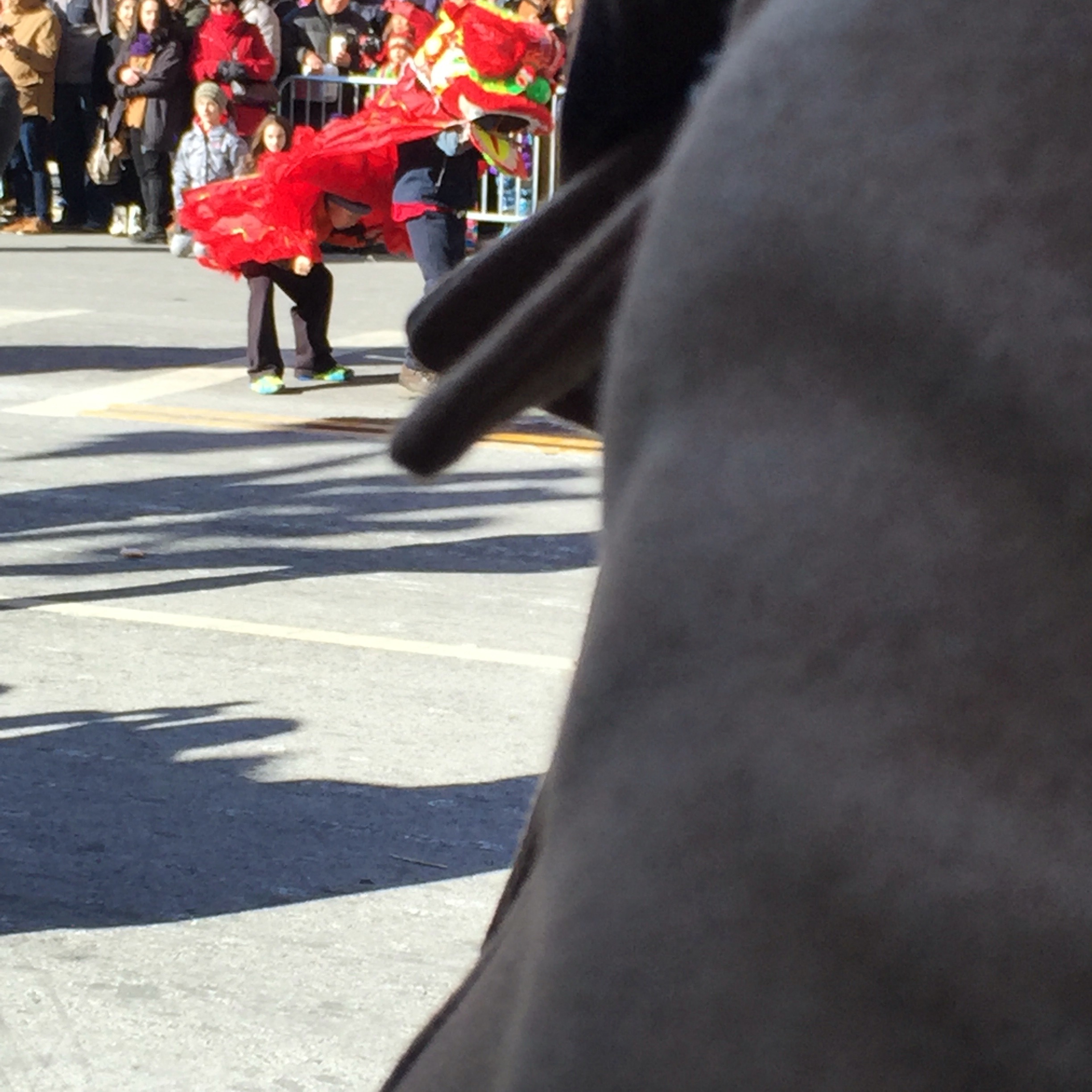
 Much of Valentine’s Day was spent in some solitary wanderings on crowded streets. My better half was away (the third year in a row we have spent February 14th apart, which, in a way, is not so bad, because, like New Year’s Eve, Valentine’s Day tends to pile on such overwhelming expectations of joy, romanticism, and impossibly good sex that it tends to crush the possibility of all three; that said, I’d rather she were with me, if I had my druthers), so I took a bus to Chinatown and carelessly browsed the Smithsonian Museum of American Art until it seemed a good time to find a spot on the street to watch the Chinese New Year (or Lunar New Year) Parade. Last year, I was on my own, I walked randomly about town and found my way to Chinatown and, unexpectedly, the parade. So I thought maybe I’d start to make it a tradition. Or not.

The parade itself contains a surprising number of white people and while I’m never exactly sure when these things cross the line from solidarity to appropriation, I suspect that that said line was, indeed, crossed. Whatever. I just watch it to see the little kids trying to manipulate dancing dragon costumes and props.

When the parade was over the subsequent parade of pols marching to the podium to speak was too much, even for me (in case you’re interested, Jack Evans was the straw that broke this camel’s back), I took a metro up to Petworth to make my first visit to Upshur Street Books.

It’s a nice little bookstore, but the selection is not very large, particularly the poetry shelves, which were few. Unusually for me, I did not buy anything. Something will, no doubt, bring me back, but it’s not going to be a regular thing.

I walked back (taking about an hour) and met a friend for a movie and then another friend and his wife for noodles.