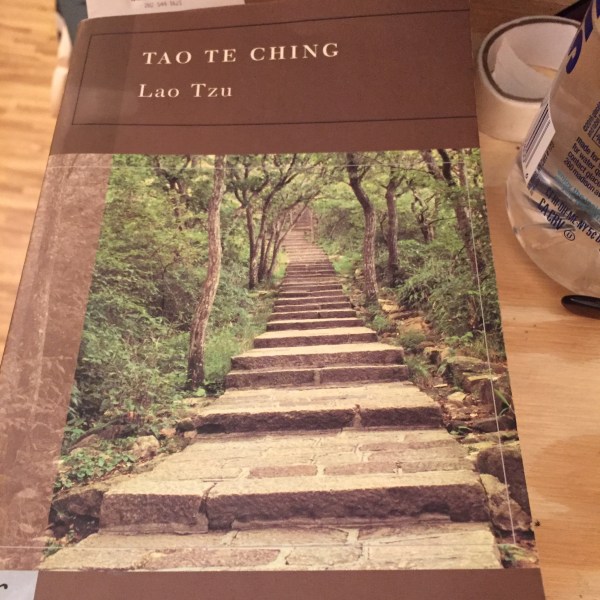
Tao Te Ching


To be totally honest, by the time I reached the last half, for reasons unrelated to Lao Tze’s wisdom, I just wasn’t in the mood to digest his guidance. I was more in a mood to be moody.

But a couple of times, I was still pulled up short by the Tao. A line about attacking by surprise during warfare that could have come from (or was cribbed by Sun Tzu). Recommendations on rulership that read like the subtext to Machiavelli’s true goals. And certainly, ‘sage’ is on my list of ideal jobs.

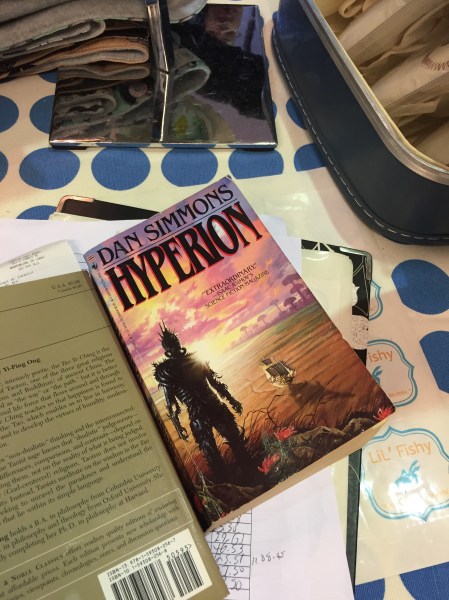
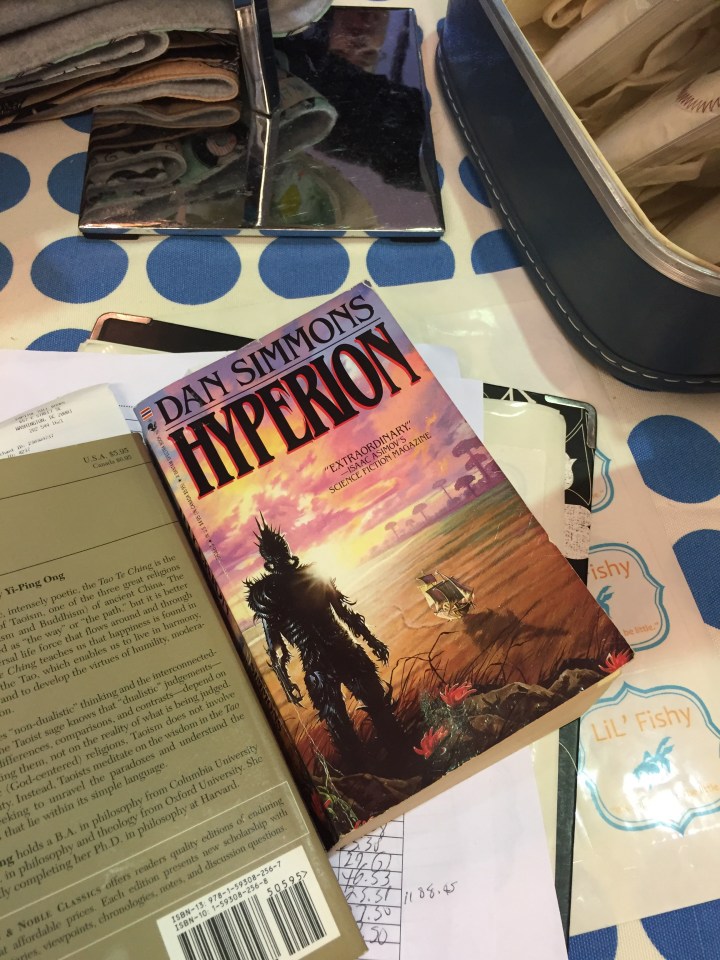
‘Hyperion’ By Dan Simmons


I swear that I didn’t know it was part of a series. I knew he wrote other books about the planet Hyperion, but I really thought this was a self-contained story. Feeling a little betrayed.

But it’s an excellent and intelligent space opera. Keats comes up a lot and he plays with Chaucer’s pilgrims (though much grimmer and with less sex and comedy).

The world is well realized (though it’s actually a vast universe) and the layers and multiplying plots are exciting rather than frustrating, overdone, or contrived. Really, if it didn’t require me to read a second book, I’d call it an unmitigated success.

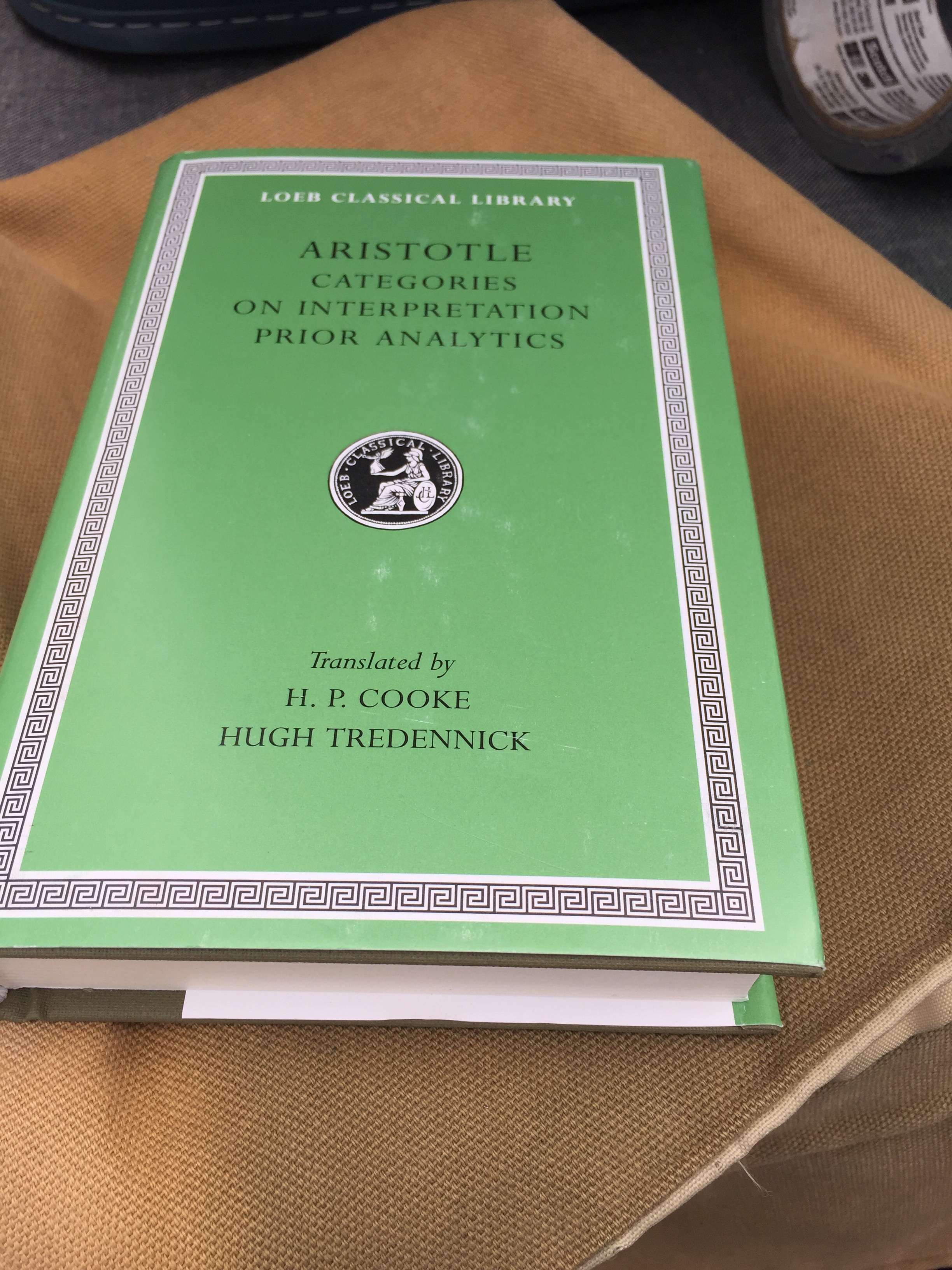
Aristotle’s ‘Categories’


Now that I finally have this book and am reading it (the volume also contains On Interpretation and Prior Analytics) I am consumed with the fear of forgetting. Having finished Categories in a careful and deliberative fashion, I still feel that I will move on to the next and remember almost nothing of what preceded it.

I minored in philosophy at college and still read it for pleasure, but while logic was my favorite branch at college, it is a right pain to read later in life, no matter how useful (and make no mistake; studying logic in college was incredibly useful; if you are in college, I highly encourage you to take a couple of logic courses, because it will give you a new and valuable perspective on things).

Alas, but I may still hope to retain something and the peripatetic master has forced me to consider the meaning of the things I say (though I wonder how many of his categories were inspired by ancient Greek’s declining nouns?).

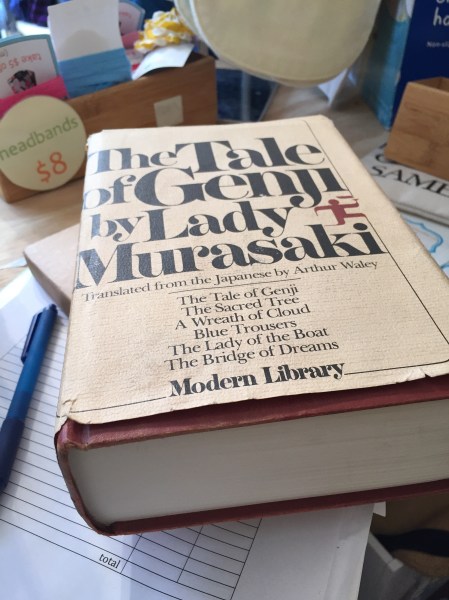
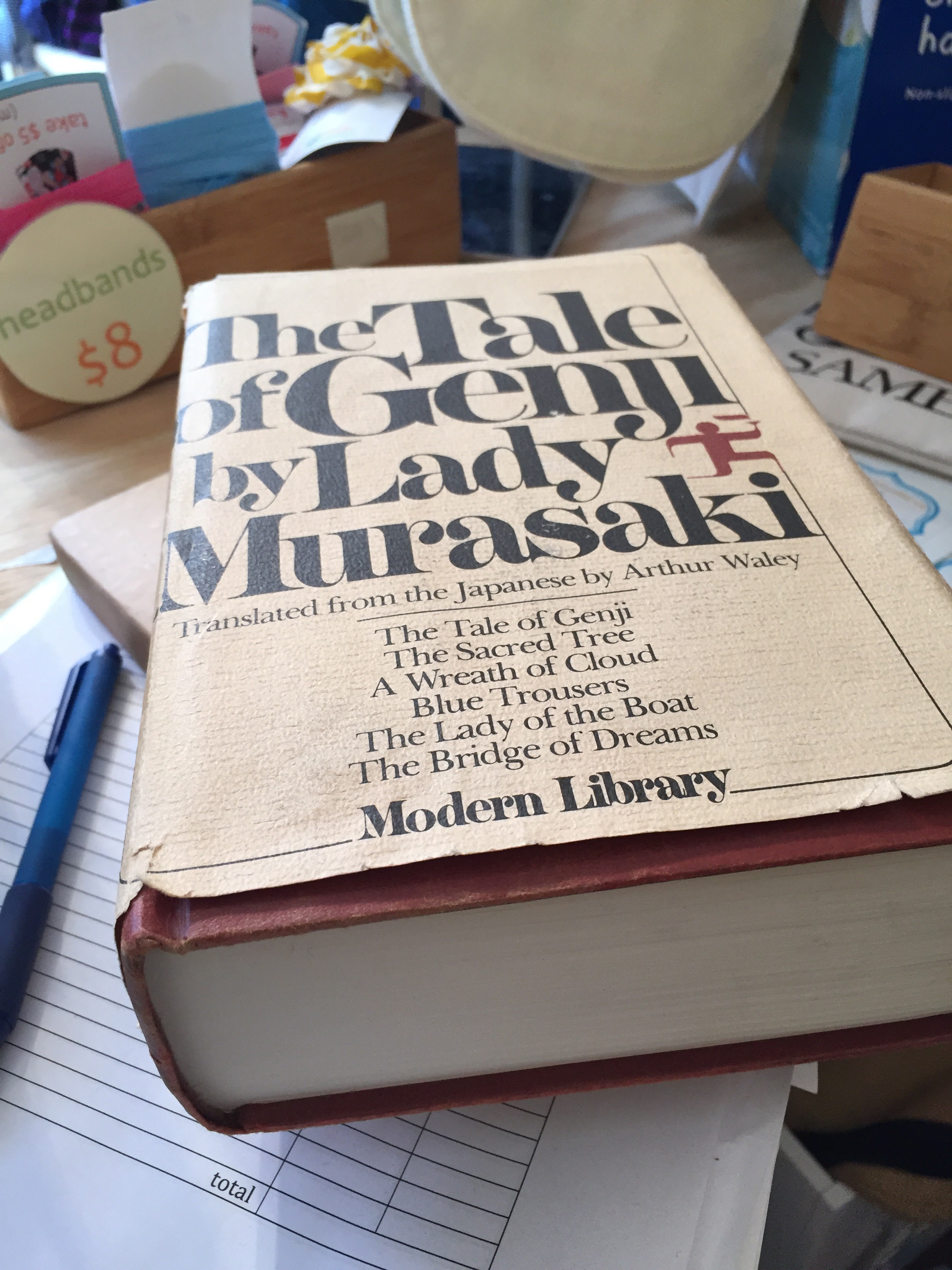
The Tale Of Genji


So technically, I haven’t finished the entire volume, merely the first of the five books that make up the Tale.

I don’t know when I first learned about Genji. Certainly, it’s been decades since I deciding I needed to read it. But I’m alittle disappointed. Is that odd? Not to say I’m not loving it, but it’s paling in comparison to other ‘great’ books (in both size and cultural cachet) I’ve read over the last few years.

Partly it’s that Genji himself is such a shallow cipher. While the narrator of Remembrance of Things Past is often the least interesting person in the room, he’s always, nonetheless, a figure of psychological interest, whereas Genji lacks most introspection. Or maybe I’m just jealous at how easily he seduces women?

When The World Spoke French


9781590173756This book is a collection of miniature biographies, focused on (mostly, though confusingly, not exclusively) non-French figures of the eighteenth century who were deeply influenced by eighteenth century French culture, most especially, the intellectual milieu of the French Enlightenment. The biographies themselves, naturally, focus on these figures’ intersections with French Enlightenment culture.

The book is deeply interesting and provides some lovely insight into well known figures (Frederick the Great of Prussia, Catherine the Great of Russia) and less well known persons (Abbe Galliani).

I did get very irritated around the half way point as the author started dropping the name Grimm. I assumed that it wasn’t one of the famed Brothers Grimm, but it would have been really cool to at least include a first name. At around the three quarter mark, we finally get a bio of Friedrich Melchior Grimm, editor of a famed journal of the Enlightenment, but only after I’ve been made to feel ignorant for not knowing ‘Grimm’ since birth. Similarly, a reference to the Enlightenment loving crowned heads included a list, among whom was Stanislaw. Stanislaw who, you ask? Well, the very last bio is of Stanislaw Augustus II of Poland.

But I shouldn’t gripe. It’s not a perfect book, but it’s a lovely, winding journey through drawing rooms and salons, highlighted by excerpts from letters, of a wonderfully fecund time in European intellectual history.

Offices


The finish to Cicero’s Offices (or On Duties or De Oficiis) was both apropos and unsettling. The book is a missive to his son and most of it is ethical philosophy as light reading. Not to denigrate it! Part of the reason it is light reading, is that Cicero is known as an excellent Latin stylist and while my translation is little old fashioned, it keeps the clearness. But also because Cicero is not Kant and this is not a technical treatise. Yes, he talks about stoicism and he mentions his own school (the sceptics or Academicians) and notes that his son has chosen to study under a peripatetic (which is to say, an Aristotlean) philosopher. But this is a practical guidebook.

Or, at least, that’s how it begins… and actually, that’s how most of it goes.

But his bitterness over his fall (precipitated by his opposition to Julius Caesar’s power grabs; Cicero was not a democratic soul, but believed deeply in the Roman Republic and its institutions) takes over and it’s hard not to read the last twenty pages or so as a pointed attack on the people and institutions he sees as having failed the Republic and contributed to its decline and downfall.

Which might seem appropriate for the times, right? Like most Americans, I voted against Trump, and have, even before he has taken office, been found right in my opposition as he rather publicly dismantles our democratic norms (en route to dismantling our democratic institutions?). But Lord knows that I need a break. I didn’t pick up a two thousand year old book for insight into the current predicament affecting my country. I wanted a bit o’ ancient wisdom and a good read.

Contemporary Literary Fiction


I just finished reading The Art Forger by B.A. Shapiro. Besides being one of only two books I read on my phone (I feel like a South Korean teenager, only middle aged, white, and unable to learn foreign languages), it is also one of two books of contemporary fiction of a sort that we might call ‘literary fiction,’ for lack of a better term.

And I’m wondering if we don’t need a better term. Because how good are they? How good are 99% of the contemporary novels that are classified as being literary?

The Art Forger is good. The ending is a little too pat and neatly tied up, but it’s a nice slice of a part of the art world (kudos for placing it in Boston and not New York) with nice touches to it. But the best bit was the back and forth between ‘now’ and epistolary sections from the late nineteenth century… but if that’s what I really want, why not read the much superior Possession by A.S. Byatt for a second time?

I also reread James Lasdun’s The Horned Man and, while still a brisk and disturbing read, plunges too quickly into its rabbit hole to achieve the effect is truly desires.

And I’m just thinking, how good is all of it? Folks like Byatt or Toni Morrison or Orhan Pamuk aside… is it really good?

I’m Back, I’m Not Back


I’ve been away, first thinking only about the election and then contemplating the aftermath.

It’s not a happy aftermath. My wife is an immigrant and a person of color. I have low income family members who depend on Obamacare. All reasons to fear for the well being of people I love.

So, in what do we take solace?

I’ve been reading Cicero’s De Officiis in a lovely little miniature hardback edition. I love those books, on a tactile level, like the original Modern Library editions from the teens, twenties and thirties. This isn’t one of those, but the same principle. Also, just reading a literate account of how to be decent person in society. While some is specific to the society of the late Republican/early Imperial Rome, most is not. And in a post-Trump world, it seems both relevant and terribly sad. But perhaps Cicero, who wrote this after being forced into a sort of exile for his support for the norms of the Republic would relate. Though I still don’t see this as the end of democracy in America. A touch of class, too, in Cicero. Not that kind of class (though he’s very classy), but socio-economic class. And jealousy. On my part. Cicero can retire to his villa, send his son to study abroad (he’s learning from a Greek philosopher in Athens), and spend his days writing awesome things like De Officiis.

I was in my study the other day. Actually, if I’m being honest, I was video chatting my way through a Dungeons & Dragons game (thankfully, we’re meeting in person next week; sometimes, technology is a hindrance to play, a statement that you should take several ways). While waiting for technology to right itself or else during lulls in the action, I found my eyes wandering around to all my books. Honestly, I’ve got some pretty awesome books.

Among them, James Lasdun’s The Horned Man, I book that I read many years and deeply enjoyed and I felt compelled to reread upon seeing it on my shelf. Like Cicero, maybe I’m looking for parallels. In this case, an unreliable narrator who quickly constructs a strange and inexplicable conspiracy. So how does this relate? Trump, the unreliable narrator spinning his improbable narratives? Me, trapped in a world created by people who see conspiracies in the quotidià of modern life? Or am I the narrator, feeling a strange noose tighten for reasons I can’t understand (bear to understand?)?

Wordworth’s The Prelude which is one of the highlights of western civilization, but which, thankfully, has nothing to with Trump. Or does it? I just called it one of the highlights of western civilization and doesn’t that relate to Trump making his closest presidential adviser a man tied to a racist, separatist, apartheidist, ethno-european nationalist movement? That doesn’t make Wordsworth particularly racist (though I’m sure he was, being a man of his erea), but am I merely taking a more highbrow kind of comfort in the same white mythologies as Trump’s supporters?

I picked up Kenneth Rexroth and Ikoko Atsumi’s translated text, Women Poets of Japan and found myself less enthralled than I remember. While waiting in line to vote, I was reading The Book Genji and the titular Prince Genji and the beau monde in which moved frequently communicated via poems, but a quick, returning glance at that once favored collection of Japanese poetry left me itchy for something else. If that something else was a white, male poet (Wordsworth), does it make my reaction more fraught?


Chessmen Of Mars


book-chessmenofmarsI’ll admit, I’ve been reading free copies of these novels on my Nook, but I think that Chessmen of Mars is the last of Edgar Rice Burroughs’ Mars (or Barsoom) novels that’s in the public domain and while I’m sure it’s possible to find a free copy anyway, it’s a moral point no to, though that seems shallow, since I took advantage to read the others for free, isn’t it? But let’s not make the perfect be the enemy of the good, now shall we?

Like many of his novels set on the dying planet of Barsoom (known to us, as Mars), Chessmen feels like two long, connected short stories. The daughter of John Carter and Dejah Thoris runs away and her airship crashes among yet another previously unknown subset of Martians, the kaldane and their rykor… well, it’s complicated. The kaldane are oversized human heads that walk on little  spiders and who mount themselves on headless human bodies called rykor, seize hold of the spinal column, and use them as their bodies. Burroughs doesn’t have Lovecraft nor Carter’s feel for imparting the horror felt by a character, but he does a decent job of showing how horrified the princess is (and her lovesick rescuer who is, naturally, also a fierce and chivalrous warrior).

When the two more or less human protagonists escape (along with their new friend, one of the walking heads and his stolen rykor), they wind up in a sort of lost and primitive kingdom where a game similar to chess is played, only with… well, you can guess. Yes, the pieces are actually people, fighting on a giant board.

Will Tara of Heliun and Gahan of Gathol escape? Will they find true love together? Will the villainous king (or jeddak) be replaced by his much nicer and braver vassal? Will there be an addendum explaining the (non-fatal) rules of Martian chess?

Well, um, yeah.

‘Invasion Of The Tearling’ By Erika Johansen


9780062290410Maybe not as good as the first book in the trilogy, but still very good. The world building is nicely realized and it’s both good and important that it’s a book with a female protagonist that was written by a female author. It shouldn’t be, but I hope we can all agree that full gender equality hasn’t been reached yet, so anything that breaks up the boys club is positive.

The other week, I was visiting my new grandniece (yes, I’m old; I can already feel the icy hand of death clutching at my still, but barely beating heart; I can only pray that when the reaper comes for me, he finds wearing nothing but a pair of ruby encrusted spurs and listening to Jefferson Airplane’s classic album, Surrealistic Pillow), and my nephew-in-law showed me one of the books the infant had been given. It was an ABCs of famous American women and ‘U’ was for Ursula K. Le Guin. I explained that she was a famous and great feminist writer, best (though not exclusively) known for writing very thoughtful fantasy and science fiction.

That has nothing to do with The Invasion of the Tearling, but feminism in the genre had been on mind and that’s why.

We are in a fantasy world, with an invasion and a young queen, but the most interesting part are visions/flashbacks to how people from ‘our’ world wound up in this fantasy landscape. There’s a messianic revolutionary named William Tear and a world of corporate control created by a former president – a far right ideologue. It’s tempting to read Donald Trump into him, but he’s actually more of a Reagan-era figure. More Christian right than meandering, narcissistic fascism. The revolutionary movement grew out of the Occupy movement and it does feel real enough, but the Calvinistic, ‘chosen ones’ nature of the people who will escape to the new world (better world, they call it) is disquieting. There’s a single mention that they are not actually moving in place, but in time (to the future? the past?).

Our heroine fends off the evil queen (actually, she gets a three year truce), but quite clearly releases some more horrible evil into the world, so there’s that. I’ll check the library to see if they have the third book available.