
This is a farm in Thailand after terrible floods that weren’t covered in American news.




This is a farm in Thailand after terrible floods that weren’t covered in American news.
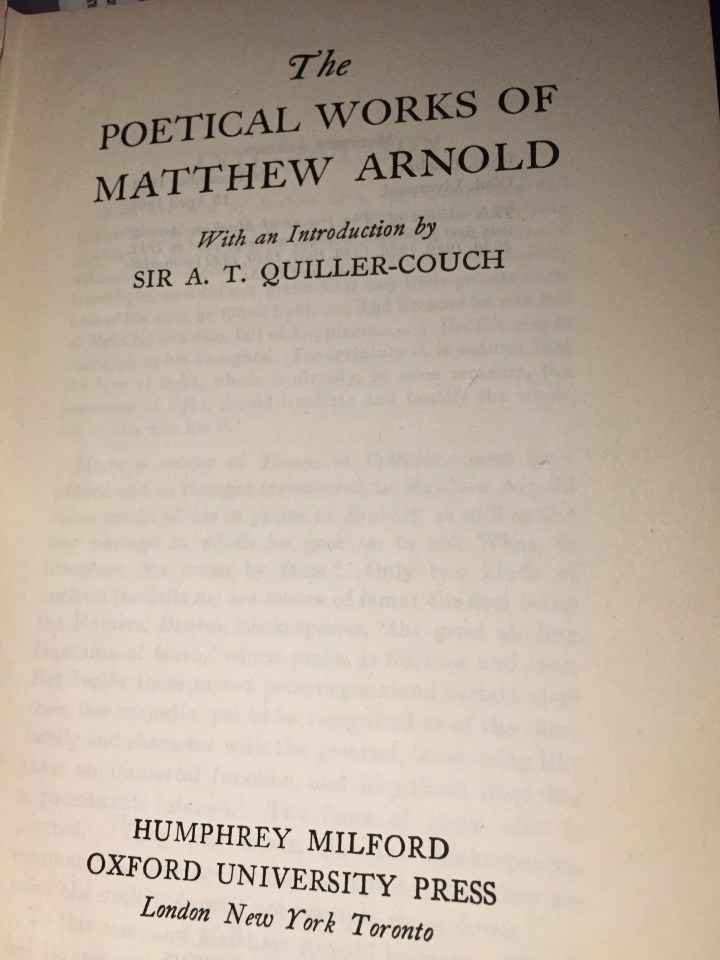 I’m going to admit that I am liking Matthew Arnold’s poetry better than I would have thought. I still have no desire to go back and re-read Dover Beach again, ever, for any reason, but if you’re willing to adjust yourself to the rhythms of nineteenth century verse (and Arnold, a traditionalist), then you can definitely enjoy him.
Empedocles on Etna, especially, I enjoyed.
While I won’t question Arnold’s knowledge of the classics, you still shouldn’t read him for a detailed and accurate understanding of Empedocles’ philosophy.
But, the worried friend (Pausanias) and the musician-cum-pastoral poet, Callicles following the melancholy Empedocles on part of his journey makes for a nice philosophical narrative.
Even after the suicidal Empedocles asks for quiet, he can still hear snatches of Callicles’ carefree poetry and music as he contemplates his own theories and the lack of job in his life. Arnold makes the philosopher’s decision a little bit political (exile having made him depressed), though he shifts back to the idea of someone maybe too smart for his own happiness (one can imagine Arnold thinking there’s a little Empedocles in himself, too).
If you like poetry, if you have immersed yourself in poetry, so that the style of Matthew Arnold isn’t foreign or anathema to you, you might enjoy it, too.
No, thou art come too late, Empedocles!
And the world hath the day, and must break thee,
Not thou the world. With men thou canst not live,
Their thoughts, their ways, their wishes, are not thine;
And being lonely thou art miserable,
For something has impair’d thy spirit’s strength,
And dried its self-sufficing fount of joy.
Thou canst not live with men nor with thyself—
Oh sage! oh sage!—Take then the one way left;
And turn thee to the elements, thy friends,
Thy well-tried friends, thy willing ministers,
And say:—Ye servants, hear Empedocles,
Who asks this final service at your hands!
Before the sophist brood hath overlaid
The last spark of man’s consciousness with words—
Ere quite the being of man, ere quite the world
Be disarray’d of their divinity—
Before the soul lose all her solemn joys,
And awe be dead, and hope impossible,
And the soul’s deep eternal night come on,
Receive me, hide me, quench me, take me home!
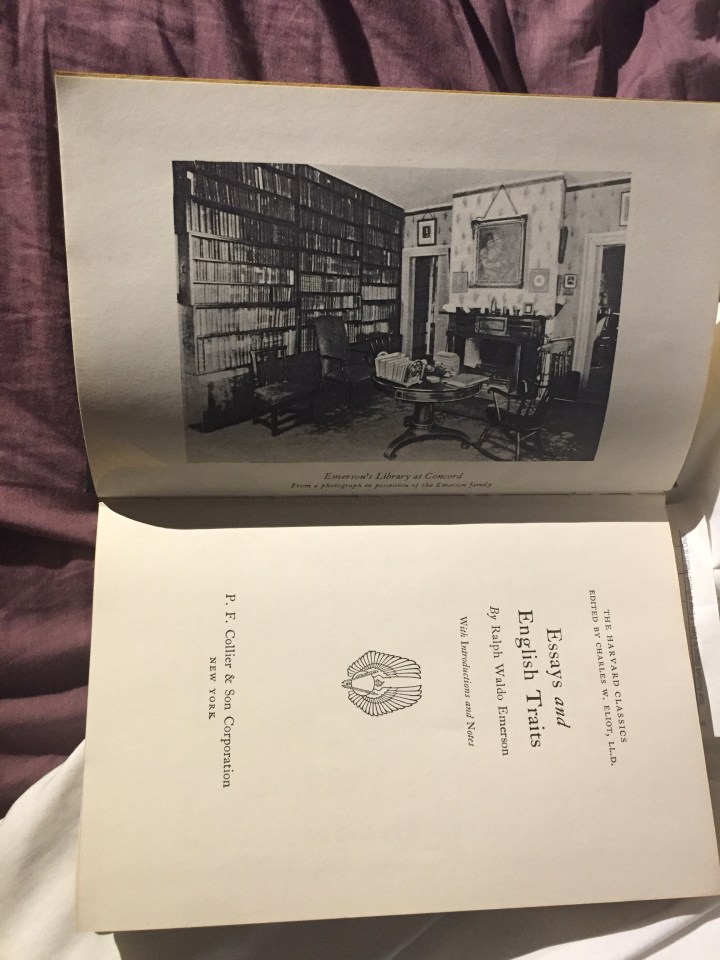 I am reading two volumes of Emerson’s writings. One is a luxurious, leather bound collection of his essays and lectures. The other is a marvelous little cloth bound book of the sort that were common in the early twentieth century (this one was published by T.Y. Crowell & Co, but is similar to the Modern Library or Everyman editions you might find of more or less classic or otherwise edifying works), containing his early poems. Read more
 While a respected public intellectual in his day (the early twentieth century), he’s certainly not someone anyone would recognize today as being a top tier epistemologist, metaphysician, nor thinker. Which would probably come as a surprise to Mr. Philip, who clearly felt that he had hit upon some excellent truths, whose veracity was easy to see once he’d made his thinly supported assertions clear.
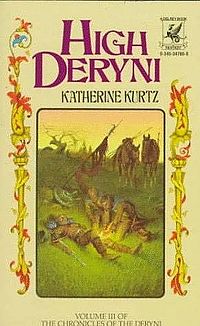 I had to read this via ebook. Not only did the library not have a hard copy, I couldn’t find hard copies on the Barnes & Noble website.
I don’t mind reading via ebook. I do it a lot. When I fly to Thailand next month, you can bet I’m bringing my nook e-reader.
But I remember browsing the genre shelves at B. Dalton and Waldenbooks and the books in this series were ever present. It feels strange that people don’t read them anymore, at least not like they used to. They have, I supposed, been supplanted by newer authors. People don’t listen as much to Suzanne Vega, the Pixies, and My Life with the Thrill Kill Kult anymore, either. Times change. People get older and the newer people feel much younger. The way of the world.
Neither here nor there.
The series has been growing on me. There are two more trilogies; one that follows and one that takes place long before the events of High Deryni. Will I read them? Maybe. I’m more likely to than I was when I finished the first book.
But even as the books win me over, they also always disappoint me. The ending is an anticlimactic deus ex machina that makes a decent portion of the final fifty pages seem pointless. And while fantasy can often be criticized for its portrayals (or lack thereof) of women, I would have hoped that a woman writer could have given us one strong and well-developed female character, but no. And the one romance is SO sentimental and cheesy. Ugh.

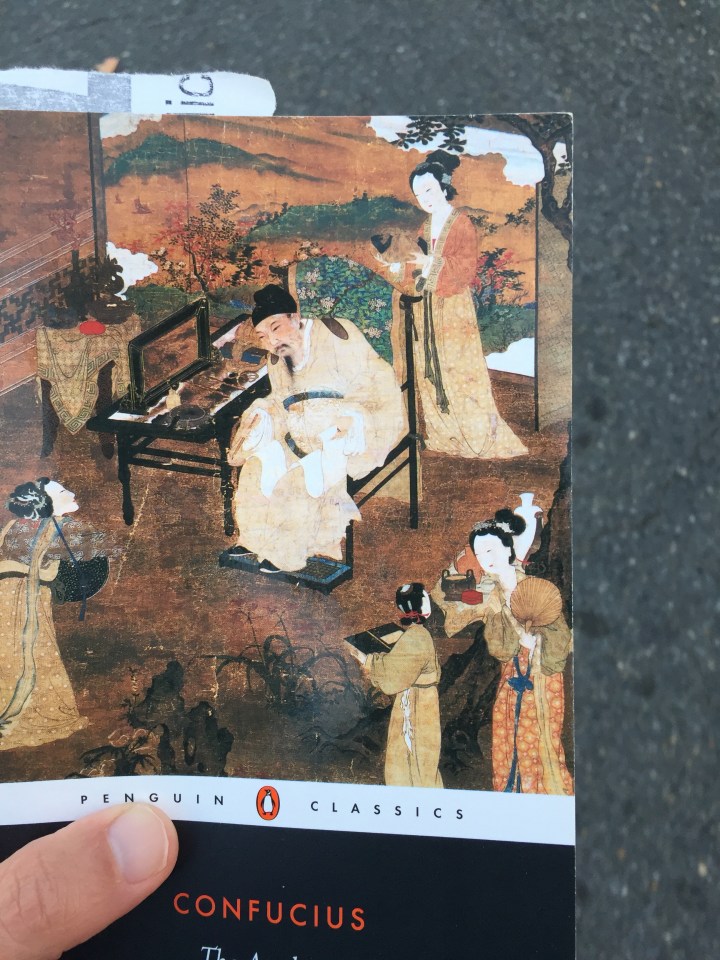
I had started to jot down some pithy phrase from The Analects: not the one in the picture, but something about a scholar or reader not being inflexible. It felt like a retort to Trump World.
But surely the point of the teachings of Confucius is not that he can be reduced to isolated lines and momentarily useful quotations?
If he is a philosopher, there must be more than that and to settle for solitary fragments is to fall into a pernicious orientalism (taking yoga instruction from a twenty-something white girl while musing over some fortune cookie version of ‘Buddha said’).
So what is it, then?
Having read a biography (of sorts) of Confucius and a primer on Chinese philosophy within the last year (I think), I feel I have a small leg up, but not much.
Little things matter.
But that’s also an orientalizing version of it.
More detailed, then. The emphasis on rites and quotidian duties and courtesies adds up into a worldview, if enacted in one’s life. Rites are also important, even when viewed separately from god and religion (which is precisely how he writes about them – as almost entirely separate from their mytho-religious context).
It is also an elitist philosophy. Like Plato or Nietzsche, he is not writing for anybody, but for a superman or a philosopher king. Even when poor, the man to whom Confucius is addressing (it could now be a woman, equally as well as man; but at the time, I think we can be reasonably sure that he was talking to men) is above the ‘masses.’ You could also think of him as being like the target audience of Roman philosophers.
But is this philosophy, in my sense? In a western sense? Is that even a valid question?
He instructs people to lead by example, especially in the small things. But what about larger issues? It is no criticism not to have a metaphysics, nor even to say that metaphysics doesn’t matter and maybe doesn’t even exist. His ideal society is guided by a meritocratic elite, though still ruled by more or less hereditary aristocracies.
When is is most explicit, which isn’t often, he speak of Confuciansim (though not, of course, using that term) as a moral philosophy, but I hesitate to classify it as ethics. It is ethical philosophy in the service of a more or less utopian political philosophy.
Someone at my work died. Unexpectedly. She was younger than me, I told someone. But I know that. I know that I thought that she looked younger than me, but I didn’t know her at all. She’d worked at my office before. Maybe it was before I came here. Maybe it was only for a short time when I first started here and I just don’t remember her.
This doesn’t make me a bad person, a colleague pointed out. It doesn’t make me anything except uninterested or inattentive.
I have been thinking about religious matters. Both about my own faith (and my poor keeping of the basic minimum expected of me from it) and about the Buddhist faith. I have been reading a little about it and have gone to a Wat Thai (a Thai Buddhist temple; they are Theravāda, if you’re interested, but with a lot of syncretic features from Hinduism and a powerful monastic tradition that is intertwined with the government) twice in recent weeks and contemplating what it would mean if my child chose Buddhism over my Catholicism.
But we’ve gotten far away from the person who died, haven’t we. Not ‘we.’ Me.
My religious point was my failure to be attentive in my compassion. I know what she looked like. I remember that, like me, she was a bit in her own world when the building’s fire alarm drove us all outside. I remember that I only pieced together by deduction that she was the same person as the email address in the ‘all staff’ list. I had to ask if she was married. If she had children. I still don’t know how she died. A human being grew up, lived, and then died early and unexpectedly and though I was in a position to know her, I did not and the fact that I did not was, in the end, a choice.
 In truth, it’s not fair to say this is by Ta-Nehisi Coates, since so much more than the writing goes into a comic book: the colorist, the penciller, the inker, etc. But we should be honest: we are reading this because his name is attached.
I haven’t been reading much in the way of comics lately, but ever since I heard that The Atlantic essayist was going to be writing for the Black Panther, I wanted to read it. And when I saw some comics in my local library, I figured I put volume one on hold.
Now here we are.
Leaving aside difficulty one: I haven’t read the arcs and stories that came more or less immediately before, so I really don’t understand what’s going on. But you just have to suck it up, honestly. Comics were around before you started reading them. They’ll be around after you’ve stopped. Just dive in and hope for the best.
So far, it doesn’t quite work. But I really want it to. Questions of power. Implied questions regarding a monarchy existing simultaneously in a liberal society. Gender. The inability to act or know what’s right.
But not enough threads come together. The dialogue can be a little over baked and too arch by half. Too talky and not well paced. And outside of the writing, the action sequences rarely popped.
Maybe I should have just gone for one his (non comic) books instead?
A surprisingly amusing primer on the Stoics by a man about whom little appears to be known (check out this page about trying to learn about him).
It is not in the least part amusing because Stock appears be slightly contemptuous of Stoicism. He speaks of it as a Tory might speak about the Labour platform. Which isn’t a bad metaphor because it is similar to his excellent metaphor on the schools of classical philosophy in the centuries after Plato. Classical philosophy generally accreted into four schools: the Peripatetics (after Aristotle); the Academicians or Skeptics (after Plato’s Academy, but not after Plato’s thought, generally); the Stoics; and the Epicureans. You had your Cyrenaics and your Pythagoreans, but that list of four is pretty good short hand, at least by the time of Cicero. Anyway, the point Stock makes is that adopting a philosophy was less like staking a philosophical position in a modern sense, than it was like becoming a political party activist. One rarely switches parties and one’s loyalty to a particular school of philosophy is expected to be surprisingly absolute (you can almost hear the tears falling when Cicero writes his son, who has not taken up his father’s Skepticism, but has chosen to study with the Peripatetics in Athens, and asks that he still think kindly on his old man’s philosophical convictions).
He also spends some time on Stoic logic. There’s not much there, in terms of primary sources, but in the ancient world, the Stoics were renowned logicians. Arguably that, and not the self-help koans that is all most people know today, was the claim to fame if we go back a couple of millennia.
When discussing their ‘Physic,’ he name drops Empedocles, which is only interesting to me because I just read Matthew Arnold’s long poem, Empedocles at Etna, about that Greek’s sad and somewhat embarrassing suicide in the volcano.
But again, he is pleasantly less interested in what today would be called a stoic attitude than in the actual positions of the school, which covered far more than a bit of imperturbability.
The Smithsonian Museum of Asian Art, also know as the Freer/Sackler, is one of my favorite museums. Not only is it directly by the Smithsonian metro station, but it is less crowded than many other museums on the National Mall and has some of the best spots for quiet contemplation you are likely to find.
After almost two years closed for renovations, the galleries are finally open. The grand celebration was called Illuminasia. Lots of cool stuff for the kids and some lovely music and some frustratingly long lines for food (the bao was excellent, but not worth the thirty minute wait).
There’s a nice exhibit on cats in ancient Egypt and a genuinely inspiring exhibit called ‘Encountering the Buddha’ that I can’t wait to see again.
 the coffee philosopher