#Instapoets


I have picked up copies of books by Rupi Kaur and Lang Leav and leafed through them. Like the alliteration of ‘Lang Leave and leafed,’ I am not convinced by their quality. Actually, I’m pretty convinced of their quality and don’t think they have much. I have seen, in magazine articles, screen shots of work by other ‘instapoets’ and it has made me think that the genre as a whole is pretty lacking.

I also don’t have much affection for slam poetry. If we are ranking these things, slam poetry ranks orders of magnitude above instapoetry in my estimation.

Me? I learn and comprehend best through interaction with the written word. I like to read, is what I’m saying. More than that, reading is how I engage in dialogue with the world around me.

So neither forms are really aimed at folks like me.

And I really don’t know what to say nor what to add to the current kerfuffle over instapoets and, to a lesser extent (mostly because of this article, which singled out a particular, recently published in book form, slam poet), slam poets. It’s not the first kerfuffle and it won’t be the last. Or, more likely, it’s all the same kerfuffle, which has been going on for a couple of years, at least.

But my two cents. It’s not good poetry. I haven’t read deeply into the genre, but I feel like I’m on pretty solid ground. Both in terms of my critical evaluation of what I have read and as regards the follow up question as to whether I’ve read enough to form a valid opinion.

But… I’m glad poetry is selling. I didn’t think the poetry collection by the singer, Jewel, was very good either (though, of course, I listened to her first  album constantly in the mid-nineties and nursed a mild crush on her in my early twenties). But I believe that having read one poem, people may read another. Having bought one book, they may buy another.

Also, though we may feel resentful that someone has achieved success with what we believe to be pretty shoddy work, most of these folks are in their twenties and I think we must forgive people their awful youthful poetry, even if it does get published, sell in the millions, and make them rich. And we should try not to be too bitter about it.


Six Four


The novel was mostly better than I expected and then worse than I had expected.

I don’t read many mysteries, but I know enough that this was not your typical police procedural – to its benefit. Mikami is a former detective; former because he was transferred to media relations and made the department’s director.

The tension comes from the protagonist seeming to discover a conspiracy to cover up police misconduct during the investigation of a now fourteen year old kidnapping case (internally nicknamed ‘Six Four’).

When that is revealed, the author keeps up the tension, but something slips. It’s not clear what the endgame is nor what Mikami will actually have to do with it. And, in the end, the resolution seems to have little to do with him.

Six Four got a good bit of favorable coverage in the press and after reading another Japanese mystery some time ago, I decided to give this one a try. This one is more a psychological tale and the differences between American and Japanese norms both more and less visible. Perhaps the ‘more’ has to do with with I found unsatisfying about the last hundred pages or so.

That all being said, if you read a lot of mysteries, chances are, Six Four is better than ninety percent of what you’ve been perusing.


Happy Burns Night


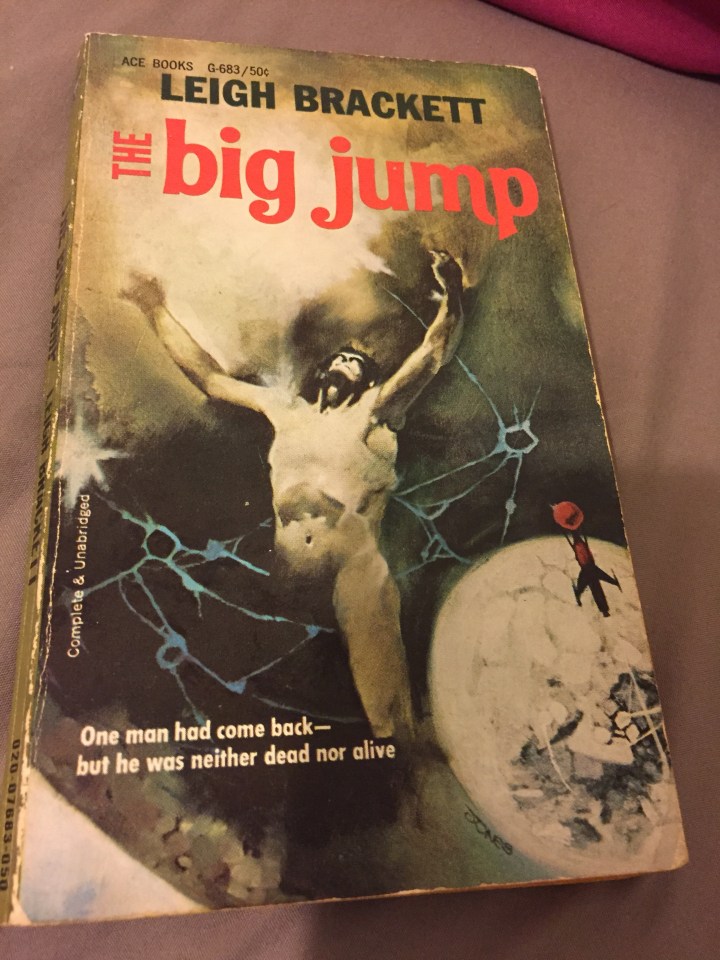
‘The Big Jump’ By Leigh Brackett


Leigh Brackett is one of the great pulp science fiction writers of the twentieth century. While definitely writing pulp, most of the time, her writing is several degrees better than most every one of her contemporaries. And if you’re a feminist, she was one of the few female sci fi writers of the period (Andre Norton is probably the one who comes closest in output and quality; LeGuin was something like a contemporary, though a little later than Brackett, but is one a whole other level – which is no dig on Brackett [nor Norton]; at least 99.9999% of all writers are not as good as LeGuin). Read more
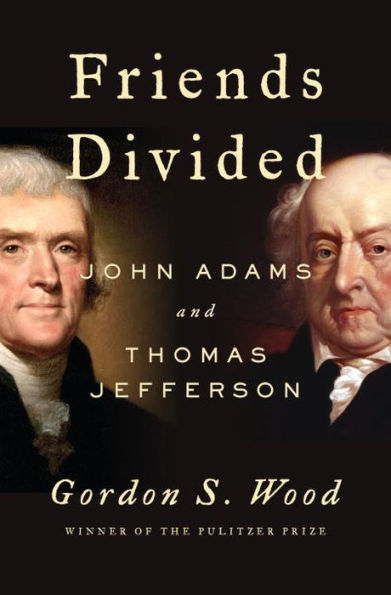
Friends Divided: John Adams And Thomas Jefferson


9780735224711_p0_v1_s600x595I got fairly excited when I read about this book because it was described as being more an intellectual biography of Adams and Jefferson. As a child, visits to Monticello happened probably twice every three years, so I always felt a closer connection to Jefferson, a sense that was only partially relieved by reading McCullough’s biography from 2001. Read more

Poet Tips


This website is awesome – you enter the name of a poet you like and it spits out some awesome recommendations. And just by some brief checking, the suggestions are excellent and the range of poets suggested even better (I checked for Anne Carson, Kenneth Rexroth, and Cathy Linh Che).

https://poet.tips/

‘Shadowplay’ By Tad Williams


Point number one, Williams’ writing is not relentlessly grim, but his books are far too grim, at least, for the writer to go by ‘Tad.’ It’s just weird.

Second, I think I have merely transferred my bibliomaniacal tendencies to buy books towards checking them out from the library. Books on hold are being made available faster than I can read them (and certainly, fatherhood has slowed down my reading – a nearly seven year old, precocious, and active adopted child does not lend itself to quiet contemplation, though the trade off is certainly worthwhile). I had to renew this book once and I feel like the other two borrowed books in my possession will not be done before they are due. And I have more in the queue. We all have problems. This one, I suppose, is not even the worst of mine.

The level of ‘high fantasy’ – magic and monsters and the like – is higher than before. In fact, this series is actually, pretty textbook high fantasy, but it feels like it isn’t, because there is a certain grimness running through it.

I miss the realpolitik of the first volume, but it did a decent job of fleshing out the world and making the threats faced by the ‘good guys’ (two of whom are actually girls; arguably to primary protagonist is a self-possessed adolescent girl) more three dimensional than before.

But I still don’t feel one hundred percent convinced, though his writing is good enough, clearly, that I have now read five books by him (in two series).

DC Artist Anne Truitt


Ok. I hadn’t actually heard of her until I read a (positive) review of the exhibit in the Washington Post. But I did go see her in the tower gallery at the East Wing of the National of Art. And I liked her.

It helps that she was a DC artist. Not just someone from DC (and technically, she was born in Baltimore) who then moved away, but someone who lived and worked in DC for most of her career. Thank you. We are an artsy city and unless your name is New York or Paris, we can probably kick your butt, arts-wise.

Her minimalist work, spaced out in the large, high ceilinged, and vaguely trapezoidal gallery, gave the space the feeling of a secular temple (maybe like the Rothko Chapel, to which I’ve never been). Which made it so disappointing that there was only one small bench, set off to the side were you really couldn’t see much of the art very well. This exhibit was just begging for a couple of rows of pews, where people could pray or meditate in a setting that really called for an appreciation of art as a spiritual practice.

Jackson Pollock’s Mural


I apologize for the distortion cause by my effort to use the ‘panorama’ function on my iphone

I am only slightly ashamed to admit that I first learned about this mural from the Ed Harris biopic, Pollock (which also helped to promote the apparently misguided belief that Pollock painted the massive work nearly overnight – the exhibit makes clear that he had been working and making progress on it for a period of at least several weeks).

So it was awesome to finally see it in person… and disappointing.

This is the first time the mural has ever been displayed in DC. The decision was made to pair it with one of my favorite paintings from the National Gallery’s permanent collection, Number 1, 1950, better known as Lavender Mist.

I first encountered Lavender Mist in a college art textbook, but without seeing it’s scale (it’s extremely large, but less than enormous), it’s impossible to fully appreciate. Sometimes, I will visit the National Gallery for the sole purpose of spending twenty minutes sitting in front of it. I’ve done that at least a dozen times (besides shorter visits, or visits focused on other works) and I’ve never grown tired of the work.

And… Lavender Mist is better than Mural. It just is. And it kind of ruined Mural for me. I wish I could have seen it on it’s own. Surely it’s important enough to be placed where one can soak it in, undistracted by other large works?

Bad call, curator. Bad call.


Vermeer And The Masters Of Genre Painting (At The National Gallery Of Art)


I have never been a tremendous Vermeer fan; I appreciate him, but do not love him nor seek him out. Overall, I was as enthralled by his featured contemporaries as I was by the master himself.

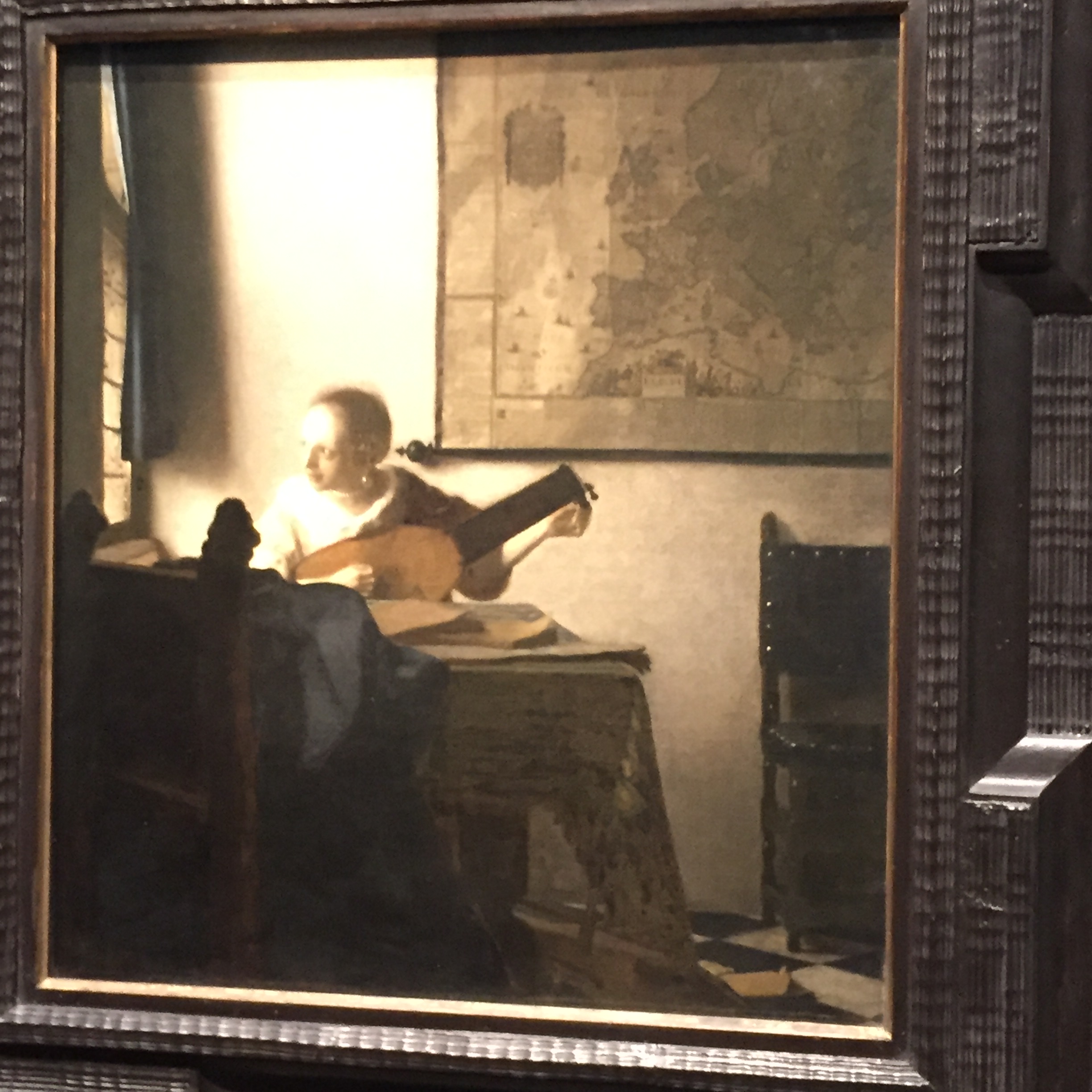
But I was deeply struck by a tiny aspect of a Vermeer. Woman with a Lute featured metal studs securing the leather covering a chair that ‘popped’ so dramatically that I had to stop, because in that first moment, I would have sworn they were three dimensional. I looked for some kind of painterly trick, but there was none. And it’s not like the studs were (to my amateur eye, at least) something of thematic or compositional importance. They were (presumably) a representation of the same plain (brass, I would guess) studs on the chair that was the model for this chair. But, wow.

Woman with a Lute

I saw a similar effect in the gold decorations on the sleeve of a woman in another Vermeer, Young Woman Seated at a Virginal.

But I can’t help but feel like that, if I were given sixty seconds to grab one from off the wall and make a run for it, I would not go for Vermeer (assuming we are thinking about keeping the painting and now trying to pawn it; in which case, Vermeer would have more value). His moralizing feels too stern and off putting, like a white evangelical church in Appalachian hill country that forbids dancing.

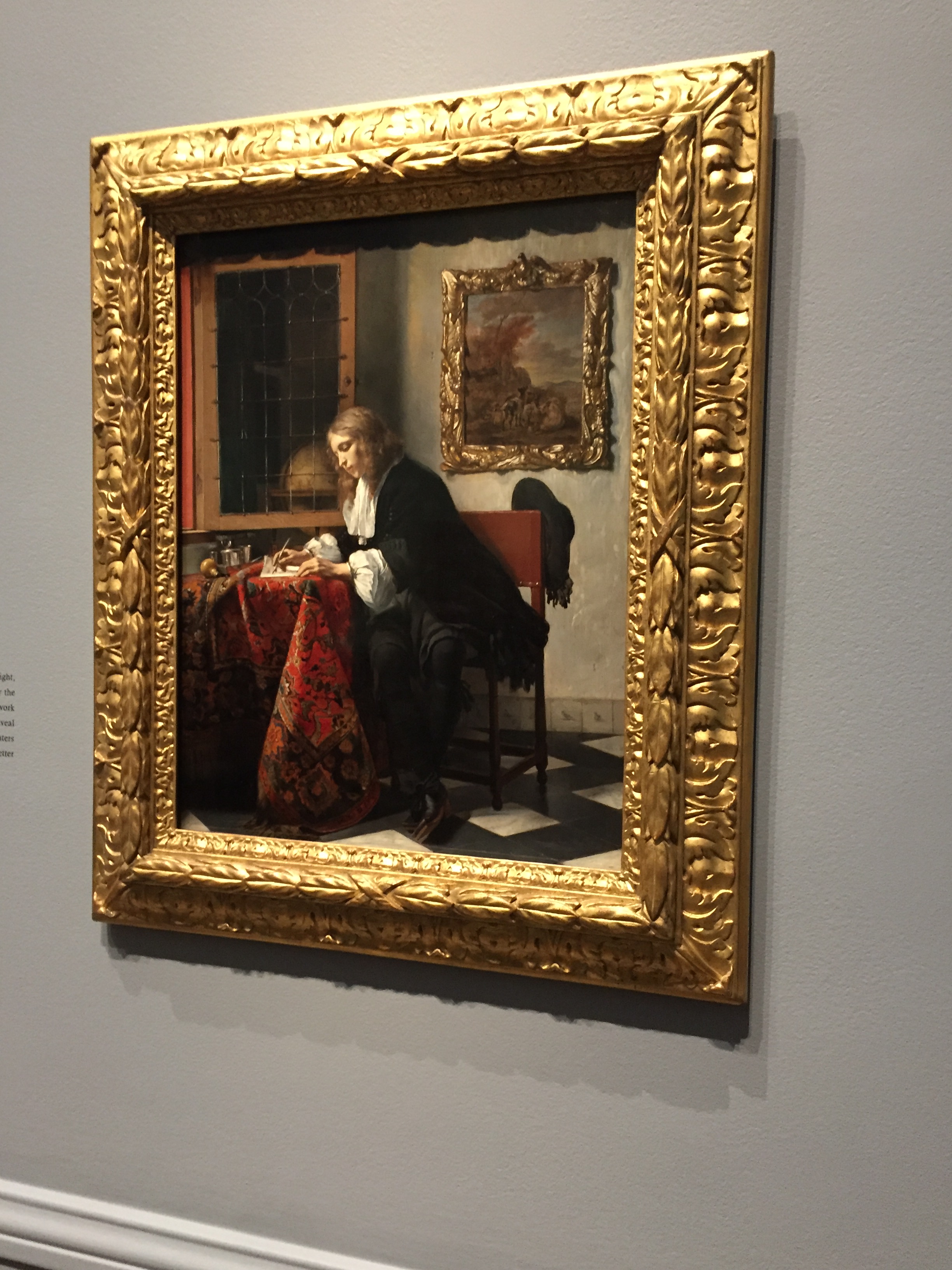
The exhibition (as the curators note) is heavy on images of women. It might almost be called feminist. So it felt a little sad that my favorite painting is actually one that features no women at all. But I have always been drawn to representations of writing and books and maybe I am looking for myself in these.

Man Writing a Letter, by Gabriel Metsu