Ezra Pound: Canto LVI


The Fifty-Sixth Canto, even more than in earlier ones, juxtaposes depictions of history (still Chinese) with American slang: licked ’em, swat, gimcracks, damned rascals, etc.

One line that stuck out for me was this:

And litterati fought fiercer than other men to out the mogul

Was this how Pound saw himself? A ‘litterati’ (sic) standing against the ‘mogul?’

And who were the mogul?

The illiterate and uncultured hoi poli?

Or are these moguls the moguls of finance? The bankers and financiers Pound blamed for so many ills?

Save St Mark’s!


Please sign this petition to save the St. Mark’s Bookshop.

St. Mark’s has been a critical institution for poetry in this country and we have to pray it stay open.

T.S. Eliot in ‘The Nation’


Reading an article about T.S. Eliot in The Nation, the ostensible raison d’etre being the publication of his letters, reminded me of what an incredible, awe-inspiring thing it was the read him as a teenager.

Prufrock was in our 12th grade English textbook, but, of course, it was the copy of The Wasteland among my mother’s books that was most exciting.

The abstraction, the literary-mindedness of it all, affected me as much as the despairing, existential gut punch of it.

Poems didn’t have to be literal, visible, but could be densely allusive, creating all sorts of possibilities that I had never seen before.

The article has a telling line, speaking of Eliot’s The Hollow Men:

a confounding performance, at once viscerally immediate and yet strangely abstracted

Though, to put it in context, the article’s author does not ascribe that to most of his other famous works, it feels very right to me as a depiction of the act of reading Eliot for the first time. Viscerally immediate and simultaneously strangely abstracted. And strange meaning more than just “oddly” or “weirdly” but something more… French, shall we say. Strange as truly Other. And most especially, strange as estranged from something. From the world, from each other.

The Poetry of 9/11


Poetry is very relevant.

No – Adam Smith Did Not Actually Believe in Unfettered Free Markets


No. Really. He didn’t.

Read this.

And when you’re done, actually read The Wealth of Nations.

And when you’re done with that, read Adam Smith’s The Theory of Moral Sentiments.

And you might actually read something by David Hume (this year is the three hundredth anniversary of his birth, if anyone’s counting), who is far closer to the spirit of the founding father (intellectually speaking) of capitalism than Ron Paul, Michele Bachmann, of the fellows residing at the Cato Institute or the Heritage Foundation.

Scarriet’s Conspiracy Theory Mongering


I pretty much never agree with the folks at Scarriet. Their kneejerk hatred of modernism and all its fruits (fruit of the poisoned tree?) runs right in the face of both my appreciation for modernism (especially high modernism) and for what I perceive to be sort of iconoclasm for the sake of iconoclasm (though in the guise of defending ‘true’ poetry – as a sort of dernière garde against the ravaging evils of modernism, post-modernism, L-A-N-G-U-A-G-E, etc).

This particular posting, is more than normally riling (which is, I suppose the point).

Leaving aside such items as the introduction of Wallace Stevens to the poetry reading public being considered, apparently, a bad thing (item number 7) and also bashing a young poet’s first book as being the final nail in the coffin of all that was bright and beautiful in poetry (item number 10), I would like to draw your attention to number 3 in the list.

3. The Waste Land, 1922

Publishing scheme launched by Pound & Eliot’s crafty lawyer and Golden Dawn/Aleister Crowley associate & British Intelligence agent, John Quinn.

Yes, that’s right. It is never said outright, but the author is clearly trying to suggest that the publication of The Waste Land was not, in fact, the result of someone recognizing the work as an important poem.

No, it’s actually a Satanic plot (‘scheme’) by foreign spies.

Sweet mother of god, people! Really?

And don’t try to deny it. No one in their right could see the referencing of the supposed ‘scheme’ (plot? conspiracy?) of this ‘crafty’ occultist spy as being anything other than a bit of paranoid conspiracy mongering.

Ugh.

Belated Happy Birthday to Dvorak


I forgot to note Antonin Dvorak’s birthday yesterday!

If you live in the DC, the Czech embassy is sponsoring some concerts celebrating his work.

Major Movements in Philosophy as Minimalist Geometric Graphics


Major Movements in Philosophy as Minimalist Geometric Graphics

The Death Row Poet?


A blogger cum poet on death row writing about the failures of the penal system. And poetry.

Here’s an article about him in the St Pete Times.

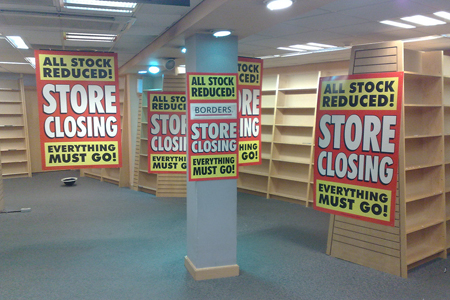
The Final Days of Borders


A litter after midnight, on Labor Day, I received an email from Borders announcing the last ten days of its existence were upon us. So I stopped in the one in the DC suburb of Columbia, Maryland that day while my better half visited a Jo-Ann’s Fabrics next door.

Lord, it was a sad sight. The cafe was closed in order to sell off the espresso machines and the like. A crowd of folks (little different from myself, of course) gathered to munch on the chain’s price reduced corpse.

For $22 I picked up John Ashberry’s Self-Portrait in a Convex Mirror, Charles Wright’s Sestets, and Claude Levi-Strauss’ The Savage Mind, and Elizabeth Moon’s Victory Conditions (I’d never heard of the book or the author, but it is clearly some kind of  space opera in the classic style of the Lensman or Lucky Starr).  Oh, and a book I bought for a Christmas present for one of the few people who read this blog.

Even Amazon should be a little saddened. After all, how many people have (and I don’t condone this) walked into a Borders or a Barnes & Noble or an independent bookstore, browsed through the selections to find something they liked, and then gone home and ordered it on Amazon.

Hell, Amazon should be subsidizing brick and mortar bookstores.

Publishers, too. After all, word of mouth from dedicated bookstore employees and shoppers is cheaper than paid advertising to promote a new book.

Of course, Amazon can afford to do a little subsidizing whereas the contemporary publishing industry really can’t. Not that I expect Amazon to do anything to roll back or at least hold back the bookstore apocalypse they were the cause of.