Sexy, Victorian-style walking.
‘Spring Breakers’ given a surprisingly positive analysis from (a) perspective of feminist theory.
So blaming Dungeons & Dragons is still a thing, huh?
I guess I’ll go play Black Ops or one of those kinds of games. Assassinating civilians appears to be okay, provided you don’t use magic to do it. And If John Yoo says he’s ‘cool’ with it.
So, we were trying to find Dumbarton House, which, as it turns out, is completely unrelated Dumbarton Oaks (I still haven’t been to Dumbarton House).
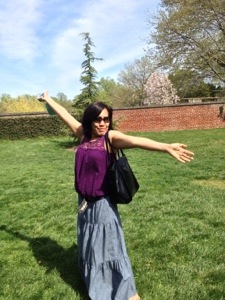
On the plus, Dumbarton Oaks Garden is insanely relaxing.
On the downside, the entirety of the Dumbarton Oaks Museum, including the pre-Columbian art wing, designed by Philip Johnson (who I am a fan of; I actually used to pick up my paycheck from a building he designed in Minneapolis), was closed.
But, with a bag full of books bought from The Lantern, a lovely spring day, and time to kill, I still recommend visiting.
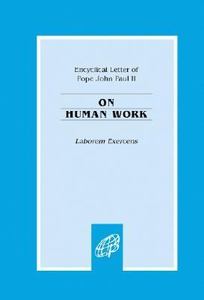 This is the official translation of Blessed John Paul II’s Encyclical Letter, On Human Work. As someone who works in the labor movement (and especially as someone who is working to help adjuncts at a well known Catholic university form a union), you can well imagine this might interest me.
Also, I bought it at Pauline Books and Media, a little Catholic bookstore in Old Town Alexandria, run by the Daughters of Saint Paul who, so far as I can tell, model themselves after Paul the Evangelist in focusing heavily on communication and evangelization. I’m guessing they have the most active twitter account of any order of nuns. But I’m just guessing.
It’s a very comfortable and contrary to images in movies, I have always found nuns to be very friendly and welcoming. It’s got a selection of devotional stuff, similar to what you might find at any Christian bookstore, but, this being a Catholic establishment, it also has a great many volumes of scholarly and intellectual interest. And a rack devoted to papal letters and other Vatican documents.
I like to go there when I play D&D on the weekends, but since we often play on Sunday, I can’t always (the store is, naturally, closed on Sunday). The other week, we met on a Saturday.
On Human Work, as one would expect of a document by the notably anti-Communist, Blessed John Paul II, speaks out strongly against ‘historical materialism.’
But reading this critique, one can’t help but notice that it is arguing for remedies for what can only be described as man’s alienation from his labor. In other words, it is the same problem as that illuminated by Marx.
Derrida wrote a book called Spectres of Marx, about Marx’s writing’s relationship to ghosts and spirit. I mention that because, the way I see it, this alienation is only an issue if it is also a spiritual alienation.
Implicitly, both Marx and Blessed John Paul are concerned with how changing attitudes and treatment of labor injures the soul.
The language used could also have come from a socialist workers conference: ‘capital,’ ‘solidarity,’ ‘technology,’ etc.
Since Marx wasn’t terribly prescriptive, I guess I am mostly referring to later Marxian thought. Both Marxian thinkers and Catholic social teaching is looking at the same issue when it comes to much of work. How the fruits of labor are unevenly and, in many cases, unfairly distributed. How technology leads to dislocation that is traumatic the dislocated (and their families and communities). And how human workers become alienated from their the fruit of their labor and how this alienation is both material (someone on an assembly lines very often does not physically see the completed product emerge, further down the line) and spiritual (though atheist Marxians may resist that terminology; but whether you call it spiritual or psychology, it is something within the worker that is suffering).
On Human Work writes about work as something uniquely human – and therefore connected to our uniqueness amongst creation on Earth, and by implication as being connected to the fact that we are made in God’s image, that, through work, we share ‘in the activity of the Creator.’
When looking at work, Blessed John Paul writes, it is important to remember the guiding view of the church is that labor has priority over capital.
Let quote that:
In view of this situation we must first recall a principle that has always been taught by the Church:
Did you get that? Reading that in these days following the economic collapse and the unequal and unjust recovery that rubbed our noses in the failures of rampant, runaway, unfettered (and unchristian) free market capitalism… well, it’s a reminder that the questions raised aren’t new and that figures ranging from Karl Marx to anti-communist Popes have thundered about them.
There’s lot to love in this if you’re a labor activist. Exhortations for the state to fulfill a moral obligation to protect worker’s rights and also to work towards ‘suitable employment for all who are capable of it.’ Unions are called ‘mouthpiece[s] for the struggle for social justice.’ Good stuff. Good stuff, indeed.
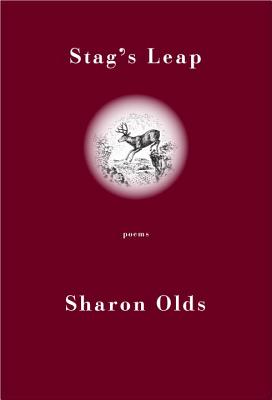 Sharon Olds was just announced as the Pulitzer Prize for Poetry for her collection Stag’s Leap.
I’ll be honest. I don’t like her very much these days. I read several of her collections and found them… a bit much. The transgressiveness and focus on the bodily eventually felt repetitive to me. But still, she’s a prominent and well respected poet and this prize will give her a platform to talk about poetry to the reading world at large, one hopes.
I was in Barnes and Noble the other day, amusing myself while my better half shopped at Old Navy, I thought I would glance at the next volume in The Wheel of Time. I didn’t plan on purchasing it. Didn’t feel quite ready to dive into a big ‘ole fantasy novel at that moment, besides which, I had my heart set on some Wordsworth (I love his longer poems like Prelude and The Hermit, but most collections focus on his shorter works, so I was looking for a collection to satisfy that itch).
So, The Gathering Storm, volume twelve in the series. The first written by Brandon Sanderson (it lists the epic’s late originator, Robert Jordan as a co-author, though my understanding is that he mainly left an outline rather than finished pages). And, good God, Brandon. WTF? Over one thousand pages? Was that necessary? The trend towards length I do not find helpful. And it also pushed the price up to $9.99, when most of the others could be had in paperback for $7.99 to $8.99. I’m not saying it is the difference between making rent or not… I’m just saying, that’s all. Not cool. I’ll read it, of course, but I’ll complain about it.
 the coffee philosopher