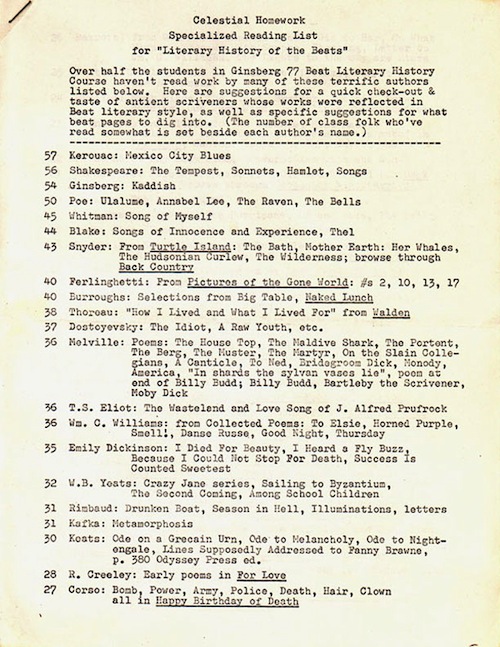
Hemingway’s Recommended Reading List To A Young Man


Hemingway-Reading-List-e1369330871727

The Trouble With Poetry (New Year’s Resolution, Book Twenty)


I am not, normally, a fan of Billy Collins. But he read at the Folger Shakespeare Library and I just don’t miss those.

Actually, he read at the church across the street (Lutheran Church of the Reformation – for the bigger draws, they set up next door and we listen prayerfully from the pews). This will be important later.

So, he read. And he’s better than his reputation. He has built this aww shucks reputation, the poet for people who don’t like poetry because it is too stuffy. He was unashamed about writing a good deal of comic poetry, but, perhaps emboldened by the academic and literate nature of the hosts, spoke deeply about a great many poets, including non-stuffy, difficult poets.

When I got up the front of the line to have my book signed, he took a moment with me. He looked at me and asked whether it bothered me, holding the poetry reading in the church. I said no. But I wished I’d added, did it bother you? Perhaps he looked at me and felt he recognized a (slightly) aging, anti-religious anarchist. But I can’t but think that he was, beneath his Garrison Keilor-esque poetic image, a bit of an anarchist himself. That he was bothered by it and that he thought I would understand. Missed opportunity, I reckon.

The Trouble with Poetry was better than I expected (though it’s unlikely to go on my ‘best loved books’ shelf). It was also darker than I expected.

A mood of quiet alienation, of feeling uncomfortably separated from one’s fellow man, abounded. Death came up not infrequently (three poems struck me in particular: ‘Bereft,’ which said I liked listening to you today at lunch/as you talked about the dead,/the luck dead you called them,/citing their freedom from rent and furniture – which poem went to outline a sort of dislocation with the objects of this world; ‘Flock’ which opened with an epigram noting that it is said that each Gutenberg bible required the skins of 300 sheep to produce, which is to say, that 300 living animals had to die to make it; and finally ‘Building with Its Face Blown Off’ about a war zone).

There is some of Collins’ (signature?) comedy, but not much, and tinged with sadness and failure.

Also, as you might expect from the title, too much poetry about writing poetry. I can’t think of another art form so obsessed with creating art about the particulars of the creation of that particular art form. I might suggest that this, more than stuffiness, is holding back contemporary poetry. It’s frankly too much and poets, in general, need to cut it out. Yes, a poem about poetry every once in a while is fine, but I counted half a dozen in this volume and a quick perusal of poetry mags will easily find you more.
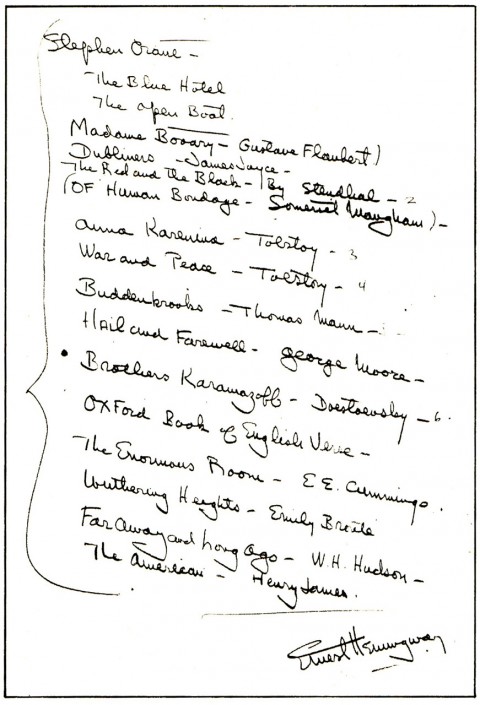
Unacknowledged Legislators


20130526-173454.jpg

Suggested Syllabus From A Class That Allen Ginsberg Taught In 1977


5-22-13_Ginsberg

Pawn Of Prophecy (New Year’s Resolution, Book Nineteen)


9780345335517How far behind am I on my resolution? I’m sure that I should be in the twenties by now, not one short of twenty.

So anyway… Pawn of Prophecy. It’s a bit of foundational document for the modern, multi-volume fantasy cycle, but no one really talks about it. Doesn’t have the cult following of some others. But certainly, there would be no Wheel of Time without it.

It has the usual trappings, an ordinary seeming boy who is far more than that. A guardian who is secretly an ancient sorceress. An old man who visits frequently, tells stories, and is actually a great wizard and shameless appropriation of poor old Gandalf. What David Eddings added is ordinary language. It’s deliberately down to earth. None of Tolkien’s rumbling influences of old Anglo-Saxon epics. Nor any of Michael Moorcock’s New Wave decadence. Nope. This is plain writing, and not it in a bad way. Yeah. I’ll say it, it’s better written than Jordan’s Wheel of Time.

It’s also a lot shorter. This first volume is just over 25o pages. It’s not breathlessly propulsive, but has a (cliche warning) brisk pace. I most admire the beginning. Seventy odd pages of the boy who will be something great (his name’s Garion, by the way) growing up on a farm. And it goes by quickly and pleasantly, not feeling like it’s slowing down the story nor wasting the reader’s time. And that’s an accomplishment not to be sniffed at.

So yeah, I’ll be reading book two.

I wanted to read this, in spite of desperately wanting not to get sucked into another multi-volume sci-fi/fantasy series because, if  you haunted the science fiction and fantasy shelves of Waldenbooks in Countryside in the eighties and nineties or browsed those sections in countless used bookstores, you saw these all the time. Their cover art is emblazoned on memory. Why didn’t I read them earlier? I don’t know. I picked up other books instead. I read book reviews from RPG magazines and exchanged suggestions with my chum, Matt. Somehow, Eddings, who was fairly prolific (he only died in 2009, though Pawn of Prophecy was published in 1982), never made it onto the list. So maybe I’m rectifying a youthful error.

The Story Of Those Moleskine Notebooks We All Use To Record Our Poetry, Our Deepest Thoughts, And Our Grocery Lists


NPR gives them their due… and it’s pronounced ‘mol-UH-skin’.

Midweek Staff Meeting – What Should You Do?


Kant’s guide to sex.

How can you hate your own father?

Michigan modern.

In modern Greece, what is a poet to do?

Mobile Political Ads


Just a little note: I was listening to Pandora the other day and was played an audio ad from Eric Garcetti’s LA mayoral campaign and also saw a pop-up ad on Pandora attacking his opponent, Wendy Gruel.

I started using Pandora in LA, so it still has that for my zip code.

This is an interesting expansion of political targeting into mobile.

I was listening to jazz, but I suspect they targeted me more for my zip code and didn’t drill down too deeply beyond that, not even bothering to geo-locate users, but rather trusting to just my initial, unverified, location. Pretty poor targeting, actually when you get right down to it.

What’s Wrong With Working For The Good Guys


The Jacobin published a good and not very surprising piece about how many union organizers are treated by their employers.

I, of course, work for a labor union and I will say that the union local I work for treats its organizers respectfully and takes its obligations to them seriously (though I should also add that I part of management, so perhaps I am not to be trusted?).

The thing is, this is actually something endemic to the progressive movement as a whole. There is a certain attitude too often taken that because one is working for the progressive movement, that one should not therefore need nor want better wages or sometimes, even decent ones.

Though my current organization doesn’t, but I have worked for orgs that do and there is nothing more frustrating than listening to someone who makes six figures explain why you it’s okay for you to make less than 40k.

Another effect os this is that is severely limits who is able to join the progressive movement. While those who hold progressive beliefs are very likely to be people of color and lower income, those can afford to work for the progressive movement are too often only those whose parents can afford to subsidize them, which is to say, predominantly middle and upper class white children.

The Black Book (New Year’s Resolution, Book Eighteen)


The Black Book is a clear precursor to Lawrence Durrell’s Alexandria Quartet, especially the first book, Justine. It draws from the hallucinogenic writing of the surrealists. But unlike Justine, it doesn’t have that deep connection to place. While his Alexandria is a hallucinogenic city of memory, it is also a very real city to the reader. I can barely tell where The Black Book takes place. I mean, it’s obviously London, but neither the city nor the residential hotel where much of the action takes place. Ironically, the Greek island of Corfu, where the narrator is ‘writing’ the book we know as  , is far more real and vibrant than locale where the action (if you can call it that; there is not plot in the traditional sense) takes place.

This is a angry, young man’s book. An angry fellow not quite resolved to live in the world, instead of his own angry, sexual, and frustrated desires.

Durrell made a good choice to move himself and his writings to the sunnier, ancient, and more deliciously decadent climes of the Mediterranean. Not that a good, sexy, spiritual, and surrealistic book can’t be made out of the stuff of London, only that Lawrence was never the man to do it.