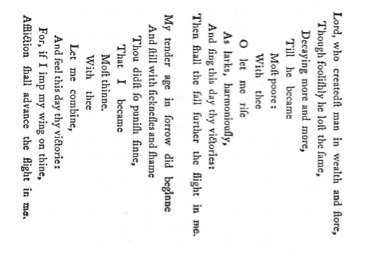
‘Easter Wings’ By George Herbert (17th Century)


db62f46fe

‘When Jesus Became God: The Struggle To Define Christianity During The Last Days Of Rome,’ By Richard E. Rubinstein (New Year’s Resolution, Book Forty-Four)


9780156013154This is likely to be the end of my New Year’s Resolution posts. There is still time left in the year. A little less than a week, to be precise. But with family coming and what not, I don’t see myself completing anything. Forty-four is not fifty-two, but it’s not a bad number for reading, when juggling reading with full time work that rarely ends at forty hours. I might even have made my goal if there hadn’t been a bad stretch when stress from work and life kept me from focusing.

But here we are…

When Jesus Became God is a narrative history, beginning roughly with the reign of Emperor Constantine and progressing through to the western Roman emperor, Theodosius, and that latter emperor’s active and not infrequently brutal support of what would now be considered doctrinally correct Christology within the Catholic church.

The first half or so of the book is a gripping historical roller coaster about the battle for the theological soul of the still new church.  On one side (eventually labelled the ‘Pro-Nicenes’) were priests and bishops who advocated for what became the Trinitarian view of Christ’s nature. On the other side were the Arians, who saw Christ as the son of God, but also as markedly different from the Father. Not necessarily consubstantial. Some even considered Christ to have, in a sense, been adopted by God. Jesus was not of one being with the Father, but more human and a symbol of human perfectibility.

For myself, I had no idea how desperate the struggle between the two sides was nor how closely fought it was. Early on, the author has a great grasp of the historical figures and the historical milieu. Figures like Constantine and the sometimes bishop of Alexandria, Athanasius, really ‘pop’ in the reading. Unfortunately, the same cannot be said of other the figures of milieu in the latter half of the book, which feels rushed and far less character driven.

I suspect that Rubinstein really buried himself in the primary and secondary sources relating to those early days of the struggle and felt a stronger connection than he did with the last half of the story, which is fine, but the reader suffers a bit for it. Honestly, the book is barely over two hundred pages and I don’t think it’s asking too much of a writer not to flag quite so much in the writing of it.

It’s Beginning To Look A Lot Like Christmas…


20131224-173854.jpg

On My Days Off, I Enjoy Being An Unindicted Co-Conspirator.


20131218-211902.jpg

Monday Morning Staff Meeting – The Trouble With Tribbles


Rick Scott GovernorW(h)ither the Catholic writer? The days of Evelyn Waugh, Allen Tate, Graham Greene, J.R.R. Tolkien, Kenneth Rexroth, Robert Lowell, and Thomas Merton are long gone, it appears. When you read about a Catholic writer these days, it is usually in the context of explicitly leaving the Church. Anyway, you should also read it because Dana Gioia is not just a very good poet, he’s also one of the better essayists of the poetry world and it worth reading. And I had no idea he was Catholic.

But where will they drink?

Another paean to Seamus Heaney. He was not my favorite poet, but he was probably the last great, English language poet who came as close as it is possible (in this anti-poetic age) to the stature of his Irish predecessor, W.B. Yeats or Robert Lowell (who has fallen out of favor lately, in favor of his confidante, Elizabeth Bishop, but was held in high esteem in the years after Life Studies) or Robert Frost as a sort of tribal elder figure, held able to comment and illuminate broad truths. Does English language culture have room for another anytime soon? Also, Seamus Heaney liked to text. Yup.

I would say that I was shocked to learn that this incident occurred in Florida, but, really, it’s just kind of inevitable that these incidents take place in Florida. Awesome job, Florida Republican Party! You have used your control of every lever of state power to… I don’t know, wreck my home state? Compete with Mississippi and Alabama for 50th place (56th if we include the District of Columbia, the U.S. Virgin Islands, the Northern Marianas Islands, Puerto Rico, American Samoa, and Guam; that’s right, I said it, Florida, and, by the way, Guam is way out of your league; you’re not competing with Guam, you’re competing with countries emerging out of multi-decade civil wars… and you’re losing). I don’t blame Rick Scott: we knew when we elected him that he was nothing more than a high finance con artist bilking taxpayer funded programs out of their cash who also just happened to look like a Star Trek villain.

Poker


There’s no point to this post. It’s just a simple bit of remembrance of something stupid.

For a time in the mid-2000s, I lived in an apartment on the beach and spent a significant portion of my time at a bar that was technically called Yabba Dew’s Beach Bar. An insanely stupid name, I agree. Really stupid. Can’t wipe its own arse stupid. But it was the bar closest by and whenever my roommate and I would go to the ones a little further down (I think their names were Paddy’s and On the Rocks), we were always disappointed in the number of irritating kids from nearby Stetson University. We wanted to drink around grown ups. We might have stayed if every Stetson girl we met were not supremely annoying. I mean, when you’re single and live within staggering distance of a bar that serves significant quantities of co-eds, you first thought is, “jackpot!” But oh my god, it was not possible to talk to them. We were in our late twenties (and I might have turned thirty during that time of my life, but I would have denied it), which probably part of the problem in trying to talk to 21-24 year olds (assuming none of them were using a fake ID which, let’s be honest, we shouldn’t assume). Long story short, there are better ways of getting laid.

So. Yabba Dews.

We drank Michelob Ultra because draft beer in Florida sucks. No craft beer in walking distance of the apartment. Mich Ultra wasn’t so bad and it’s a union beer (never drink Coors). I regularly ate salads there and french fries slathered with tabasco sauce (I have mixed feelings about ketchup).

At this time in American history, we had collectively decided that watching people play poker on television was something we wanted.

ESPN and ESPN2 showed nothing but poker tournaments all day and all night, so you sit there at the bar, numbly drinking your watered down piss until something like a buzz comes on and watching people play cards. I credit Obama for the end of non-stop poker on television.

There was a crazy sculpture named Fishbone who claimed he designed and made the metal logos for the Bonefish Grill chain. He looked sort of like an oversized hobbit. A server who had crush of me and was quite upfront with her willingness to sleep with me, but she was nineteen and had some terrible stories about bad family life at home and it just seemed wrong, except when I was drunk enough and fortunately, I was never quite agile enough to call the phone number she had given me.

I went to the library almost every day and browsed through a magazine or two or read the paper. Cool Beanz had mediocre coffee, but a nice patio. These were my alternatives to poker, but the dark draw of the bar was impossible to resist for a full twenty-four hours, so inevitably, there I was, a glass of almost totally transparent beer and plate of fries and a bottle of hot sauce.
Saturday Post – Hacks


Online predators (it’s not what you think) disguised as missionaries.

Independent bookstores turn a new page on brick-and-mortar retailing - The Washington Post-1Because pointing out that Thomas Friedman is vaguely racist (in a neo-colonial way) idiot whose grasp of current economic and socio-political realities is on par with a chimpanzee who has been locked in a room with a March 3, 1971 edition of Time Magazine.

Oracular revelations and the artist as mystic.

I’m not convinced by the author positing Norman Mailer as a great public intellectual (though, the author is very upfront about Mailer’s deep flaws), but it’s something I think about a lot. The idea of Jon Stewart and Stephen Colbert deliberately shrugging off the possibility of becoming ‘public intellectuals’ is interesting (and not something I would have thought of), but the point about Paul Krugman drills down to the real issue. Sort of. It’s not just that Krugman’s writing is typically specialized (I wish he would write more deeply about science fiction, apparently, one of his great affections). It’s that the ideal of the generalist is nearly impossible to attain. I read many years an essay where the author wrote that Goethe was the last Renaissance man (in the sense of being able to write and study and theorize as an expert in an incredibly wide range of human knowledge). He was not only a great poet, but one of the greatest novelists of all time. He was a scientist, who wrote innovative papers on meteorology. Too much is out there and available to humanity for someone to realistically be sufficiently well versed in a wide variety of intellectual fields (particularly the sciences) to contribute to a wide variety of fields.

Ooohhh… a new bookstore has opened up in Frederick, Maryland. Not so far away, or not so far away from my work. But otherwise, this is your standard (and, thankfully, accurate so far as I know) story about how indie bookstores are making a comeback.

Weekend Reading – Intentional Lives


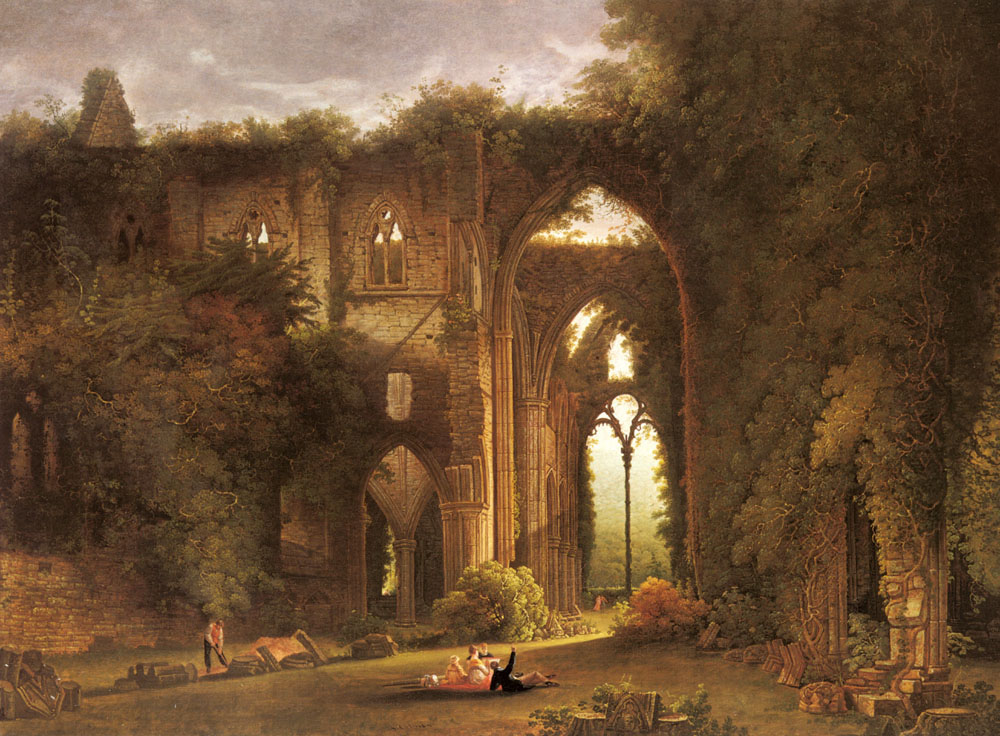
Tintern Abbey
Tintern Abbey

In hard times, it is good to turn to Wordsworth, the most boring and most satisfying of the Romantic poets.

Is the monastic life the way past late capitalism?

Reading poetry naturally leads to introspection. I didn’t really need a brain scan to know that, but it’s nice to be shown right. After all, reading poetry is a slower, more thoughtful process. Maybe that’s the difference. A collection of poetry is rarely very long. Most of the contemporary collections I have are under one hundred and fifty pages, but you can’t breeze through them like a Mickey Spillane novel. You have to move at the speed of the poet’s pen (some poets compose faster than others, it is certain). But what happens when you read poetry is ineffably different than when you read prose. And no, being able to brain scan it doesn’t make it effable. Did you see what I did there? Effable. That makes for a kind of sex joke, too. Doing double duty.

DC United To Get New Stadium? Maybe? Finally? We Hope?


It’s a Christmas soccer miracle

Midweek Staff Meeting – Cranky Poets


warner_2-121913_jpg_600x777_q85

There be monsters still.

Nothing wrong with being a cranky old poet. It’s how I want to end my life.

We are not seen as the guardians of culture, but the greedy gatekeepers of knowledge. The majority of people do not know what publishers actually do.’ That was YS Chi, Chairman of Elsevier and President of the International Publishers Association. And I think it’s a valid point. I respect books published by actual publishers than those that are self published because some sort of gatekeeping process has taken place. Gatekeeping is not bad. And I’m not saying the publishing industry doesn’t often print absolute c–p (Dan Brown, cough, cough). But it’s something and it’s important.

This sounds less like a problem of French books and more of a problem of Anglophone readers…

For a country as surreal as America, we haven’t been very open to surrealism.