Midweek Staff Meeting – Don’t Go Mistaking Me


We are not a southern city.

Build a better subway station and they will come.

‘Selfies’ and knowledge of the self. Not the same thing, apparently.

Adorno and the Ends of Philosophy

Books that changed people’s lives. We’ve all got them. But if you’re going to check this one out, I suggest you go down to Eileen Myles’ list. She’s a great poet and her opinions are worth listening to.

DC is good place to buy vinyl.

The (not so) strange friendship between Frank O’Hara and Amiri Baraka.

Joshua Bell Plays Mendelssohn


Friday night, we saw Joshua Bell play Mendelssohn’s concerto in E minor for violin and orchestra, followed by Hindemith’s When lilacs last in the dooryard bloom’d (a setting of selections from Whitman to music).

Naturally, Bell was the real draw. He was very ‘present’ during the first movement, but didn’t always impose himself on the second and third movements. That said. Joshua Bell. Wouldn’t have missed it. And, c’mon. You just can’t go wrong with a Mendelssohn violin concerto. It’s like sex. Great sex is, well, great. Bad sex… is still pretty good. And Bell makes it like sex with a supermodel, so even if the sex is not good, well, there a supermodel.

The Hindemith piece was very moving. There was a huge chorus and two leads, a baritone and a mezzo-soprano, so the tones were pretty deep and necessarily somber. The Whitman selections were about the Civil War and the death of Lincoln, so it was almost an elegy, but a distinctly American elegy. Hindemith may have been a German expatriate, but When lilacs last in the dooryard bloom’d inspired a sort of patriotism in me.

Anyway. You’re not supposed to ever take photographs inside the hall, but I did anyway.

20140201-202109.jpg

Review: ‘Richard III’ at the Folger Shakespeare Library


We saw the second night performance at the Folger Shakespeare Library, a very elaborately (for a small theater like the Folger) staged production, with the stage moved to the center and raised up and the audience on four sides all around (occasionally with actors moving among us). The costumes were gorgeous and little goth. Queen Elizabeth, in particular, wore a blood red, form-fitting dress, leather corset, and a great plunging collar of black and red-black feathers. The widow of Henry VI, Margaret, was dressed like a mad woman from your local Renaissance Faire. The men, Richard excepted, wore items like leather trench coats and velvet jackets – all in black. Richard, though, wore a simple, military looking grey overcoat.

When a character died (was killed, usually by one of Richard’s lackeys), the ‘body’ was taken down, beneath the stage, through a series of trapdoors built into the stage. At the end, the central trap door was made translucent by the light on it and a skeleton was visible: a reference to the relatively recent discovery of the historical Richard’s bones beneath a shopping center parking lot.

Most actors in a production of Richard III are going to seem a little pale in contrast to the oversized presence of Richard himself – exception being Elizabeth. Her height (she was taller than Richard and, indeed, taller than almost everyone else in the play) gave her some physical advantage in matching Richard’s presence. His opening soliloquy breaks the fourth wall (or, in this production’s case, all four fourth walls), something he does several times throughout the first half of the play. The actor played with a strong limp, but was (so my companion assured me) very good looking and radiated an oily, sexual charm. Certainly, one could see Ann falling for him.

Queen Elizabeth did match him well and the greatest sexual tension was not between Richard and Ann nor Richard and Buckingham, but between Richard and Elizabeth. Even when asking for her daughter’s hand in marriage, the real fire was between the two of them. The director even went ahead and made it explicit, with the two of them sharing a brief, but passionate kiss. Had this play been x-rated, you would have expected the two of them to immediately get down to some really dirty hate sex at that point.

Richard did lose me for a bit. Between his initial, risky, but calculated murders and his descent into paranoia, I wasn’t keeping up with where the production was going. But, at some point in the final act, it clicked for me again.

In general, the whole thing was done at a fast pace, well acted, exciting, and innovatively done. And, I finally got to see Richard III performed live!

richardiii0037


20140125-103720.jpg

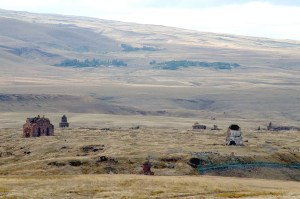
Ani, The City Of A Thousand And One Churches


s_a06_00000001

Ezra Pound: Canto LXXVI


This one is beautiful to read. Not to say that I understand everything (or even most) of it ‘says.’

This Canto is very melancholy. Italy is a fallen empire, with tourists and American soldiers wandering its decay and fall. Leviticus XIX is mentioned again. It must have some meaning for Pound, but I do not know what that is – so if anyone knows, feel free to enlighten me. I could just look it up online, but I feel like being analog (an odd thing to say while writing a blog post on a Mac).

Once again, an older generation of writers is name dropped, including the great Italian writer, d’Annunzio (an American tourist tries to find his home), as well as James Joyce. A ‘Teofile’ is mentioned beside Cocteau. I wonder if that isn’t a reference to Théophile Gautier?

                            l’ara sul rostro
20 years of the dream
and the clouds near to Pisa
are as good as any in Italy
said the young Mozart; if you will take a prise
or following Ponce  (” Ponthe “)
to the fountain in Florida
de Leon all fuente florida
or Anchises that laid hold of her flanks of air
drawing her to him
Cythera potens,
no cloud, but the crystal body
the tangent formed in the hand’s cup
as live wind in the beech grove
as strong air amid cypress

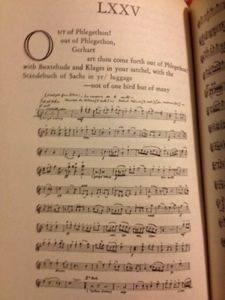
Ezra Pound: Canto LXXV


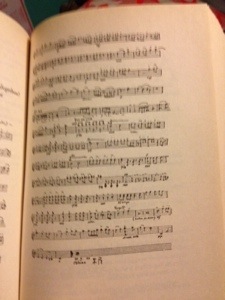
Okay. It’s mostly sheets of music. I can’t read music. Can’t even play an instrument. Not even the triangle. I’m really bad.

If you’re musically inclined, make what you will of what’s below. It’s probably something famous.

So… apparently, ‘Gerhart’ was pianist friend of Pound and he transcribed the music below, which was originally composed by Clement Jannequin for four voices. Phlegethon is one of the rivers of the ancient Greek underworld.

20140126-184956.jpg

20140126-185041.jpg

Midweek Staff Meeting – You Are Doomed To Failure


The soul crushing poverty of the humanities’ major has been overstated. Slightly. It’s not so bad, really.

But since you don’t read anyway… meh.

Can I just say that this a great little list of why D&D is awesome? You’re welcome.

So, yeah. The Gulf is still screwed. Good times.

deepwater_horizon.jpg__800x600_q85_crop

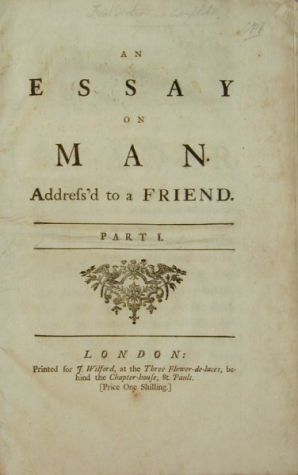
‘Essay On Man’


essay on man picI read a short collection by Alexander Pope last year – a collection that contained this poem – but I honestly rushed through it. While the collection may not have been long, reading essays in the form of three hundred year old heroic couplets is not a swift process, so I went back to leafed through it again.

The emphasis Pope seemed to put on the existence of angels felt to me like a product of Catholicism. Don’t get me wrong, angels are not a major part of this  poem, but when he talked about Man wanting to emulate the angels, the angels did not at all seem like a metaphor, but a reference to actually, heavenly beings. And, by the way, it was not considered as a compliment, because the whole poem is about accepting Man’s place in the world.

The whole thing was very Leibniz-ian, with a ‘best of all possible worlds’ aspect to it (though I don’t recall Voltaire ever publishing a satire against Pope; probably because, on the whole, he would have seen pope as a kindred, satirical spirit). Questioning how things are being put as being tantamount to questioning God.

I don’t know. Maybe more thoughts to come later. Or not.

Ezra Pound: Canto LXXIV


In case it was not already obvious, we are back to reading The Cantos. So, that’s what we’re doing this year. No New Year’s Resolution, though. I don’t know if I’ll finish them. I do have other things to do – including other things to read (we’re still not done with the final book in The Wheel of Time, so lots of catching up to do).

Apparently, this is actually the beginning of the Pisan Cantos. I don’t know what the other section was. Just that it was… short.

The themes remain (Chinese characters, finance, anti-communism, anti-semitism, Italian history), but the style has changed. Not radically, but noticeably.

There’s a reference to Hemingway, which may not seem like much, by this adds a bit of autobiography that I didn’t notice before, and that’s not a small thing. Also, I feel like Pound has moved into the thirties. Obviously, this was written after the Second World War, but the earlier bits were still well within what we might call high modernism. This is still that, but I feel like I can detect some surrealist influence. The lines feel more loose, more free flowing, more driven by the unconscious. Or maybe it’s just stream of consciousness. But I stand by what I said. It’s evolving into something influenced by surrealists.

A brief reference to Tangiers pulled me up short. Was Pound connected, did he follow, was he friendly to writers like Paul Bowles and William S. Burroughs? Also, was this Canto finished when Burroughs and the Beats were making pilgrimages to that North African port city?

A mention of Leviticus XIX and First Thessalonians 4, 11 (the differing nomenclature comes from Pound). The first, Leviticus, is when God instructing Moses in how the Israelites should behave. The second are instructions from Paul. God’s instructions are lengthy and precise, but Paul speaks more generally. And passage 4:11 goes as follows:

And that ye study to be quiet, and to do your own business, and to work with your own hands, as we commanded you;

Is that a reference to what Pound intends to do, post-War, post imprisonment?

Some disparaging, colloquial quotes about Italian generals and the Duke (Il Duce? A Mussolini reference?) indicate… what? Is he mourning the end of Fascist Italy? I think that the quotes, with their lower class tone, are more likely intended to be mocking the speaker than the speaker’s subject.

And a lot of references to modern art and writers. Hemingway, I already noted. But also ‘Mr Joyce’ (surely James Joyce) and Manet and Degas…

                         (made in Ragus)  and  :  what art do you handle?
” The best ” And the moderns? ” Oh, nothing modern
we couldn’t sell anything modern.”

This is a melancholy bit. The whole thing, actually. I can hear Pound adjusting to a new world, one that doesn’t respect… him? The world he loved, he helped created (I am not speaking here of those odious politics, but of how he made literary modernism possible: Eliot, Joyce, Hemingway – all benefitted enormously from his great artistic generosity; maybe be wasn’t the greatest writer of his era, but he made much of it possible).