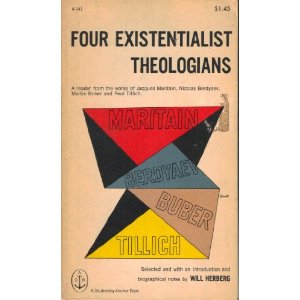
 Some time ago, I picked up a book at Capitol Hill Books (I can’t remember whether it was filed under theology or philosophy) on existentialist theologians (the cover design, for all you fans of those Masterpiece Mystery title sequences, is by Edward Gorey). It began with Jacques Mauritain.
I first came across his name in a book my father got my some two decades ago called Inventing the Middle Ages, a fascinating work of historiography (which also led me to read The Waning of the Middle Ages by Huizinga and a couple of others).
Mauritain was a dedicated Thomist for most of his intellectual life. Now, I can’t pretend to have read much by Aquinas and I understood not all of what little I read (though I’ve read plenty about his writings, so I understand the basics, unless everyone I’ve read who wrote about Aquinas was lying to me).
Anyway, he (we’re back to talking about Mauritain) puts a nice spin on Aquinas’ teleology, making it far more palatable.
If, like me, you were taught about Aquinas spin on Aristotle’s ‘unmoved mover,’ you were probably less than impressed. Purely philosophically, I don’t think I’m generating controversy by saying that it’s lacking.
But Mauritain is looking at things as more of a hybrid theologian/philosopher (I don’t mean that he was necessarily trained or studied theology; but that hybrid role could, perhaps, could be said of all philosophers who come at their studies from a specifically religious-minded position; also, this rather suggests that if the book wasn’t filed under theology, maybe it should have been, except the theology section is a lot more Purpose Driven Life and a lot less I and Thou). He comes at his teleological argument implicitly tolling the primacy of faith. For him, likely as it was for Saint Thomas, the ‘unmoved mover’ is not so much a way to ‘prove’ the existence of God as it a way to create a means for fellow men of faith to improve their understanding of God; not by truly ‘understanding’ God (impossible, surely?), but by rather by providing a framework to understand one’s relation to God.
 the coffee philosopher