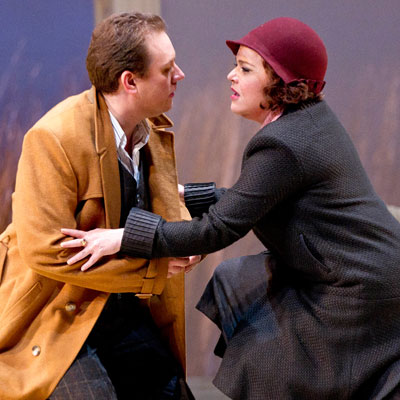
 The other week (May 25th, to be exact), I went to the Washington National Opera to see Jules Massenet’s Werther. Having only recently read the Goethe novel upon which it was based, I was a bit excited.
Massenet is not among my favorite composers, by any means, but I enjoy the works of those great French composers who followed him and built upon his work, like Debussy and Saint-Saens.
Overall, the two leads (Werther and Charlotte) were strong singers, but the opera itself, frankly, lacked.
In terms of the production, the 1920s style costume and design, were present, but not used to add anything to the opera, so I’m not quite sure what the point was.
But mainly, when I say the opera lacked, I mean the music and libretto. And mainly, I mean the first half.
The opera ends strongly, with the two singers pouring their hearts out in some truly moving duets. But the first two acts are rambling and have a lot of loose ends. For example, there are two friends, drinking buddies of Charlotte’s father, but heck if I know what their dramatic purpose was. I can’t even remember if they appeared in the second half and if they did, they certainly didn’t have much to do. So why were they there, except to fill up space and time?
Massenet is accounted to be famous for his ability to match music to the conversational pace and cadences of natural conversation, so that the singing comes across as unforced and natural. Which it did. But Werther is about all-consuming, tragic, deeply romantic love and not about the rhythms of life in an idyllic French countryside. So push the musical envelope a bit, eh? Like those two disappearing characters, I don’t really know what the point was to a lot of the early music.
So, some excellent singing, but in a flawed opera.
You can read the Washington Post‘s review here.
 the coffee philosopher