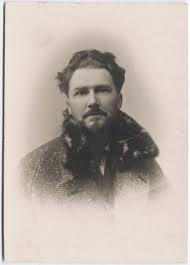
 I came across a photograph of a young Ezra Pound. When he was young, beautiful, and romantic. Before we had to question his work for fascism and anti-semitism.
Around the same time, I brought my copy of T.S. Eliot’s Four Quartets to read on the Metro. In comparison to his earlier work, the poems disappoint.
We already know how influential Pound was in determining the final form of The Wasteland. But how much of Eliot’s genius evolved from part of the literary circle orbiting around Pound’s artistic generosity? And how much of his genius atrophied in its absence?
 the coffee philosopher
It’s interesting that you called Ezra Pound romantic. That’s the last word most people would use in reference to him, and on a greater scale, to modernism. Did you choose this word because he was young? That this youthfullness can be seen as young mans last attempt to engage with a defunct romanticism? Do you think this was the point he was most open to the romantic world view only to depart from this in his later life?
I meant romantic in a very colloquial way (though some of his earliest poems are surprisingly old fashioned, none of them have much in common with the Romantic movement) – and you have caught me out. Yes, I primarily meant that he was young, with all the possibilities that implied – including the possibility that he might not have trod the path of anti-semitism and fascism.
In the strictest sense of the word, I wouldn’t actually describe Pound’s work as romantic – he was neither very much like Shelley, Byron nor Yeats nor was there ever much in the way of romantic love or eroticism in his poems.
I also tend to “romanticize” the modernist period, particularly those associated with high modernism.
is this a photo of T.S. Eliot or Ezra Pound cause I really need to know…..when you get the answer to this question please get back with me. Thank You
Ezra Pound.
It is actually a photograph of Henri Gaudier-Brzeska. He was a French sculptor and a friend of Ezra Pound. He died in 1915 in the First World War. Just thought you might appreciate this correction.
I came to this post thinking it might be an analysis of Eliot’s obvious love affair with coffee. I’m no expert (although a huge fan) but what was it about Eliot and coffee? I can count at least 4 of his poems when it crops up. Do you know of any discussions or other wrting that address this? What was the cultural deal with coffee when he was writing? I’m guessing it carried a different set of meanings and what have you in those pre Starbucks days, huh?
No – my nom de plume comes from own love of coffee and coffeehouses.
But when I think of Eliot and coffee, I certainly think of Prufrock’s ‘coffee spoons.’
In that poem, he was writing in an arch impression of ‘Englishness’ (or so it seems to me). The insertion of ‘coffee spoons’ always sounded like an American-ism rearing it’s (ugly?) head.