‘His Masterly Pen: A Biography Of Jefferson The Writer’ By Fred Kaplan


The conceit of a biography of Thomas Jefferson through the lens of his writings is a conceit tailor-made to interest me and Kaplan, by and large, does an excellent and interesting job of it. He is willing to criticize some writings for not being his best and to draw attention to some under appreciated writings, like his inaugural addresses, especially his second one. He acknowledges that his approach leaves out entirely important aspects of his life, especially Jefferson’s relationship with Sally Hemming and their children together. This is understandable and he does a good job of recognizing that his conceit has limitations.

What I found unforgivable was that he spent no time on the late epistolary relationship between Jefferson and John Adams, after their presidencies were over and Benjamin Rush had patched up their friendship. It is one of the most brilliant and learned series of letters you will ever read and it feels shameful that they aren’t discussed. The only excuse I can give is that they don’t, so far as I have read, offer much a glimpse into their previous political careers (a sore subject, they surely avoided).

“James Madison” By Garry Wills


I checked this book out from the library because I had very much enjoyed Wills’ Inventing America, which was about Jefferson and the Declaration of Independence. He’s a fine stylist, though this slim volume on James Madison is not the best introduction to him (though a decent introduction to Madison).

Part of a series of books on American presidents (to which Arthur Schlesinger placed his imprimatur), Wills struggles manfully to write an introduction to one of the most intellectually interesting men to ever be president that is simultaneously under 150 pages, covers the major points, and is new/interesting. To he credit, he doesn’t like the middle prerogative interfere too much.

He tries to put more of emphasis on Madison’s presidency, which he suggests has been given short shrift in the past and treated as an embarrassing interlude, rather than the highpoint. While not necessarily revisionist, he argues that the War of 1812 didn’t end as badly as most of us think and that Madison, though not a natural executive, was more successful that he is given credit for.

Interesting fact I learned from this book: A young Benjamin Franklin, attempting to make a name for himself in London, decides to return to America where geniuses are less thick on the ground, so more likely to be rewarded; he expresses this sentiment as part of his correspondence with David Hume!

Original Intents: Hamilton, “Jefferson, Madison And The American Founding” By Andrew Shankman


The good: learned some interesting things. Was not up on the conflict between Madison and Hamilton on paying the domestic debt. Hamilton wanted to pay the wealthy Americans who had bought up Revolutionary era debt at a discount, whereas Madison wanted to give them a small profit on their below face value purchase, but also make sure the the original holder, who received a promissory note for $100 (for example) for $100 worth of grain, would, if not made whole, at least receive some part of it. Suffice to say, I’m on Madison’s side. Also interesting to read how a man named William Duer, a one-time lieutenant in Hamilton’s treasury department, almost singlehandedly (according to Shankman) created dangerous investment bubbles and subsequent crashes in 1791 and 1792, which feels downright contemporary, except that Duer went to prison and we never seem to hold the rentier class accountable.

The bad: AP style gone awry. The dreadfully boring style and monotonous sentence structure makes this a real slog to read. AP style is not meant to create boring prose, but to set a floor which the writer can choose to rise above. This writer, ahem, does not appear to have made that choice.

I’m probably being too harsh. It’s a fine monograph, limited in scope, but covering an important issue (debt and credit) in the early years of the United States, through the lenses of Hamilton, Jefferson, and Madison, though Jefferson is, surprisingly, the least important of the three (possibly because Madison, as his de facto political lieutenant, was more active in the national conversation, while Jefferson kept his image as the retiring philosopher).

Founding Myths: Stories That Hide Our Patriotic Past


This book should probably be assigned to high school seniors. From debunking the image of Sam Adams as a rabble rouser and pointing out that everything in Massachusetts besides Boston had been in revolt and not under British control for a year prior to ‘shot heard ’round the world.’ The bit that was new to me was that Patrick Henry’s ‘Liberty or death’ speech was written by a guy named William Wirt, who wrote Henry’s biography in the early nineteenth century and reckoned with the fact that Henry didn’t write much down, including his speeches.

Raphael brings up that we really do not teach the Revolutionary period of American history after the fifth grade in the United States. I’m not sure if that tracks for my experience, but it sounds about right. And part of the problem is that teaching fifth graders, he argues, plays into a more binary sense of morality.

Anyway. Read it.

The Essential Debate On The Constitution


I put this book on hold on account of Bailyn’s presence as an editor, even after my disappointment in volume of his own writing. Of course, it’s not really about him (his preface is remarkable in its brevity and lack of information), but about reading these late eighteenth century American political writings.

It’s easy to say that, wow, look at how literate and intelligent this discourse was, why can’t we be like that, but I’m certain there were plenty of broadsheets being passed around calling the other side out for scatalogical fixations. And, who knows that a hundred years from now, the four years (thus far?) of Trump’s reign may be collected in volumes depicting the debates of the age as a discourse between Ross Douthat’s melancholy concern trolling and David Brooks’ hand wringing exercises?

The argument in favor of ratification are well known due to the canonization of the Federalist Papers, some of which, like Federalists 10 and 30, are collected here (to the editors’ credit, they try not to simply collect Federalists, but to find other documents in support of ratification).

The arguments against are probably less well known, or, at least, were less well known to me. The rightness of the ratificationist cause was taught as an uncomplicated truth in my schooling. The writings of ‘Brutus,’ whose identity is not known for certain, I believe, part of the so-called ‘Anti-Federalist Papers,’ are particularly interesting and well written. That said, arguments that a federal government would take away state independence feel overwrought when states feel so presently empowered to pass whatever racist and discriminatory laws that their White majorities might want.

What struck me most was how suddenly prescient the warnings about the Supreme Court feel now. They feel almost prophetic, especially when you think that they were written before Wilson and Marshall instituted judicial review. The opportunity for unsupervised and unaccountable judges was well recognized then. I will admit to a certain ambivalence. I find judicial elections unnerving, because its feels like justice is vulnerable to being warped to support re-election.

American Scripture: Making The Declaration Of Independence


Described as a bit of a broadside against Garry Wills’ earlier book on the subject, rather than situate the Declaration within a pan-European intellectual environment, with special attention to the ideas of the Scottish Enlightenment, Maier is more interested in a strictly American context. The state and local proclamations that preceded it, for example. She is not terribly interested in the philosophical background of it (though she is interested in the philosophical implications).

If I’m honest, I found Wills to be a better writer. This is partly because I wasn’t too interested in the straight revolutionary history that makes up the first third or so the book.

Nature’s God: The Heretical Origins Of The American Republic


This wonderful, if sometimes clunkily written, book is a series of long digressions on figures of deep influence to the intellectual leadership of the American Revolution and America’s founding. He begins with a discussion of two lesser known Revolutionary figures, Ethan Allen and Thomas Young, who wrote stridently ‘Deist’ (really, atheist) works. Theoretically, it is about the influence of Deism on the founders, but really, it’s about making sometimes tendentious, but always interesting arguments for another layer of philosophical forebears beneath accepted intellectual forefathers like John Locke.

So how does that work in practice? A long discussion of Epicurean cosmology and how it (supposedly) informed the intellectual climate that directly influenced Revolution figures (mostly Jefferson and Franklin; though this also undercuts the idea that these were foundational, since in their learning and interests, they were sui generis). Spinoza is brought up early and often and is taken to be a key figure whose ideas were behind all the most influential ideas of those most directly connected to the ideas of the Revolution.

I’m not sure that Stewart was all that deeply interested in writing a book about the intellectual history of the American Revolution, but rather that it made an easier sell on his actual book, a fascinating look at two marginal figures of the American Revolution combined with an expansive view of the influence of Epicurean physics and places Spinoza at the center of the Enlightenment (yes, he makes a point towards the end that Spinoza is an ‘early modern,’ but in context of the whole book, he is clearly shifting the Enlightenment backwards a good bit, moving it’s beginning to Spinoza and Hobbes).

Stewart is himself a materialist of the Spinozan variety (he wrote an earlier book about the Dutch-Iberian philosopher), I would hazard by his good natured glee when writing about it. I don’t mind a position, in that respect, especially when it is joyful in its advocacy, rather than disrespectful in it.

I enjoy listening to (and usually disagreeing with) some of the podcasts and YouTube videos put out by the gloriously titled “James Wilson Institute on Natural Rights and the American Founding.” I will give them credit for introducing me to the philosopher Daniel N. Robinson and also for aiming to influence the legal community in a specific conservative direction. Unlike the Federalist Society, which is really just a political organization dressed up in judicial clothes, the James Wilson Institute has a very specific legal philosophy around natural rights, which also puts it in opposition to the current trend of pretending to be originalist (natural right theory is not orginalism).

I bring this up because Steward waits until the book is nearly done to bring James Wilson (a Founding Father who is not obscure, but, let’s just say, sits in the second tier) up and goes on to describe him as: avaricious, socially ambitious, lavishly educated

Ha.

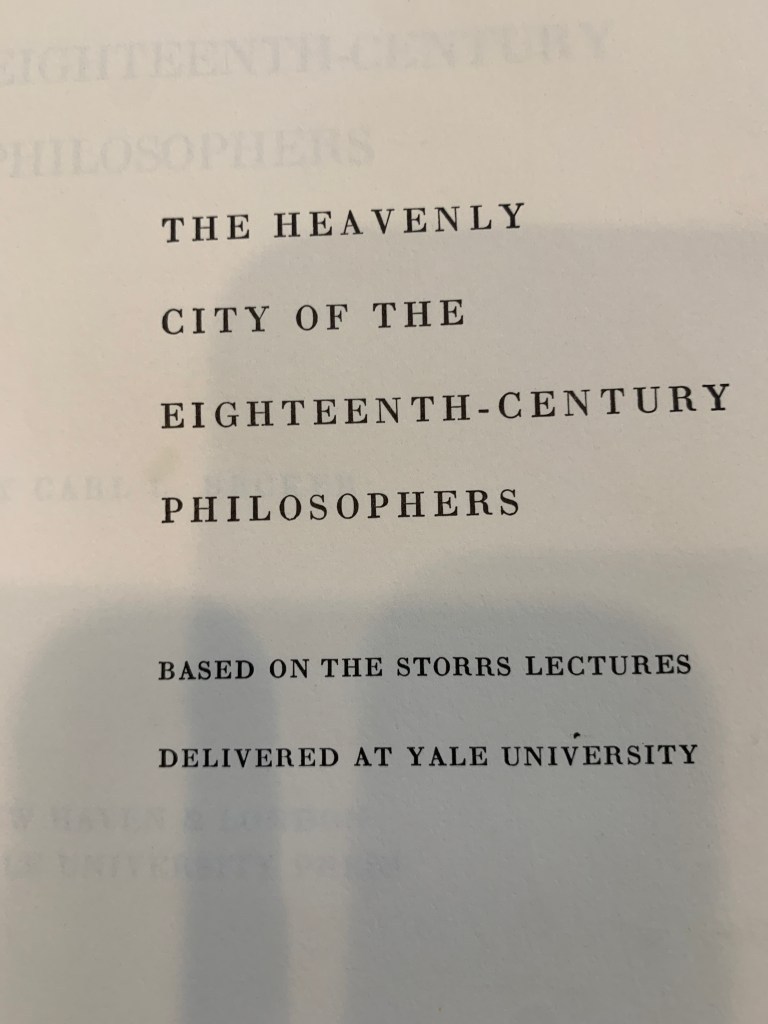
‘The Heavenly City Of The Eighteenth-Century Philosophers’ By Carl L. Becker


How did have I not read Becker before? He has the classic style of the great, witty, learned, essayists of the nineteenth century. This book reads like a sequence of connected essays, which, effectively, they are, being based on a series of lectures he gave. Becker’s name appeared before me while reading Garry Wills’ Inventing America; while arguing against Locke’s influence and for that of the figures of the Scottish Enlightenment, mainly Reid and Hutcheson (I hadn’t realized this was controversial).

Primarily about the francophone philosophes (francophone rather than French, so as to include Rousseau), with frequent attempts to loop in the Enlightenment figures of the American founding and into the Scottish Enlightenment, it makes eighteenth century philosophy a fascinating, discursive read, which is an apt metaphor for it.

Sadly, for me, he fails to stick the landing. First published in 1932, he waxes unhappily about Bolshevism and the socio-political tumult of nineteenth century Europe. While I don’t necessarily mind (if also don’t necessarily agree) with his grumpy reactionary-ism, he doesn’t connect it to his lyrical discourse on the eighteenth century philosophers, except perhaps to say, that was good and these are bad.

Inventing America


I loved this book, but mostly because it made me want to read other books. I’ve started reading Carl Becker, because Wills mentions him. I definitely need to read more Scottish Enlightenment (Hume, Home, Hutcheson, etc).

However, the argument itself seems… unnecessary today. That the Scottish Enlightenment was the critical intellectual yeast of the Founding documents does not seem controversial today, nor does relegating Locke slightly (though not so much as Wills does; he tries to dispel any idea of Locke’s political writings being an influence on Jefferson’s Declaration, which smacks of a lady protesting overly vigorously). He also leans heavily on finding references to Francis Hutcheson (followed by Kames, Hume, Smith, and only rarely Reid).

Wills writes that Lord Kames was Jefferson’s intellectual hero. Of course, Kames, Christian name, Henry Home, was David Hume’s uncle (Hume changed his name so that the spelling matched the phonetics) and Jefferson notably raged against Hume.

He spends as much time emphasizing the Declaration was not seen as a momentous documents at the time it was signed, only later becoming so (in part, through Jefferson’s own efforts to elevate it), as he does on the specific influences that this book is supposed to address. C’est malls vie, I guess.

I did learn things, though, or at least gain new perspectives. He provides new lenses through which to view Jefferson’s famed Head and Heart letter, provided by Scottish sentimental (which doesn’t mean what you think it means) moralism and Laurence Sterne. Incidentally, though I mostly fall into the camp of those who feel that the recipient of that letter and Jefferson did have a sexual relationship, though the letter suggests to me that our third president was an awkward lover.

Agony and Eloquence: John Adams, Thomas Jefferson, And A World Of Revolution


Another book about the relationship between Jefferson and Adams; less formally innovative than the other, but a nice, brisk read, nonetheless. Some odd choices though. It focused less on than the bitter divide that kept them apart for over a decade and more on the things that connected them. For about half the book, it seemed to be using their differing views of the French Revolution as the lens through which to view these two men, but then it seemed to forget about it. Which was weird, because it spent at least fifty pages discussing important figures within the French Revolution. Was that just padding?

Also, kind of amazed how historians (mostly white, male historians) are still tip toeing around Sally Hemings. It was a terrible, terrible thing he did, because her age and lack of freedom meant she could not consent and wildly hypocritical. But he did good, too, and it need not be interred with his bones, and Antony might say, it we acknowledge his deep sins.