Blue Rider (New Year’s Resolution, Book Eleven)


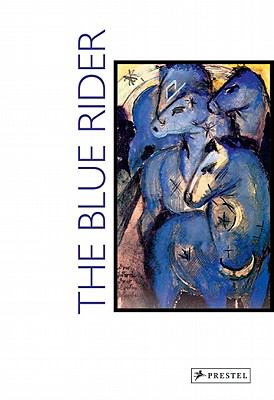
9783791345284I was at MoMA in New York back in January and they had a wonderful exhibit on abstract art – Inventing Abstraction 1910-1925. There was some kind of an effort to make some kind of a point, but they failed quite masterfully at that. So, as a thematically/narratively curated exhibit… well, it really wasn’t. But as a grab back of awesome, early abstraction, it was freaking awesome. I love avant-garde art from that period. And I love how they incorporated music and especially poetry. Some Mallarme and Appollinaire, some of those lovely old journals and publications, with the poets wild typographies. Good stuff.

They also had some Italian futurist stuff, including a long poem/dramatic prose creation by Filippo Tommaso Marinetti, the manifesto writer extraordinaire of the Italian Futurists. Of course, those folks devolved fairly rapidly into Fascism.

Looking at some of the graphic design on Marinetti’s pieces in the exhibit, I couldn’t help but notice how much it looked those iconic covers of Ayn Rand’s novels (see here and here). They shared an obsession with technology and progress (Rand’s novels, Marinetti, and Fascism). Especially in Atlas Shrugged, her obsession with phallic, thrusting trains and long beams of powerfully strong steel.

But at the very beginning of the of the MoMA exhibit, was a little something about the Blue Rider Almanac, the love child/brain child of folks like Kandinsky (who claimed to be deeply influenced and move by Schönberg’s innovative music. 

So, it seemed like fate when, a day or two later, I was in Rizzoli Bookstore (a great place for art books and for Italian language works) and I saw a book on the Blue Rider movement. Since I was on a kind of quest to buy a book at a bunch of famous bookstores and Rizzoli was on the list. I’d been to Rizzoli once before and it’s such an indulgent and decadent feeling place (though also pricey; don’t like for a bargain bin over there; but you do pay for quality).

So, I bought The Blue Rider and I”m now getting around to reading it.

The book itself reads rather like a catalogue or monograph written on an exhibition that never took place. Which isn’t a bad thing. If exhibition catalogues weren’t so darn expensive, I’d own a lot more of them.

When reading about the Blue Rider group on the little placards and seeing the collection of works and documents associated with it, I wanted to learn more about this group. I wanted to read about Kandinsky and Schönberg sitting down at a bar and chasing the same woman and then Franz Marc and August Macke struggling with the typesetting and printing of a broadsheet. I don’t know if these things actually happened (and the first one seems very unlikely), but that’s what wanted that went beyond just a catalogue and I didn’t get it.

Sure, there was some talk at the very beginning about which group drank at which cafe, but for heaven’s sake man, I learned that about some pre-Blue Rider groups! Where in the good Lord’s name did Kandinsky get drunk and take his coffee?! Part of this also about an incredibly drowsy writing style. We’re talking about some of the twentieth century’s most influential cultural figures, yet sometimes, I can hear a voice in my head while reading this saying, ‘Bueller… Bueller… Bueller…’

The book’s progression is also weird. First, there is a description of the cultural environment leading up to the formation of the Blue Rider group. Then there is some description of how they set up their first exhibition. Then there are brief bios of some major figures associated with the group. Then some bios of minor figures. Followed by a narrative history of later exhibitions and activities of the group and its members. And then the author tries to explain what  Blue Rider group was about and wanted to accomplish. Then there are a bunch of photos and descriptions of places associated with the Blue Rider group. But those descriptions sometimes appear pulled from brochures. One of these places is actually a walking route across swampy moors. The author recommends that the reader, should the reader take this walk, bring some water. There’s even a recommendation that I, the reader, visit the Wernstein Am Inn in Austria. See what I mean? That’s not history, that’s… I don’t know. Advertising? National park service?

It feels like this whole thing was written without an outline. Like I said earlier, it feels a bit like an exhibition catalogue, but it’s not about an exhibition, so it lacks the unifying drive an actual exhibition might have imparted to it.

But I shouldn’t complain that much. For $19.95 plus tax, I’ve got reproductions of some stunning art work from my favorite period in art, plus some good history about a subject I knew little about (despite a great fondness for Kandinsky, if I ever knew about the Blue Rider group, I’d forgotten it by the time I’d reached MoMA.

Midweek Staff Meeting – Reviewing the Reviewer


Defending the honor of Adrienne Rich.

Words are so twentieth century.

The Sunday Paper – The Typewriter From ‘Naked Lunch’ (The Movie) Is Almost Here


Niterói Contemporary Art Museum

Your typewriter can read your mind.

Museum quality illustrations of… museums.

Thinking about Eileen Myles.


How To Use a Kindle as a Bookmark - GalleyCat

Midweek Staff Meeting – No More Books For You!


Amazon trying to kill the free Kindle e-book? (not that I object – too many free e-books sets a bad precedent for how we view and treasure art, literature, and literacy)

Actually, it would be nice to have someone in charge who actually cared about preserving the brick and mortar business.

Barnes and Noble giving up on the Nook? (I hope not; I own one and enjoy it, though it would be nice to see them focus on their core retail business)

If a poet dies in the forest, does anyone notice?

Midweek Staff Meeting – Use Your Words


_65587521_20011de3-1c96-48cb-8fec-63b6a0141238Vocabulary is the secret to success.

Poetic picks.

Reading is expensive.

A city that truly loves its books.

Used e-books. This could be a real thing (actually, no it couldn’t be a ‘real thing,’ but it could be an elaborate scheme Amazon uses to get a monopoly on the business of books).

Out Of The Silent Planet (New Year’s Resolution, Book Six)


Reading the first book in C.S. Lewis’ trilogy of Christian science fiction, I realize how huge his debt is to the planetary romance of early pulp writers like Edgar Rice Burroughs and his Mars and Pellucidar books.

Lewis certainly gets his theological apologetics in, but the descriptions of his hero (Dr. Elwin Ransom, professor of philology) exploring the planet (which is Mars by the way!), encountering native flora and fauna, and his interactions with the native life, including quickly learning their language… well if you replaced Dr. Ransom with John Carter and added a couple of sword fights (though, there is a harpoon hunt of a giant, freshwater monster in Out of the Silent Planet) you could probably have sold this as a long lost novel of Barsoom, especially since it even takes place on Mars, though the natives here call it Malacandra, not Barsoom. It also uses the trope of having this story be Ransom’s unbelievable story told to Lewis so he can sell it as a novel, because it would otherwise be too unbelievable if sold as fact.

The apologetics come in the time honored fashion of presenting a fictional (or fictionalized) society as expressing the utopian ideals of the author’s religion or philosophy. There was one little throw away line where Ransom wonders whether it is his duty to evangelize to the alien hrossa and then realizes they more truly represent the ideals of his High Anglican Christianity than whatever he could express in their alien tongue.

The (more or less) climax is a little preachy and Lewis lays it on too hard in one area. Ransom must translate the arguments being made by the villains of the novel (Devine and Weston, if you must know) into the native language of Malacandra. Because of both the limitations of the language (having a relatively utopian society, they don’t have words for some negative things) and his own understanding of it. The result is Ransom giving the Malacandrans such a straw man version that it becomes irritating.

Despite that Caveat, Lewis is always and engaging and earnest writer, though never as good a writer as his fellow Inkling, Tolkien (upon upon whom, apparently, Ransom was based). This book is not as good nor the world as well thought and engaging as that built in his Narnia books, but it is still a good book by an important twentieth century writer.

I read this book years ago, but this time, I will go on and read the rest of the trilogy (though not next week, I’m thinking Alexander Pope for next week). In fact, I have the complete trilogy already downloaded onto my Nook. So, maybe sometime in March… Perelandra.

Weekend Reading – The Real Advantage


The reason why Borders went bankrupt and Barnes & Noble is still surviving actually has little to do with differing e-books and online strategies.

College kids still prefer the old fashioned kind ‘o textbook and aren’t really into ‘enhance e-books’ or other such nonsense.

What is ‘the work of art?’

An interview with Michael Moorcock.

For the third year in a row, Washington, DC is ranked the most literate city in America. I can only assume that my New Year’s resolution to read a book a week will help us secure the title a fourth year running, so… you’re welcome, DC.

Capsule Coffee


The artisans versus the cyborgs is what this article is about – Joy in the task: Even the finest restaurants are serving coffee made with capsules. Have we completely lost faith in the human touch?

Basically, a taste test of a very high end automatic espresso machine (Nespresso), versus hand pulled espresso, versus c–p stuff from some place down the street. Obviously, the last wasn’t a serious contender.

I tend to fall on the same side as the author. The Nespresso machine may have won the taste test, but the sameness was noted.

Several years ago, I remember the president of Starbucks convening a bunch of baristas because he felt that the coffee chain had lost something in the systemization and automation of the process: the individual touch and character of a quality barista.

Also, I worked in an office that had a Keurig and frankly, it made terrible, terrible coffee. Maybe it just wasn’t a good enough machine, but I just couldn’t pick out any particularly redeeming qualities. After all, it wasn’t so much easier than just making some coffee the normal way.

Finally, finding good coffee, like finding a good anything, should be a quest. Choosing to walk up to Peregrine Espresso, rather than settling for the Starbucks stand in the grocery store next door. Comparing Peregrine’s coffee with Pound the Hill (note: Peregrine has retaken the title in that fight). Sometimes taking the trip to Sova in the Atlas District or to Chinatown Coffee to explore what distinctions other coffeehouses can offer.

It’s not more about the journey than it is about the destination because, after all, if the destination is c–p coffee, than the whole experience will have kind of sucked. But the journey matters, doesn’t it?

Why We Need Bookstores


So, according to this, only 7% of book discovery occurs online. In other words, more books are discovered in book and mortar bookstores than are every discovered through Amazon’s inane recommendations.

Amazon’s already poor financial results would be even worse without the old fashioned bookstores they (with our assistance) are driving out of business.