The Typewriter Lives!


After the sad news about Godrej and Boyce closing down the last factory to manufacture new manual typewriters, I’m pleased to report that electric typewriters are definitely still being manufactured.

Of course, despite the impact of the IBM Selectric on businesses around the world, there is no question that the electric typewriter completely lacks the romanticism and drama of an old fashioned manual. Fortunately, there are rumors that a company in China continues to produce portable manual typewriters. No word on whether they produce any with English letters.

The Last Typewriter Factory Closes Its Doors


The last remaining manufacturing facility to continue to produce typewriters shuttered its doors with only a few hundred typewriters (mostly Arabic language machines – which makes me think of that wonderfully disturbing seduction from the movie Naked Lunch involving such a typewriter). The company was Godrej and Boyce.

The factory was located in Mumbia, India. It seems that typewriters were commonly used by government offices and businesses in India long after other countries had completely switched over to computers. But finally, even India succumbed.

The only typewriters that will remain are used models, like mine. Though I had expressly sought out an older, anachronistic machine, there is something very sad in the shuttering of the last factory to make new typewriters, even though I hadn’t known it existed before.

It’s only a matter of time before I won’t be able to find ribbon for my typewriter, or parts when it breaks down. But it still has something to offer.

The little girl who lives downstairs used it and ran down to tell her mother about this old-fashioned computer that printed every letter as you were punching the key. I was trying to use it to help with her spelling, encouraging to use the machine’s limitations as a means to focus on each and every letter, rather than rushing through like one would on a computer.

Even More on Marginalia


College professor Pamela Newton wrote this article purporting to explicate a flaw in the Kindle (and in e-readers, in general). The flaw, it turns out, is the difficulty and awkwardness involved in annotating volumes.

While she uses the far more studious sounding “annotation,” as opposed to the dilettantish “marginalia,” it amounts to the same thing.

I have never done much writing on the pages of my books, yet now it seems to the raison d’etre du jour for bemoaning the rise of e-readers.

Poetry and E-Books


Basically, the issue is that poetry is a massive failure in e-book formats because ePub and other e-book software have no respect for line breaks. This is not such a big deal when you’re talking about prose, but it’s death for poetry.

As e-books become a larger and larger segment of the book market, the failure of poetry to be included will become more and more of a problem for poetry in America.

Right now, about the only solution out there consist of using PDFs, rather than than “traditional” (what is the best word to use here? I don’t know) e-books. Bookmobile’s Ampersand is an example of this.

The Allen Foundation did recently give Copper Canyon Press a $100,000 grant to search for a solution to this problem. While I have somewhat mixed feelings about Copper Canyon – they are the most prominent publisher of poetry in America, but they are also amazingly conservative in the poets they choose to publish – there is no doubt that, of all publishers of poetry, they have the commitment and profile to actually get this done.

Analysis of E-Book Consumption


Someone did a(n imperfect) analysis of the states and their consumption of e-books. They compiled Smashwords e-book sales data from Barnes & Noble from December 2010 through March 2011. This is, of course, a limited and limiting sample, using a single e-book publisher and only looking at sales on one e-book device (of course, that’s my device – the Nook), presumably because the Kindle doesn’t support Smashwords books.

They put together two charts. The first is basically useless. It measures what percentage of total e-book sales take place in each state. Unsurprisingly, the four states with the greatest percentage are… the four states with the largest population (Texas, California, New York, and Florida).

The second chart puts together a list of per capita e-book consumption, which could actually tell us something. The first four states are among the most rural and sparsely populated in America (Alaska, North Dakota, Utah, and Wyoming). States where visits to a bookstore could become problematic.

My own “state” of Washington, DC is actually dead last in the per capita sale of Smashwords e-books. Again, despite my own ownership of a Nook, I can understand this. DC is just chock full of bookstores – Politics & Prose, Busboys & Poets, at least two Barnes & Nobles (and we used to have two Borders), Second Story Books, Capitol Hill Books, Bridgestreet Books, Kramerbooks & Afterwords… In other words, there’s no lack of access to bookstores in this town.

Oddly (or not – the state does have some great independent bookstores), California, the home of Silicon Valley and much of nation’s tech industry, ranked next to last.

Before the Internet


I miss the days before the internet when I couldn’t find everything I wanted. No more searching for an unabridged Count of Monte Cristo or a copy of Richard III. No more days when used bookstores were the only place to find certain books. No more buying copies of Richard Wagner’s overtures to discover that what I was really looking for Carl Orff.

New Coffeehouse on the Hill: Pound


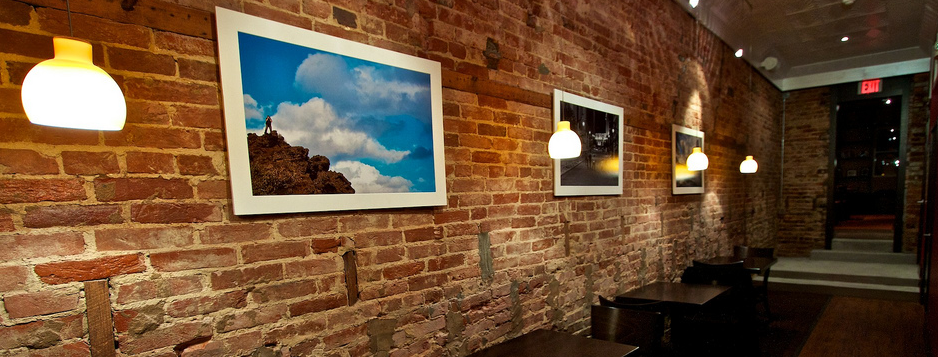
While my better half was away doing real work, I took the opportunity to head up to Pound, a new hipster coffeehouse on Pennsylvania Avenue. While the coffee is not nearly as good as that at Peregrine Espresso, the ambiance is certainly more inviting to sitting down and staying for a while (though this may be a bad thing for the long term financial prospects of Pound; Peregrine’s ability to get someone inside, make them a great cup of coffee, and then get them out the door is certainly a recipe for better financial turnover). I brought my laptop with me, but the wireless at Pound was password protected and I felt too embarrassed to get up and ask what the password is. Of course, it might not even be available to the public. They don’t have cash registers or credit machines, just iPads and Squares to calculate tax and run credit cards. Certainly they’d want that running on a secure network.

Anyway…

The place manages to be bright and airy without sacrificing the dim and cramped vibe one expects from a coffeehouse. I know the first adjectives are pretty much entirely in contradiction to the second two, but I stand by my statement. If you are suffering from some sort of brain lock from that, pick up a copy of Kant’s Critique of Practical Reason and read until he starts talking about antinomial thought and then come back and complain to me if you still don’t understand, but keep in mind, I will be quizzing you about the book, so make sure you’ve really read it and made a good faith effort to understand what Kant is trying to say. And also keep in mind that I could just tell you that Critique of Practical Reason is part of a philosophical trilogy and insist that you read the first book, Critique of Pure Reason, and call me back in two weeks. This is all for your own good. If you can’t be bothered to read canonical works of western thought before pissing and moaning about me holding two seemingly contradictory beliefs (bright, airy – dim, cramped), then I’m not sure I can be bothered to listen to your small minded complaints.

Pound also has a small but interesting menu. I haven’t eaten anything yet, but they seem to be trying to focus on just a few things, so there’s more chance they’ll get it right than if they tried to cram the supplies to run a full kitchen in their narrow space.

So Pound basically gets a conditional thumbs up from me. I’ll bring a book here and notebook here every so often and settle down for a while, though until I (or they) figure out a way to get me some free wireless, I won’t be bringing my work here on regular basis to have lunch or a snack and a large coffee. And if all I want is a really good cup of coffee and to get back home or wherever I’m going, I’ll still go to Peregine.

The Million Dollar Poetry Blog


Sadly, I don’t think this will be happening to the Coffee Philosopher anytime soon.

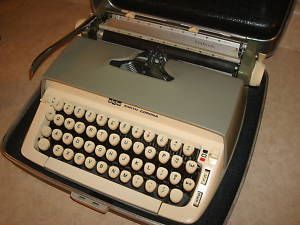
Smith-Corona Typewriter


On Friday, February 18th, the ribbon for my typewriter arrived. Several years ago, while I was still living in Los Angeles, California, I purchased a manual typewriter on EBay.

This particular model is a Smith-Corona Galaxie SCM manual in suitcase/carrying case (if you are a would-be writer, you probably know the type). According to my research, this machine dates back to sixties (Machines of Loving Grace pins the year at 1968).

When I first bought it, I kept merely as a piece of decoration. A pretentious announcement to visitors that a “Writer” (capital w) lived here. It remained little more than decoration for a number of years.

But at last, I ordered some ribbon through Amazon. I did not actually buy it from Amazon, but through another seller on Amazon’s network. Specifically, through an office supply company called EBS that specializes in hard to find office supplies. The exact ribbon I bought was a Smith Corona Typewriter Ribbon Spool – Black – SC-20-SCM Compatible for just $9.75, plus shipping (for a total of $14.38).

And I am so glad that I did.

Composing on a manual typewriter is amazingly satisfying. The only other time I tried was once or twice, just after I graduated high school and was living in the famous Parisian bookstore Shakespeare & Company. The owner, George Whitman, kept an old manual in one of the upstairs rooms for his “tumbleweeds” (as he called the itinerants who slept in his bookstore) to write on. At the time, though, I did not use it much, preferring pen and paper.

Using this machine requires one to slow down considerably. You must forcefully pound the keys, or else the letters will come out to faint to be read. This slowing down makes you very aware of each and every letter, giving you a greater aesthetic appreciation of language at its most basic level – that of the word (apologies to Ludwig Wittgenstein who, in his Tractatus Logico-Philosophicus, insisted that the basic unit of language was the sentence). I also have, over the last few months, fallen in love with fonts that resemble that of classic typewriters. Even on my computer, I have been experimenting with this sort of typography.

So far, I have not tried composing poetry or essays on it, but I did write a letter to my good friend, Ryan Leonard.

My intention is to continue to drive towards a sort of nostalgia. One is always seeing new collections of letters from famous writers and poets being released, but the rise of email and Facebook has rendered this form of communication obsolete. My reasons for this small scale resuscitation of it are both presumptuous and selfish. The truth is, I still hope to be somewhat famous as a poet or writer (though my current, meager publications are hardly likely to inspire such renown) and would like to leave some correspondence for future grad students to sift through.

I suppose the next test is to see if Ryan is inspired to write back in turn and, if so, to discover what device he will use (printer, typewriter, pen).
Automated, Online Submissions


As the careful reader knows, I have developed a certain obsession with automated, online submissions, as used by contemporary literary journals. While I understand their utility, I am still haunted by the notion that, in practice, we lose something. Though it is still possible for editorial staff to use the content management systems to deliver more detailed messages, it is so much easier to simply click “reject” and automatically send some formulaic language to the writer.

No one liked receiving those old letters, with the notes describing the many flaws and deficiencies of our submitted works, but we learned something from them. I don’t get a damn thing from an email that contains the same language as everyone else received.

And of course, the editorial staff can still choose to offer a more detailed critique with their rejections. But how many really do? And how many really do compared to when they had to print out a letter with your name on it and containing the names of one or more of your poems? A letter truly feels more personal, which is what drives editorial staff to write critiques – even if just a hand-written scrawls across and otherwise formulaic letter. But this new method, for all its efficiency, is too detached to encourage that.

The reason I am bringing this up again is simply because I ran into this little article online — http://www.pw.org/content/new_treefree_submission_services – a list and a brief history of some online submission systems. Of those listed, I know that I have dealt with submishmash, though I’m not sure about the others.

Anybody want to disagree with my opinion on these systems?