Dungeons & Dragons Reboot


Dungeons & Dragons in the New York Times

I’m basically unaware of much of contentiousness the article talks about, mainly because there was a twenty-year gap, more or less, between last playing the game and joining a campaign in 2010. I’m just happy that I can remember some things from the now ancient days of the first edition of Advanced Dungeons & Dragons.

But, to date myself, I will admit to remembering when AD&D issued its second edition rules. I will also admit to having greater affection for the 1st edition rules. I will further admit that I like the relative fluidity of the current D&D rules (Advanced Dungeons & Dragons doesn’t exist anymore; the ‘advanced’ literally referred to the greater number of rules governing more situations, as opposed to the greater emphasis on ad hoc improvisation in D&D), though I am still getting used to the greater tactical emphasis implied by playing out fights on a grid with small figurines indication the location of each actor in the fight (AD&D fights were somewhat more likely to be simply sounded out verbally than played out in this manner, or maybe I was just doing it wrong before).

This article also makes me think that it’s no surprise that our group is made of men in the 30s and 40s. We predated the dominance of video games. Oh, I had video games as a kid, but they weren’t the huge, all encompassing part of culture that they seem to be now.

Of course, I was warned off joining a group by a friend who tried to take the game again after a similarly lengthy absence and said, Don’t do it! Everybody was a teenage! I felt so old and creepy!

It seems that it is my band of intrepid, armchair adventurers who are typical and his that are the atypical ones. Breathing a sigh of relief.

P.S. – The company that now owns D&D is preparing to re-release the original, 1st edition rules from 1974 (the year I was born, actually) in honor of Gary Gygax.

The Cathedral


It was a bit of a slog, but I finally finished The Cathedral by J.K. Huysmans.

Unlike the works from his Decadent period, namely Against the Grain and The Damned, The Cathedral lacks that tasty frisson of sex and evil. It actually continues the story of Huysmans stand-in, Durtal, that was begun in The Damned. If you think of the four Durtal novels as a tetralogy, than The Cathedral is the third novel in the series.

Durtal is a writer of modest success but good connections who, in The Damned embarks on an affair with an upper class woman and the two of them explore the world of satanism and Black Masses.

Apparently, the second book, En Route, features a re-conversion by Durtal to Roman Catholicism. The Cathedral finds him living in Chartres, beneath the shadow of the great Cathedral, Notre Dame de Chartres.

The novel lacks much resembling a traditional plot. Mostly, it is a series of conversations between Durtal and himself and Durtal one or both of a pair of priests on Catholic symbolism, particularly the symbolism of the art, statuary, and architecture of the titular cathedral.

The long, constant discussions of odors, animals, gems, etc. and how they relate to particular saints, angels, and virtues can get tiring. There’s even a discussion of how to plant a garden to symbolize various attributes of the Virgin, Christ, and saints and apostles.

But beneath all that is an interesting story.

Durtal is bitter and restless and can only truly see meaning in art and literature and a particularly medieval style of Catholic worship. For all his efforts to be holy, everything is through this filter that stands between him and world. It should be noted that Chartres, cathedral aside, is depicted as a gray, lifeless, industrial town. Durtal seems to enjoy the self flagellation that living in such a lonely, culture-free locale entails for a man of art and learning.

It should be noted that the book ends with Durtal traveling with one of the priests to a convent and adjoining monastery where Durtal retires in the fourth book.

The Cathedral was actually one of the first books I purchased for my nook.

Tuesday Morning Staff Meeting – Amazon Is Coming For Your Children


“We’re in Amazon’s sights and they’re going to kill us.”

Will the Kindle wreck book markets overseas?

Overseas bookstores try to adjust.

Indie bookstores should stop trying to compete with Amazon (but no one is saying they should quit).

Trying to physically measure the humors of love & sex and thinking one had succeeded (but actually being a little crazy).

Parking tickets are almost as bad in Los Angeles as they are in DC.

Do we want to be punished?

The Coffee Philosopher Goes Viral In A Very Minor Way! #Coffeephilosophy


My good friend @joshsulier has started a hashtag named after my nom de plume – #coffeephilosophy – for the wise and random musings that occur to one after that first cup of coffee.

I’ll have to start using that myself now.

Huzzah!

Review: Trading In Danger


I just finished Elizabeth Moon’s Trading in Danger, which I bought mainly because I picked up Victory Conditions back when the Borders in Columbia, Maryland (where my better half used to drag me while she shopped at Jo-Ann Fabrics) was liquidating.

Victory Conditions didn’t necessarily seem, at first glance, like a sequel, much less the fifth in a series (which it is). After purchasing it, I settled down to make sure I wasn’t jumping ahead and found out that, yes, I would be, should I read it.

Eventually I got around to finding a copy of the first book in the Vatta’s War series, Trading in Danger.

Moon is known for writing ‘military sci fi,’ which, so far as I can tell, is just space opera, though with lots of space battles.

But space opera was exactly what I was looking for. Trading in Danger makes the necessary effort to be either scientifically accurate or at least somewhat realistic in its speculation, but unlike ‘hard’ science fiction, it, like most space opera, is not interested in exploring the scientific and cultural implications of a particular scientific speculation. Arthur C. Clarke tends to write ‘hard’ science fiction, taking a particular conceit and going from there, but with the story primarily focused on that conceit.

Space opera generally just wants to write a cowboys & Indians Saturday pre-movie serial (my parents told me about these), but in space and with laser guns.

I’m okay with this. After all, Star Wars was space opera (George Lucas really didn’t give a flying frog about the societal implications of the first hyperdrive, alien contact, or telekinetic powers, but he cared a lot about fights with laser swords) and Star Wars is one of the great achievements of humankind (for all you children out there, when a grown up says ‘Star Wars‘ he or she means what you call ‘Espisode IV‘ but that’s all wrong and don’t give me that garbage about it being in the credits, I was alive and going to movies in 1977 you were a gleam in the eye of someone too young to even know what sex was, so back off).

You don’t really get to know any of the characters except for the main character, Kylara ‘Ky’ Vatta, but she seems surprisingly well rounded. I couldn’t tell you what made her well rounded, but reading it, I always felt her to be a real, realistic person. That may not sound like much, but a lot of genre fiction features characters who are an unrealistic collection of traits and quirks. Even when she displays that certain hyper-competency endemic of heroes in thrillers, fantasy, sci fi, etc., it somehow manages not to feel strained, as it so often can.

The ‘world’ itself is reasonably interesting. No aliens, just humans. And no galaxy spanning governments either, just independent planets. The only ‘galaxy spanning’ entities are corporate, including banks and the monopoly that controls interstellar communication. Certainly, a set up with a good deal of potential in the follow ups, which I will be reading, though I don’t feel absolutely driven to read them right now.

The story itself is ‘complete,’ i.e., there are no cliffhangers. That said, it was clearly intended to be part of a series. The story of Trading in Danger is hardly epic enough for a standalone novel (though it would do for a short story – not to give the impression that the book feels like a short story drawn out to novelistic lengths, because that is not at all the case), so most readers would guess that the author intended to write a follow up.

So, interesting, well done genre fiction. Fast paced read. Want to read more, but necessarily right now (I mean, I would if the sequel were in front of me, but it’s not and there other books in the queue right now).

Monday Morning Staff Meeting – Nook E-Reader


Barnes & Noble considering spinning off it’s e-reader business?

Liberty media behind the idea of B&N spinning it off?

It was a big Christmas for the Nook, after all.

Homages (Odes?) To The Typewriter


Lawrence Ferlinghetti

and I am waiting
for some strains of unpremeditated art
to shake my typewriter.


Allen Ginsberg

The typewriter is holy the poem is holy the voice is holy the hearers are holy the ecstasy is holy!

Looking For Book Recommendations?


Ask the Bookseer!

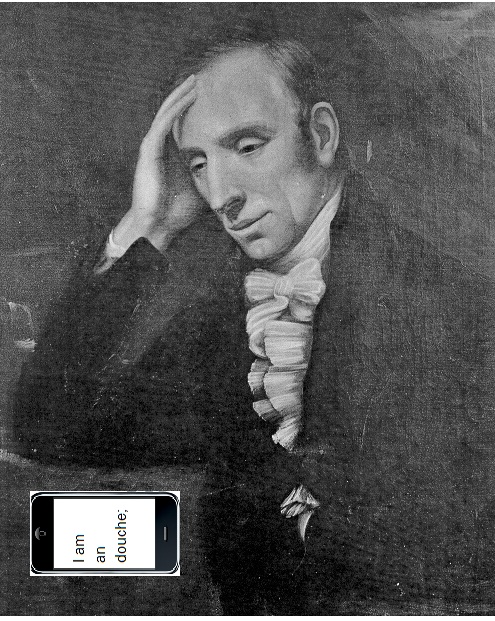
Reading Poems From Your Phone


This would piss me off, too.

I still see poetry as being intrinsically attached the page (yes, yes – I know that poetry began as an oral art). And I would definitely feel cheated if I went to a poetry reading and someone started to read a poem from their f–king phone. Cheap, man. Real cheap.

Poetry Apps


Famously, one of the best selling apps in England was about T.S. Eliot’s The Wasteland.

Now, in Mexico, Octavio Paz is storming the iPad app world.

Still waiting to find out the best selling app in America is something about Walt Whitman. Should I hold my breath?