The real threat to competition.
Tuesday Morning Staff Meeting – Serious Scholars Only
The Books Of The Future
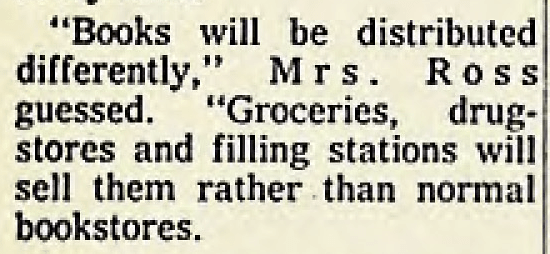 This blog posting, A 1962 Vision of the Twenty-First Century Book Trade, made me unexpectedly nostalgic.
First off, let me acknowledge some of the prescience of those prognosticators of fifty years past. The prediction about microfilm could easily be seen as prefiguring the e-reader. And they predict modern audio books and reading on computers and one person was right on in predicting the rise of the Borders and Barnes & Noble style bookstores (though he did not predict their struggles).
But it was Mrs. Ross’ comment about books being sold in groceries, drugstores, and filling stations.
Of course, one of the big stories of the book business has been how warehouse stores like Wal-Mart have cannibalized a decent percentage of the business of bookstores by stocking a small collection of best sellers.
But I remember the circular, spinning wire racks in drugstores filled with thin paperbacks. Mostly of the Harlequin and Zane Grey type, but sometimes with some kids novels or science fiction or fantasy. You can still find a few thick romance tomes in drugstores, but I haven’t seen one of those wire racks filled with pulps in a drugstore since visiting Arkansas for my aunt’s wedding. We stopped in a drugstore (with a soda fountain counter) and there it was. The last I can remember in such a place.
I know I must have bought a few books from such racks. Though as a kid, mostly I just looked at the cover art and read the back of the book in awe.
Mrs. Ross was right, but the books in drugstores didn’t really make it to the twenty-first century.
Tuesday Morning Staff Meeting – Kindle Not On Target
Tuesday Morning Staff Meeting – The Book Of The Future
Monday Morning Staff Meeting – It’s Amazon’s Fault
E-Book Typography
 James Felici’s piece, The State of E-Book Typography, brings into sharp relief some of the obstacles standing between e-books fully participating in literature at its highest and best level.
Essentially, reading on a screen – especially a computer (include tablet) screen, but also an e-reader – is always (using current technology) going to be less readable than even the cheapest printed dime store pulp.
Felici makes the distinction between readability and legibility. Legibility being the reason that most folks (including myself when I’m reading my Nook at Eastern Market or on the subway or on the National Mall) use the sort of font size on their e-readers that, in a traditionally printed book, would be associated with large print editions for the vision impaired. Just the other day, I had to increasee the font size I was using to read Melmoth the Wanderer, an earlier nineteenth gothic novel, on my Nook while riding the Metro here in DC.
But that doesn’t help, he says, the readability, which is limited by the pixelated technology used to create the words on the screen.
And though there some fonts that are better than others (Verdana, Tahoma, Georgia, Cambria) for use when reading on computers or screens, the limitations remain.
As a result we still read 25% more slowly on e-readers than on traditional books.
I also think of the writers, designers, and typographers who choose the font used in their books so carefully.
Especially poets, who are already crippled in their ability to transmit the true quality of their work in an e-reader because of how the devices lay out the lines. In a literary art form that is so much connected to its appearance on the page, the inability to even truly control the font size seems like salt in the wound, insult to injury, or whatever metaphor you prefer.
I’ll let Felici finish up this thought:
The problem today is that after 500 years of evolution, the “printed” word has taken a step backward in quality. According to “The New York Times,” electronic publishers are commissioning shorter books because their readers find it too tiring to take on longer works. Ever since I started writing for online magazines I’ve been obliged to write shorter pieces than in the past because editors tell me that online readers simply won’t finish longer articles. With today’s technologies, reading is simply more of a chore than it’s been in the past. Access to reading material is amazingly easy — a revolution, in fact — but reading is more than just taking in information, and the aesthetics of text presentation involves more than just making type pretty. It means making type functional as well.
Weekend Reading – Imagist Journals

How Can We Not Want To Do This Anymore?
Look at this video of a book being created! Naturally, it’s from England, not America.
Just a reminder of the tactile and generally fully sensual beauty of a book…
The Coffee Philosopher Reaches A Minor & Unimpressive Milestone
As of sometime this afternoon, yours truly (or rather his blog) got his fiftieth ‘follower’ (which is less cultish and apocalyptic than it sounds) and has been visited more than 10,000 times. Took me long enough. I’m really not very much read considering the amount of time that goes into this. Maybe I should get a real job.
 the coffee philosopher