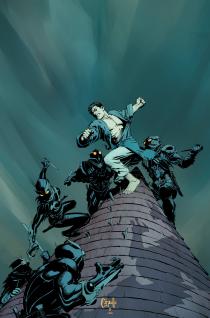
Reading Batman On The iPad


You’ll recall that I indulged in reading a bound trade copy of the first seven issues of DC Comics ‘New 52 Batman.’

Well, it quickly became clear that if I wanted to continue the story, I’d either have to wait until next spring, when the next six or seven issues were bound, or catch up by reading the latest issues on my iPad, because comic book stores don’t have space to keep back issues like that.

In any case, the title of this darn thing should have given away what I eventually chose.

The physical technique for reading (scrolling?) through on an iPad took a few moments for me catch on to. But the effect is dwnright cinematic. My two complaints are that if you choose to pull back and view an entire page rather than a single panel, the resolution suffers greatly, particularly when reading the dialogue; and that sometimes, you just need to see a larger image because of how the panels are arranged (smaller panels placed over a larger panel, for example), but it doesn’t always make clear when you should pull back and it gets a little confusing. The latter, though, can be mended by practice on the reader’s part.

When I left off, Batman was looking more than a little battered and he remains that way when issue #8 opens. Which, artistically, is a good thing. One of my complaints was that square jawed men tend to look alike and that the only way I could differentiate Bruce Wayne from the character of a particular politician was by Bruce Wayne’s boyishly tousled hair (and I didn’t like him with boyishly tousled hair; too young and hip when I feel he should be formal and old money styled).

Now Bruce Wayne’s hair is tousled from having been been beat up and battered. He looks appropriately aged and appropriately unique. Not just another squared jawed hero, but a particular one. Of course, that also runs contrary to an earlier criticism, which I implied that I almost wanted the earlier Wayne to be more generically handsome and rich than uniquely something. So I hold two ideas at once? So what? Read Kant’s Critique of Practical Reason, ’cause he totally says that’s cool, at least sometimes. Or, at least, he writes about it a lot.

As if taking advantage of the cinematic appearance on the iPad, several action sequences are broken up in that ‘Bourne’ style – with fragments of the body seen, rather than a complete whole. Frankly, that style works a whole lot better in a comic than in a movie. Assuming the comic pulls back to show the whole every so often. Christopher Nolan’s first two Batman movies suffered from incomprehensible action sequences on account of never pulling the camera back to give the viewer an idea of geography – of where characters were situated in relation to each other.

#8 comes dangerously close to the error of making what had been a dangerous, nearly unstoppable villain before (in this case, a sort of owl ninja – which is a lot more impressive than it sounds) into something a little more manageable. In the first seven issues, Batman struggles to fight even a single one of them. Now, he’s fighting a bunch of them and having too easy (though still a difficult) time of it (particularly as he’s still hurt).
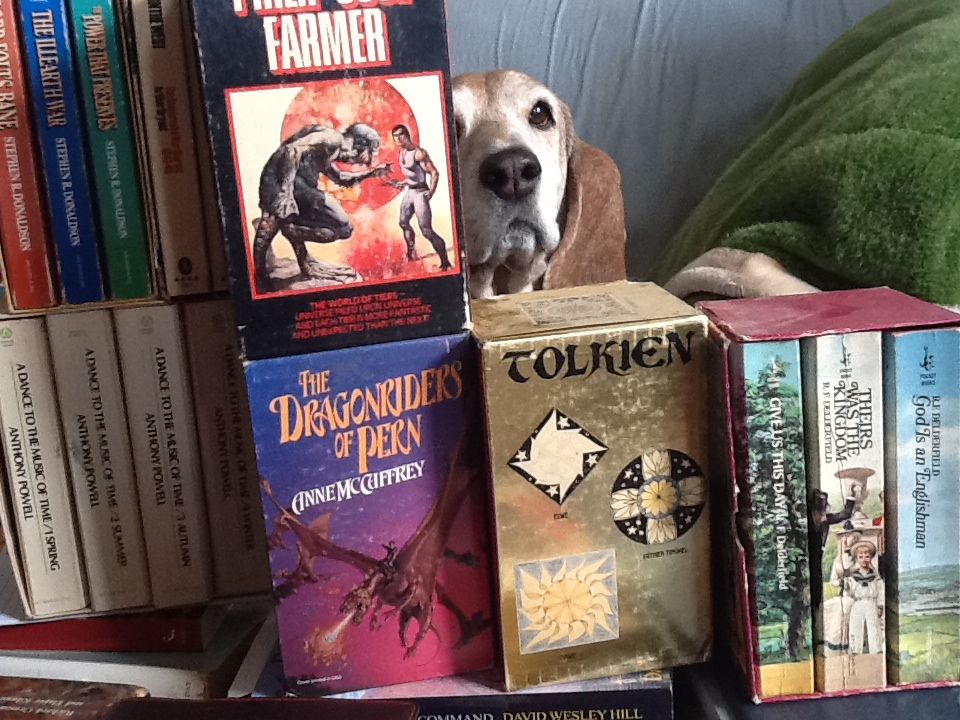

Whither Boxed Sets?


So, I read this fun little piece about box sets by Steve Donoghue in Open Letters Monthly, but rather than reveling in the potential playfulness of box sets and the implied seriousness of box sets, I wondered ‘whither box sets?’

It’s no surprise that of the six boxed sets featured over there, four are of science fiction or fantasy series.

After all, the last boxed set I purchased was of books seven through nine of the the Wheel of Time series.

With the rise of e-books, do they make much sense?

Or perhaps they do.

Boxed sets of music are generally of higher quality musicians (a lot more Miles Davis and Led Zeppelin than Backstreet Boys and Justin Bieber), but what if that is because fans of (say) Sonny Rollins are more likely to feel attached to the physical object of the CD or LP and more likely to desire it.

Similarly, science fiction and fantasy readers tend to be obsessive and completist types. Might’n we be tending that way, too?

But, of course, all that goes back to the issue of books becoming less items of mass consumption than something for rarefied and (generally) older collectors. Like fans of jazz. Jazz hasn’t been truly popular since the sixties (I once read an article that blamed Dave Brubeck’s rarefied style for helping establish jazz as arty and intellectual and laying the seeds for it’s decline as part of the vocabulary of popular music).

Stand Up To Hurricane Induced Power Outages


Use a typewriter.

Saturday Post – President Heidegger


Goes straight after John Ashberry, doesn’t he?

What if Heidegger had become leader of Germany?

The ultimate in existentialist blogging.

The myth of the ‘Liberal Media.’

The Sunday Newspaper – Poetry In Jakarta


The Call to Poetry festival.

T.S. Eliot Prize nominees announced.

In Newark, poetry matters.

Do you young people still read and go to libraries? (hint: yes, they do)

Embarrassing


I point to this piece only to note what c–p it is.

‘In the face of the openness and honest labor of engineers, the priestly class closed ranks.’

So, authors and publishers were the ‘priestly class’ (Pharisees?) interfering with these yeoman engineers. Nothing at all about the fact that their intellectual property, which is also their economic property, was being put online to used however one like without the creator having any ability to control its publication nor receive compensation. And a (I don’t say the) reason, let’s face it, was for Google to make money. To make Google to source for one more thing (literature), thereby making their ad sales that much more valuable.

The essayist tries to create the unsubstantiated straw man argument that the ‘priestly class’ acted out of some kind of luddism, a refusal to accept change (some pointless crap about literature becoming data; correct me if I’m wrong, but isn’t ‘data’ really just information, knowledge? and was there ever an argument that, Great Expectations, for example, contained words which conveyed information and knowledge?), when it was actually about something far closer to theft of future economic value.

Monday Morning Staff Meeting – Future Books


Institute for the Future of the Book

Writing the ineffable. And why you won’t be able understand what our alien invaders are saying.

This Is Why I Don’t Buy From Amazon


You think they have your interests at heart? You think that once they’ve driven out all the brick-and-mortar stores, from Barnes and Noble to Inkwood Books, that they’ll keep prices low? If so, I’d like to sell you mineral rights in Costa Rica.

And our Justice Department carryied Amazon’s water for them, helping them to build monopoly.

Plainly, Amazon’s behavior didn’t resemble that of a retailer laser-focused on serving consumers. It resembled the behavior of a cable company fighting with a TV network over transmission fees by cutting off its viewers’ access to the network’s programming. You want to buy your books from a company that models itself on your cable provider? Me neither. – Michael Hiltzik, Los Angeles Times
http://www.latimes.com/business/la-fi-hiltzik-20120912,0,1949778.column

Book Reviews


The nature of book reviews has become rather controversial lately. Especially as high profile book reviews, in magazines and newspapers, have become more precious as newspapers and magazines reduce or eliminate the amount of space given to books. One question is: should one be critical? Not critical in the sense of critical thinking, rather, in the sense of writing negative things about a book. This is an especially poignant questions when it comes to poetry. With so little space left (and please, let’s not count blogs like this one – they are no substitute for the Sunday book reviews that your local newspaper hopefully still includes), is writing about a book we don’t like worthwhile? Or should we focus on book reviewing as promoting quality books? But even when writing online, if we truly care about book culture and poetry culture, does writing harsh reviews hurt it, but making it seem less worthwhile, or support it by building an honest dialogue and culture of critical thought? It’s easy to take the high road and say, the latter, of course. But it is true that literary culture is suffering from a debilitating sickness, I think. And if it is, does the latter actually speed its sickness towards a nasty end?

Below are some articles and arguments on this subject:

Against Enthusiam

Some Notes Against Enthusiasm

In Celebration of Enthusiasm

Has Twitter Made Book Reviewers Too Nice?

Arthur Krystal: The Excuses of a Mean Book Critic

A Critic’s Case for Critics Who Are Actually Critical

Is This Book Bad, Or Is It Just Me? The Anatomy of Book Reviews

How Is the Critic Free?

Nice Book Reviews

How to Be a Critic

A Failure in Four Parts

Melmoth The Wanderer


Can I just admit it? Melmoth is a slog. I bought this book for my Nook at least two years ago and I’m just now finishing it.

A late period gothic novel (which is the say, the 1820s – well after the gothic novel’s Radcliffe fueled heyday of the 1790s), has the anti-clerical bias of the form, but without the intricacy of Radcliffe’s best novels or the over the top salaciousness of Lewis’ Monk.

I think The Monk is the best comparison, or rather it is what Charles Maturin is attempting to re-create in Melmoth the Wanderer. But The Monk kind of killed off the form by taking it nearly as far as it go (a priest rapes his sister at the suggestion of the Devil; Lewis didn’t hold back much).

This has the supernatural elements of Lewis (which Radcliffe famously eschewed), but lacks his lushly, filthily erotic sense of elan.

To give a quick overview: there is a sort of Wandering Jew character, except he’s not Jewish and he’s an instrument of diabolic temptation. His name is Melmoth. There’s also the Melmoth family in Ireland and it’s sole heir who sees a painting of this other Melmoth and maybe sees that other Meltmoth in person. And then there’s the Spanish dude who shipwrecks on the Irish shore after escaping from a monastery and the Inquisition (all of which occurred because of some incredibly evil yet also incredibly over complicated and poorly thought out plan by the confessor of this Spanish dude’s parents). And then there’s the story within the story found by said Spanish dude about how Melmoth finds a beautiful shipwrecked girl who is innocent and pure, who then gets found by her real parents and discovers that the Catholic Church is bad (unlike the pure spirituality in her heart) – oh, and they fall in love, too, and run off to get married.

Anyway…

I don’t mind the complications and permutations – I love Almodovar films, after all – but it just lacks… I don’t know. Something. If you’re going to write something nearly six hundred pages and not put any sex in it, you need to do something to make it pop. Maturin doesn’t make it pop. But you should read The Monk. That s–t is freaky!