I Forgot Huckabee


I forgot Huckabee while writing about the GOP field. And he is a strange case.

He is a strange case partly because, for all the talk about the Tea Party, Huckabee manages to lead the GOP field while being very much an anti-Tea Party candidate. He has not tried hard to kiss up to them and his record is not all in line with their ideals. Yet he is the most popular GOP candidate and has the highest favorables.

If Huckabee runs and wins, it would signal the decline of the Tea Party as the dominant force in Republican politics (which is already happening, as a number of new congresspersons and senators elected with Tea Party support are backing away from them now that they are in office; I’m talking to you Marco Rubio!).

The GOP Field


Besides poetry, my other love is politics. Up until now, I have refrained from commenting much on politics, but a relative encouraged me to speak my piece a little. I will promise not to write about candidates in races where I have a vested financial interest, i.e., where someone is paying. I won’t necessarily tell you who I’m working for, but I won’t comment on their campaigns.

Senator John Thune (R-SD) pulling his name out of contention for the Republican presidential nomination is the best thing that could have happened to President Obama and to former Governor Tim “T-Paw” Pawlenty.

Obama is consistently polling slightly behind a “generic” Republican. But, once the names of the leading contenders are included, he jumps to a solid lead. Thune was the closest thing the GOP had to a “generic” Republican. With the exception of his vote for TARP, there were no major knocks on him. He was telegenic, handsome, conservative, and… well, generic.

Absent Thune, T-Paw becomes the closest thing the field has to a “generic” Republican. He has a decent shot of snatching the nomination against better known and better funded rivals, just on the basis of being less unpalatable than figures like Romney, Gingrich, Palin, and Bachmann.

Unfortunately for the GOP, while T-Paw is a decent campaigner, he will also lose his home state of Minnesota and is probably not dynamic enough to take out Obama. He would probably do better than those other names I mentioned, but he is unlikely to win the election.

Wayne Kramer & Street Dogs


In lieu of a traditional holiday party, the AFL-CIO hosted a small concert in the Samuel L. Gompers room last night. They brought in a couple of hard core, activist musicians – the Boston-based celtic punk band Street Dogs and the godfather of punk, Wayne Kramer. Street Dogs rose from the ashes of the Dropkick Murphys. Front man, Mike McColgan, actually left the Dropkick Murphys to become a firefighter and only returned to playing music full time about six years ago. Wayne Kramer, of course, is the former guitarist for MC5.

The show was pretty damn awesome. Both sets were fully acoustic, but the Street Dogs still rocked it like it was plugged in. And a middle-aged AFT member showed up carrying a vintage MC5 album from the early 70s and we got to see Bob Creamer, Congresswoman Jan Schakowsky’s husband, get his groove on near the front of the audience.

What Is An Intellectual?


I ask because I’ve been reading two books address that question.

On my Nook, I just finished Tony Judt’s The Burden of Responsibility: Blum, Camus, Aron, and the French Twentieth Century and have been reading (in a more traditional form) Edward Said’s Representations of the Intellectual.

I was, I am ashamed to confess, mostly unaware of the stories and works of Leon Blum and Raymond Aron (like many young men with intellectual pretensions and a smidgen of angst, I feel deeply and platonically in love with the idea of the Albert Camus – the tormented figure on the cover of my edition of his collected journals from 1945-1951 [see picture]: the aggressive sex appeal of Humphrey Bogart and the tormented moral questioning of Soren Kierkegaard).

Edward Said was someone I had read, but never in depth (a fact that this slim volume cannot be said to have remedied).

Whereas Said is explicitly attempting to impose stricter criteria on the intellectual (in an age where every blow hard on Fox News thinks himself to be a public intellectual), trying to take that title away from those whose actions have thrown away the right to call themselves one, Judt takes a less questioning view of the idea of the intellectual. Ultimately, he does not question that those who put themselves forward as intellectuals are exactly that. What he does do is put these three figures (Blum, Camus, and Aron) up as sort of “super-intellectuals.” Figures who somehow exceeded or at least operated outside the traditional lines that mark the French public intellectual. He even denies that Albert Camus was truly a public intellectual (not an intellectual, but a public intellectual) but rather part of a tradition of les moralistes – of moralists. Camus as a tormented Rousseau to Sartre’s self-confident Voltaire.

Said’s main beef is with professionalism, which he sees an insidious force that works to (my words, not his) neuter intellectuals (which point, Said would no longer consider them intellectuals).

It’s a hard road he calls for. One of the pitfalls of professionalism is specialization, which is singled out as a means by which a potential intellectual, with the potential to shake things up, is moved to an area of safety (safety from the perspective of those who might be called out by an “un-neutered” intellectual). This is a hard road, because he calls for the intellectual to be as close as possible to being an Renaissance man – someone who has made reasonably deep studies in a number of different fields. Arguably, it has been impossible for nearly two centuries to be a true Renaissance Man. Not since Goethe has the available scope of human knowledge (at least in the Western world) been sufficiently manageable for one man to be able to write innovative treatises on both the science and mathematics of meteorology and chromatics and to also be a world class novelist, poet, and essayist.

What Said is calling for is resistance to some of the specialization one sees in the literary and philosophical fields that, of necessity, limits wider vision.

But both Judt and Said see their respective figures (three specific figures in Judt’s case; a more nebulous construct in Said’s, though he seems to view Noam Chomsky as a sort of ideal intellectual) as being outside the dominant intellectual sphere.
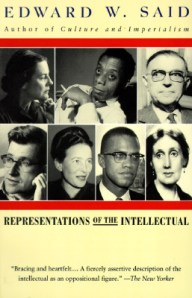

Edward Said


I was with a friend watching the Cleveland Cavaliers get stomped by the Miami Heat (starring Cleveland apostate, LeBron James). It was not a pretty sight. My friends was not from Cleveland, but had spent a lot of time there as a fundraiser for Democratic candidates in Ohio last year. We crowded into a Dupont Circle sports bar and watched. Eventually, I gave up and made my way home via the metro while my friend joined some other Ohio expatriates at the Big Hunt.

Before moseying home, I stopped at Kramerbooks to browse and to pick up something to read on the subway. I was bouncing back and forth between selection of poems by Paul Celan and a transcribed lecture from 1993 by Edward Said entitled Representations of the Intellectual.

As you have probably guessed, I went for Said. No disrespect to Celan, but Said was slightly less expensive and small enough to fit in my winter coat’s capacious pockets.

In the early stages, Said is simply juggling with what an intellectual actually is. He seems to be leaning towards a conclusion of the intellectual as someone who is outside the system in many ways – that, in fact, the classic French mandarin might not actually be an intellectual.

This struck me because of how it lined up with Tony Judt’s The Burden of Responsibility: Blum, Camus, Aron, and the French Twentieth Century. I just finished reading the middle section of that book (on my Nook, no less), the part about Albert Camus. He proposed that Camus was not truly a public intellectual, in the way that Jean-Paul Sartre and Simone de Beauvoir were. Instead, he places him in a slightly different tradition, that of the French tradition of les moralistes. Different from our moralists, which, in English, implies a hypocritical and conservative figure who speaks with ill-conceived religious certainty. Rather, une moraliste is someone who exists outside of the mainstream of thought and is constantly wracked by doubt and approaches the problems of the age from an abstracted, alienated perspective. The example he gives is Jean-Jacque Rousseau as le moraliste in contrast to public intellectuals like Diderot, Voltaire, and Montesquieu.

I was struck because Said’s definition of an intellectual appears to be similar or parallel to Judt’s les moralistes.

Of course, Said has the entire rest of the book to flesh out his definition and this similarity may not hold up until the very end. But it is certainly a new way to think about the role of the intellectual in society.

going going


The other day, I pulled a little chapbook called  going   going by Jen Hofer out of my bookcase. I was just looking for something small to put in my pocket and read when going out to grab some noodles and pick up my niece, who was taking one of the Chinatown buses in town.

I remember very clearly buying this chapbook. It was at a Poets Against the War reading at Skylight Books. I went because I love Skylight Books and because Wayne Kramer was reading. Wayne showed up in an orange, prison jumpsuit and read some works in his hyper, rat-a-tat-tat style (he reminds me, in that respect of my friend, the Florida poet Brad Morewood – though Brad has never been, so far as I know, a seminal punk musician like Wayne).

I can also say without a doubt, that this occurred on January 13th, 2008. I know that because Jen wrote it in the chapbook.

going  going is a little handmade number, constructed out of index cards and postcard from Death Valley, clipped together at the upper left hand corner. Whether it was done on a typewriter or not, it wonderfully mimics the font of an old, manual typewriter. The whole thing has a sort of Larry Eigner feel (though I say this having read very little of Eigner – I leave it to my betters to correct me in my comparison).

It is a good, hard edged books of politically aware (if not always explicitly political) poetry. It was put out by the small internet mag and sometime chapbook publisher, Dusie if you wanted to try and find it.

Charles Wright and Pastoral Poetry Further Reconsidered


For some reason, pastoral poetry has been in my thoughts these last couple of years. It’s genesis, I put down to my (re)discovery of Wordsworth a while back.

But much of what I’ve written here was been somewhat critical of contemporary pastoral poetry. I tentatively agreed with the idea that pastoral poetry that does not also participate in a certain eco-poetic-politics is insufficient – the idea that it is not enough to write about the nature when so many dangers to it exist. The example given (not by me) was that it is insufficient to write about the songbird and not about the bulldozer nearby that threatens it. Adam Johnson called it “ecological orientalism.”

I have also jumped on the bandwagon of those who look at W.S. Merwin and see someone whose writing since The Lice and The Carrier of Ladders leave something to be desired. I bring that up because, The Lice, in particular, is such a great example of eco-poetics: pastoral poetry that encompasses the man made dangers threaten the natural world. His more recent writings, while still perhaps good, lack the urgency and conviction of those early eco-poetics. They are, in short, what I find to unpalatable about contemporary pastoral poetry.

But my feelings may change. Even now, I reserve the right to change and evolve.

For example, I used to lump Charles Wright in the same category as Merwin. Wright’s first book was published between The Lice and The Carrier of Ladders, so I think we can safely place them in the same generation of poets. And he has also indulged in his fair share of pastoralisms. But I read him and see someone who, while not writing within the Snyder-esque, deep ecology vein of early Merwin, still finds a way to make his pastoral indulgences relevant. He also gives the aging poet some hope, having not clearly peaked by his forties and continuing to evolve and improve over the years.

I bring this up more to question myself. I am not sure how real the distinctions I make really are and much I am merely justifying unjustifiable prejudice. Because I must be nearly the only person to prefer Wright to Merwin (I know plenty of poets who lean more towards the avant-garde who can’t stand them both and my classically quietist and septagenerian father just loves Merwin and couldn’t care less about Wright).

Oh well. As long as I continue to find Billy Collins offensive, I will know I haven’t completely lost my way.

Slow Poetry


The Atlantic‘s five part series on poetry continues with this piece on “slow poetry.” I skipped over the third in the series, which discussed “flarf.” Why? Because, frankly, I have little interest in flarf. I don’t deny its aesthetic value, merely that those aesthetics have yet to grow on me.

Slow poetry – that sounds like something more up my alley.

Of course, it quite self-consciously reflects the “slow food” movement. The idea of slow, close reading and respect for local small presses is something I can get behind.

He also discusses (all too briefly) the difference between “nature” poetry and contemporary “ecopoetics.” The argument being that traditional, pastoral poetry is insufficient for the poet writing today. If you write about nature without writing about the human threat under which nature lives, you are just engaging in a paternalistic program (he calls it “ecological orientalism”).

Co-Owner of Politics and Prose and Titan of the DC Literary Scene Passes Away


Carla Cohen, one of the two co-owners of Politics & Prose, passed away early this morning. She was 74 years old and suffering from a rare form cancer.

The owners of Politics & Prose have been seeking new owners to buy them out for some time now. Carla Cohen and Barbara Meade turned the bookstore into a nationally recognized bookstore and a DC institution. Even as Barnes & Noble and Borders have struggled, Politics & Prose has, according to all reports, remained solidly profitable. It is believed that there are a number of would-be buyers, but that they were looking for someone they could count on to maintain the store’s cultural, as well as business, legacy.

Like Sylvia Beach, we should recognize the contributions to modern literature of people like Ms. Cohen, who provided a place where books where properly and respectfully flourish.

re: evolution


re: evolution, another book from Les Figues Press, did not immediately hit me the way that Voice of Ice, Voix de Glace did, but that does not make itless of a work.

The work is divided up in small sections – an “introduction,” 48 “chapters,” a “denouement,” “the end,” and finally a section that mimics (but is not) end notes entitled “research paper.”

The dominant tool is one of deconstructing language, science, and culture. re: evolution also contains more than a whiff of feminism – with the deconstruction seemingly put to the task avoiding redcuctivism by objectification or fetishism. Unfortunately, it also led to the relative absence of any eroticism. Not strictly sexual, but the sense the writer “desires” the words, “desires” the poetry s/he is writing is not there – not for me anyway. But am I just inflicting/projecting my own gendered sexuality onto the work?