Why Liberalism Failed


A sort of instantly frustrating book, beginning with the misleading statements and deceptive terminology of the (apparently) new preface. When he claimed liberals were ignoring custom, and this written post-Trump, I nearly put it down.

But the real issue is that he conflates or distinguishes classical liberalism from contemporary western liberalism (or what can frequently be called progressivism), as it suits his needs. He acknowledges this complaint… but miraculously fails to explain why it’s wrong.

His arguments are, in truth, against modern Western culture. His targets begin with modern philosophy, which is to say, around the seventeenth century, but really, he is railing against what is sometimes referred to as the Enlightenment project, but deliberately uses words or goes off on tendentious digressions (usually around culture war issues) to make it seem like centuries long project is identical with a caricature of the Democratic (and implying, as well, that the loyal opposition is nearly free of these original sins).

I was reminded of a moment during the 2020 vice presidential debate and Pence answered a question about climate change and hurricanes by saying that scientists actually say that we aren’t having more hurricanes. Which is true (scientists say that climate change is increasing the strength, not the frequency of hurricanes). And knowing that, it is obvious he knows the truth about climate change and just chooses to ignore it for crass political reasons.

Oh. And apparently acceptance of transgendered people is the direct cause of both child trafficking and the use pregnancy surrogates. I wonder if this is what QAnon is like?

I could write more, but after reading some unfortunate remarks about the Civil War (which included some subtle support for the unreconstructed), I became convinced that is an attempt to creat an intellectual framework for the overwhelmingly white and mostly male rage that has fueled bigotry and violence in our country. He sometimes seems to praise a semi-rural, (practically speaking) white golden age and I almost thought he would advocate for a sort of Benedictine option, but running beneath it all is an angry undercurrent of support for tearing it all down which only feels more dangerous today than it must have felt when it was first published. And while he makes symbolic jabs at Republicans (Rubio gets name checked, which is fair, seeing as how he has never had a real job in his entire life but has always suckled at spigot fed him a mixture of tax dollars and lobbyist largesse; but the real target is always a caricature of white liberalism and dependents on the government, by which he doesn’t mean snotty little brats like Rubio, but the more usual targets of Republican ire).

I am trying to read conservative thought because I want to go beyond my own accepted beliefs, but I want to read intelligent discourse, too, and this book is a hot mess of learning gleaned from watching YouTube lectures on ‘Great Books’ (note: being able to reference the allegory of the cave from The Republic doesn’t make you sound smart; go a little deeper into the catalog if you want me to think you’re well-read) and dime store sociology, overlaid onto what I have said I believe is toxic resentment.

In short, it’s trash.

The Tyranny Of Merit: What’s Become Of The Common Good?


Despite some half hearted references to other cultures, this book is distinctly aimed at America. While I agree with much of its premise (which is more about assumptions of merit; that those who more deserve it, while those who have less are intrinsically inferior, because they lacked the necessary merit), I was made hesitant early on by his relatively uncritical acceptance of Weber’s famed Protestant work ethic as a sort of modern source (though he also notes earlier, also biblically inspired ideas about meritocracy).

My fascination with Thomas Jefferson got a jolt when he compared the introduction of the SAT to Jefferson’s idea of providing education to America’s ‘natural aristocracy.’ In Jefferson’s view, small, local schools would exist in part to unearth the small number of geniuses from among the ‘rubbish.’ Conant, the man who came up with the SAT, also wanted to find those select few. It was never intended to expand access, but only to find what Jefferson would happily would have agreed was his natural aristocracy.

Solutions are few and far between, but I don’t ask Sandel to be Rawls (who, incidentally, gets a minor, but definite, raking over proverbial coals). And I liked his idea of changing college admissions to a modified lottery process. For example, a competitive Ivy League university will get tens of thousands of applicants, something more, or at least close, to half of which can be reasonably considered to be qualified and otherwise equipped to succeed there. Take that number and give out acceptances based on a lottery. I like it. The book as a whole, however, feels like it somehow fell short. The analysis goes into depth on issues, but always feels like it pulls back and doesn’t go all the way in ways that I can’t quite put my finger on.

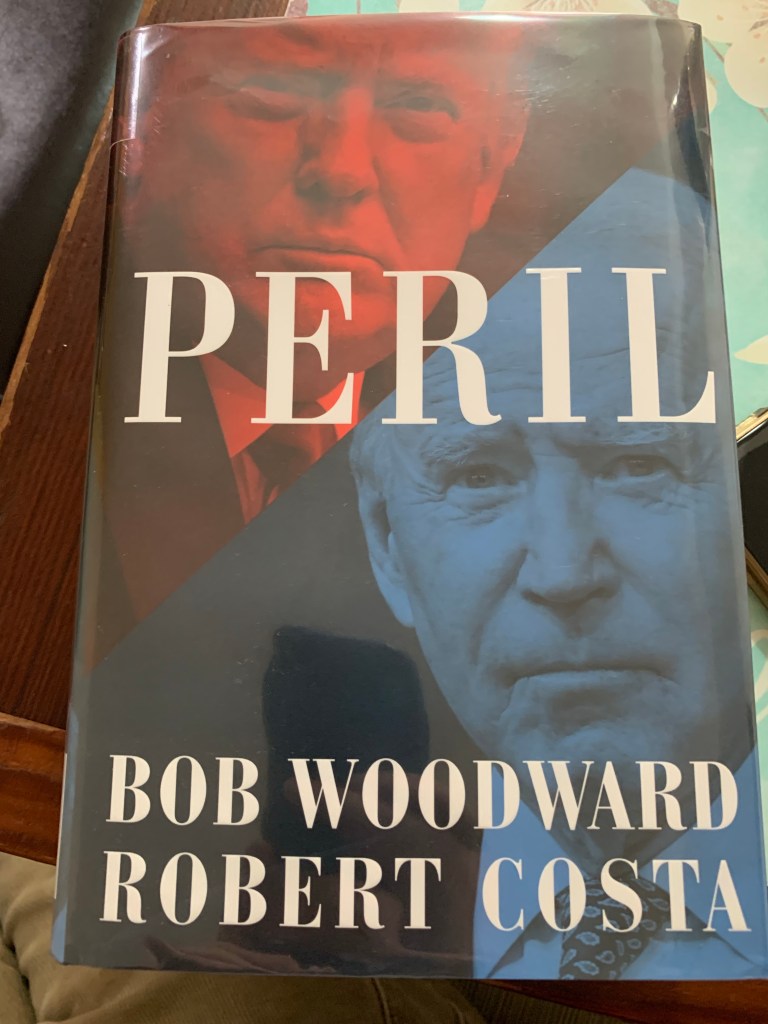
‘Peril’ By Bob Woodward And Robert Costa


I remember being told that newspapers were deliberately written at a fourth grade level. I, uh, um… I can kind of see that here.

Don’t get me wrong. I wish I had properly learned AP style, but for heaven’s sake, men, modulate your sentence structure just a little! Reading these short chapters, containing short sentences and simple language is surprisingly exhausting. I’m not saying it’s like reading Ulysses, but I never reading such basic writing could be so tiring.

Despite, the title, the book was less terrifying that I had suspected. Yes, it’s terrifying, just less so. You never get a good view of Trump (the authors might have tried engaging in just a little psychological theorizing, just to jazz things up). He’s just an angry guy with a short attention span and a potty mouth. If Woodward and Costa were inclined to psychologize, they might have suggested that childhood trauma left him an emotional child, who things ‘I won’t be your friend anymore’ is a viable threat to a grown man. But they don’t do that.

You probably won’t learn anything you didn’t already know if you read newspapers… at all. I mean, did you really not know that Trump is a petulant, foul-mouthed man-child who never grasped the realities of governing?

It’s fair to say that reading Woodward’s Trump book (I know, Costa is a co-author) is less about learning the facts than playing DC cocktail party games of identifying who the sources are. It’s an easy game, because you can clearly see his secret ‘sources’ burnishing their patriotic credentials and engaging in a drawn out process of explaining that ‘it’s not my fault’ or ‘I was the only thing standing between the Constitution and Trump’s gold plated toilet.’

The book also suffers from splitting its time between Trump and Biden. At first, my interest was perked by insights into Bidenworld, but that is just so much less compelling than Trump’s unhinged bucket of crazy. The only thing that really caught my eye was the deeply petty excuses that Senator Susan Collins fed to Woodward and Costa to justify being Lucy to the football of bipartisanship (I kid you not, one was that Ron Klain shook his head too vigorously during an Oval Office meeting; she really is a piece of work, I must say).

Twilight Of Democracy: The Seductive Lure Of Authoritarianism


I don’t mean to say it is not a well written book. It is even, dare I say, seductive. Nor that its points are not well taken. Ms. Applebaum brings a certain intimate knowledge of Eastern European and English politics.

I used to read her columns in The New York Times before the paywall was instituted (which I do not begrudge; I proudly subscribe to my own, local paper and some magazines, but like the multiplying streaming services, I can’t subscribe to them all), but it’s been a while and my understanding of her positions has faded somewhat.

So while reading all of her interesting anecdotes and well-made points, I keep thinking, who did she remind me of? Htichens? No, someone more… irritating. Then it hit me! Thomas Friedman! A well worn gasbag of a neoliberal, technofetishist, with a penchant for name dropping that would make Gore Vidal feel ashamed. Friedman was neoliberal masqeurading as center left and Applebaum was neoliberal who was rather openly center right (Tory, really, though her husband was once with the quite right leaning American Enterprise Institute), with solid smattering of classical liberalism. She doesn’t have Friedman’s veneer of Bernard Henri-Levy-ism (and neither try to pull of inimitable coiffure and sartorial exposures), but, yeah. A less irritating Friedman, but because his conclusions are always so facile and suspect, I immediately began to suspect her, too.

Which is not to say that she deserves to be splattered by drunken Pollock with Friedman’s bloviating brush. I’m just saying that I’m suspicious.

She also notes that some of what the new Trumpist conservatives (like… wait for it… seriously, she name drops… Laura Ingraham) says is ‘real.’ Why am I implicitly impugning it’s real ness through the use of what amounts to air quotes? Because the first thing she mentions on her list is cancel culture, which is – and I can’t emphasize this enough – not real. Unless you’re talking about our God-given, Constitutional right to have a talk show or be highly paid to write poorly research columns for that publication. Now, I am doing her slightly wrong, because she notes that it’s cancel culture on the internet, but… I’m sorry. No. There are lots of terrible things out there, but no. Just… no. But she does say that Laura Ingraham once went on a date with Trump and found him unbearable. So that gave me a small amount of pleasure that almost made up for one millionth of one percent of the hatred, violence, and chaos that demented t—t consciously stirred up.

The most interesting idea in Twilight, which she readily credits to others, is key the personality trait in those susceptible to a longing for an authoritarian society: not closed mindedness, but simple mindedness (her phrase, not mine; I would have looked for a less charged way to put it). A dislike of complexity leads to seeking guidance from figures who explain that the world is simple (and often a more than a little manichean). Diversity and different ideas and experiences cause anguish in those who thrive under simpler concepts.

The other (sort of) interesting idea is the medium sized lie. Unlike the big lie of old fashioned fascists, the still big but less gargantuan lie of modern authoritarian parties dominates. While she didn’t use this example, something like the incendiary references to hordes of immigrants at the southern border (arriving in caravans?) came to my mind.

Thomas Jefferson: A Modern Prometheus


First, let me credit Professor Moses with being the first person I have read to refer to Thomas Jefferson as ‘the Count of Monticello.’ As someone deeply impacted by both Thomas Jefferson and Dumas’ epic novel of revenge, The Count of Monte Cristo, I applaud without reservation.

Jeffersonian agrarianism from Locke’s idea that property derived from making use of the land. Against speculators, rentier capitalism, and… American Indians making ‘unprofitable’ use of the land.

On the whole, his criticism and occasional fury are well merited, I must allow. His showing that Jefferson was not the child prodigy and possibly not as intellectually gifted as Franklin and Hamilton feels a little petty, but is possibly a necessary corrective to Jefferson’s (unwarranted, I reckon Moses would say) reputation for such great intellectual gifts as inspired Kennedy to make his famous remark about Jefferson dining alone to a group of Nobel Prize recipients. He actually spends almost the entire chapter on genius casting shade on Jeffersonian claims to it, before ending that chapter by concluding that, yeah, he actually was pretty darn smart.

Moses also made some nice references to Jefferson’s relationship to various works of history and philosophy, some based on direct knowledge (because Jefferson wrote down his thoughts) and some conjectural (like suggesting that Jefferson must have absolutely hated Plato’s dialogue, Crito).

I must also allow that when I defend Jefferson or feel defensive when he is attacked is possibly my own white privilege rearing it’s fish belly pale head.

I must also allow that this an absolutely terrific book. I don’t know who you are, reading this blog (besides my mother, of course), but whoever you are, this a fantastically researched, elegantly thought out work and you should read it.

I think I am the first to read this copy, which I borrowed from the library. The paper feels wonderfully new and so lovely to the touch. I remember in the Tin Drum, the narrator asking for a ream of virgin paper. This paper, too, feels virgin.

Thomas Jefferson: Revolutionary: A Radical’s Struggle To Remake America


The author is, quite clearly conservative (though I read that he received no little flak for having admitted to having voted for Obama in 2008). Not a Republican writer, per se, but something one might find favorably mentioned by the folks at the James Wilson Institute. Unsettlingly, Gutzman, while (grudgingly?) acknowledging Jefferson’s fathering of Sally Hemmings children, he also writes sympathetically of unreconstructed historians who rejected the idea.

But, I should be fair. He does not shy away from criticism of Jefferson on issues of race and slavery. Indeed, he is rather cutting. For example, he notes that our third president wrote rather deceptively of Benjamin Banneker. He suggests without evidence that a white friend might have given him help in creating his almanac (specifically, in doing the mathematical calculations) and criticizes his writing style as being indicative of an average mind, whereas Gutzman found it to clearly be from a man of cultivated intellect and sensibilities.

The section which covers in the most detail Jefferson’s thoughts on race and slavery is, I found, one of the weaker sections. Gutzman’s heart is clearly in the first part, when he outlines the Virginian’s federalism. Yes, a little jarring that the party opposed to Jefferson’s politics was called the Federalist Party, but he is using federalism correctly, at least in current usage, which, is, of course, a strict view of the limitations on federal power, with the greatest balance of government authority in the hands of the states.

Some of the other sections lacked, I felt, partly because Gutzman’s ideas on Jefferson and federalism were relatively new to me and many other topics were not. Under a chapter on education though, there is a remark that Jefferson was a fan of Henry Home, Lord Kames. That particular Lord Kames was actually David Hume’s uncle (Hume changed the spelling of his name, because when he spelled it ‘Home,’ Englishmen kept mispronouncing it) and my interest was piqued not just because I have an interest in Hume, but because of a particular letter in which Jefferson roundly attacked him.

‘The Enigma Of Clarence Thomas’ By Corey Robin


When I started reading this book, I didn’t realize that I’d already read a book by this author. And it arguably contains some of the same flaws, which is to say, a certain tendentiousness. Which is not to say uninteresting.

Robin makes an fascinating case for Clarence Thomas as being counterintuitively driven by a sense of black nationalism. I was frankly too lazy to read all the end notes and double check it all, so I’m taking the author’s word for it, at least insofar as the citations go. No reason to doubt, I should add.

Thomas, he argues (and this, to be honest, is not really debatable), was always a political creature and that was his route to the Supreme Court. He had never been a prominent nor respected jurist nor anything like a leading legal mind. In fact, he claims that Thomas literally hired two legal scholars to help him come up with a legal philosophy, because he was angling for seat on the Supreme Court and knew he needed one, or at least he needed to plausibly claim one.

Despite this political background, he believes that politics is ultimately incapable of solving anything for black Americans. His opposition to voting rights and support for gerrymandering is really, Robin argues, about weaning black people from the idea that there can ever be a political solution.

There are more arguments like that and… it’s frankly pretty nihilistic. Which, let’s face it, Thomas’ record is pretty nihilistic.

Something more than mid way through, perhaps around the 2/3 mark, there is a remark which struck me because it encapsulated something in head and which also, I believe, explains well the judicial philosophy of the late (great?) Antonin Scalia:

There is little doubt, however, that the originalist Constitution, the vision of the text as it was written and understood at a distant point in time, plays an outsized role in Thomas’s imagination. The originalist Constitution functions as an organizing myth, a holy fire Thomas is forever nearing, an idea more important for its “expressive function” – what is says to Thomas and what he means to say by invoking it – than for its regulatory role in his jurisprudence.

The Enigma of Clarence Thomas, pp 151-152

‘From Dawn To Decadence: 1500 To The Present: 500 Years Of Western Cultural Life’ By Jacques Barzun


I knew of Barzun as one of one of the New York intellectuals of the fifties and sixties, but only knew of him; I’d never read him.

But after reading an essay by someone who knew him (I can’t remember where I read; some right leaning publication, I believe, but one of those who mostly try to ignore Trump and assert some intellectual legitimacy to the right), I thought I should rectify that.

For better or worse, all the library had was his immensely long, late in life, magnum opus.

A couple of things struck me while reading it.

First, a fascinating aside about Hamlet within another aside about Shakespeare. He points out that it is a modern understanding to think of him a vacillating. In fact, Barzun argues, he was being judicious in a difficult environment. It is no small thing to kill a king and dangerous if you fail; also dangerous if you succeed, because you are vulnerable in the short term to popular unrest or the ambitions of nobleman who sees opportunity in the inevitable chaos. That he was not indecisive is proven, he writes, by Fortinbras saying, upon finding the scene of slaughter at the end (I am giving nothing away, I hope), that Hamlet would have made a great king. Surely, if Hamlet were the waffling type, this would not be the case. He also suggests that Laertes is included to point out the contrast between an impetuous character and a careful one; Laertes’ recklessness makes him an easy tool for Hamlet’s uncle. It also nicely matched an interesting (but not great) production of Hamlet that I saw at the Folger, where the director challenged the actors and audience not to focus on psychology, but on the actions of the characters.

Second, I am an elitist. I already knew this. But Barzun is writing elite, cultural history. He is not Braudel. He’s not even a Durant. He is an apostle of high culture. And, well, I like reading about that. That said, his brand patrician elitism can elide decency and slip into something distasteful, as in his off hand, Malthusian remark about “the rapid increase in people as hygiene and medication recklessly prolong life.” He was in his nineties when he wrote this book.

What did I learn? Well, it is the sort of magisterial, grand work one doesn’t find so much anymore, so one does learn a lot. Too much to sum up. But…

I’m not sure that counts as learning, but his thesis that monarchism is the key to unlocking an understanding of the baroque was fascinating, even if I am not qualified to judge it.

His portraits of cities as exemplars of particular times – Venice in the mid seventeenth century or London in 1715 – are as masterful as they delightful, until they are not. Paris in 1830 is oddly, mostly about German thought. His pastiche of 1895 showed an unsurprising indifference.

It feels like, and this especially struck reading his reading of the twentieth century, that the figures he most enjoys are more contemporary ones whose style harkens back to the witty and learned diaries, essays, and criticisms of Samuels Pepys and Johnson and the men who filled the pages of the Tatler and its siblings of the eighteenth century. But he does namecheck Garbage, one of the great bands of the nineties (the 1990s, that is), even if disparagingly (in the context of band names that are… bad? Dirty? Filthy?)

Should you read Barzun? Probably. He is Eurocentric and not terribly interested in non-white cultures, but these deep flaws don’t make him unreadable. Indeed, he is a witty writer. Lines like “a thin slice of antiquity for a large spread of modern butter,” in reference to French baroque culture’s preference for Roman over Greek antiquity struck me very nicely.

Some Peace Made, Some Peace Not


Did you know that Thomas Jefferson responded to Benjamin Rush’s letter suggesting rapprochement betwixt him and John Adams exactly two hundred years before Baiboon was born?

Which is important, but not exactly what first struck me.

While praising his erstwhile friend turned rival, he manages to get in a totally unnecessary dig at the late Alexander Hamilton of recent musical fame.

Another incident took place on the same occasion, which will further delineate Mr. Hamilton’s political principles. The room being hung about with a collection of the portraits of remarkable men, among them were those of Bacon, Newton and Locke, Hamilton asked me who they were. I told him they were my trinity of the three greatest men the world had ever produced, naming them. He paused for some time: “The greatest man,” he said, “that ever lived, was Julius Caesar.”

Thomas Jefferson, in a letter to Dr. Benjamin Rush, January 16, 2011

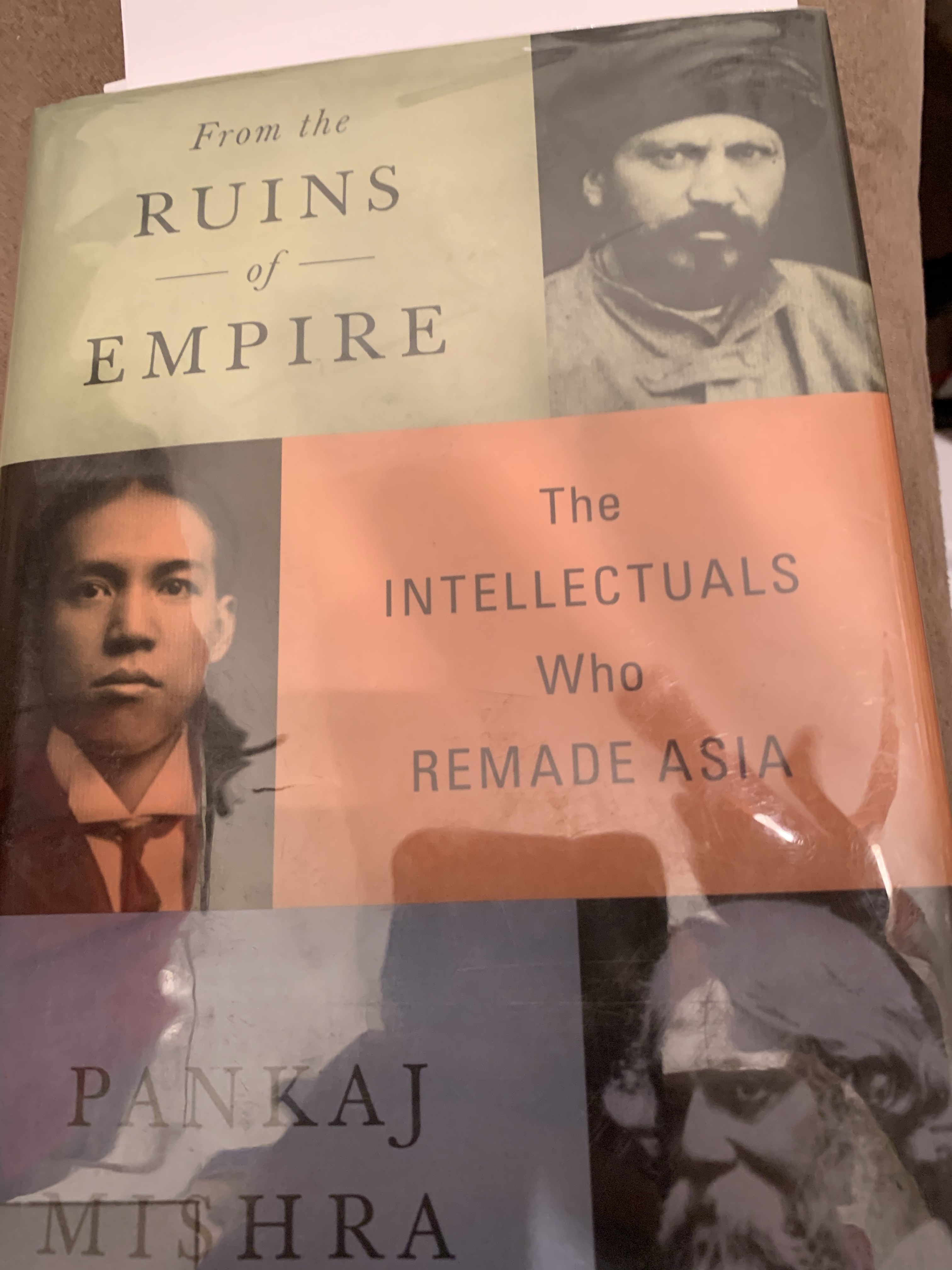
‘From The Ruins Of Empire: The Intellectuals Who Remade Asia’ By Pankaj Mishra


This book had been happily sitting in my ‘one day to acquire and read list’ with not much hope of moving on to a less passive state when The Washington Post took it upon themselves to review his follow up publication, which caused me to bestir myself and pester my local library to lend me a copy of the earlier book.

My father would greatly enjoy reading about the first figure Mishra biographs, Jamal Al-Din Al-Afghani, which is mostly fictious name (a Shi’a Muslim from Persia, he adopted ‘Al-Afghai’ to imply he was from mostly Sunni Afghanistan), classic sort of roving intellectual who traveled to many of the cultural capitals of the nineteenth century (Calcutta, Alexandria, London, Paris, Istanbul, and Moscow) as a sort professional public intellectual, sometimes making a living by giving informal lectures or classes to young, educated Muslims, sometimes as journalist, and always seeming to espouse a sort of pan-Islamic movement that was simultaneously slightly secular, while also being fundamentalist.

Liang Qichao was also new to me, though Mishra rather muddled him up with other figures, so that my sense of his importance was similarly muddled. Poor Tagore… the first non-white person to win the Nobel Prize for Literature. If the author didn’t really know what to do with him, why include him? The point seems to be, he was important because he’s kind of famous, but maybe his ideas went nowhere (so how did he remake Asia, in that case?).

Japan is posited as a simply fascinating intellectual center in the late nineteenth and early twentieth century and I finished the book wishing that Mishra would write that book for us.