William Vollmann, writer sui generis and… terrorist suspect?
Emily Dickinson was not a pick-up artist.
Charles Simic eulogizes for the used bookstore.
Memorializing the dead through conceptualist poetry/art.
And now for some Dungons and Dragons humor…

Archy and Mehitabel is a collection I’d read and that I’d stored away somewhere in my head to find and read later. So some years later, I found it in the poetry section of Capitol Hill Books for just just four dollars. As luck would have it, I had six dollars store credit remaining.
What is it? Is it poetry? Maybe.
Archy is a vers libre (free verse) poet who has been reincarnated as a cockroach and who chronicles his own adventures and thoughts and those of his companions (mainly, a cat named Mehitabel and a rat named Freddy) by jumping up and down on the keys of a typewriter in the dead of night in the office of a newspaper. Because he can only jump on one key at a time, he can’t make use of the shift key, so writes everything in lower case (and doesn’t use apostrophes for the same reason).
Mehitabel claims to be the reincarnation of Cleopatra, among others, though her story often doesn’t hold water. She comes across as a working class gal with a vulnerability to the charms of manipulative and cruel upper crust bad boys. The only vague indication that she might once have been a bit more couth is that she knows (and frequently describes herself as being, despite setbacks) toujours gai.
The chronicles are written as poetry (mostly free verse, naturally), but what are we to think of them as poetry? They lack the genius of a comic verse genius like Lear, but they are lightly amusing and I read it fairly well through in a short burst, so it held my attention.
The writing is witty, in a workmanlike way. The conceit is amusing. Most of it is downright fun (highlights include a suicidal struggle between Freddy the rat and a tarantula, which results in Freddy’s demis and after which Freddy is dropped into the alley with ‘military honors’ by the various vermin of the office; also when Archy takes the wrong train and types a note on a typewriter in Long Island, asking the owner to mail said note to the newspaper office where Don works so that he will know to pick Archy up at the station).
They were written as filler for a six day a week column, starting in 1916 and going through the thirties and I can’t help but feel that if I knew better the politics and gossip of New York City during the times when they were written that I would pick up on a great many funny references. Alas, I do not. Nonetheless, if you see an affordable copy, pick it up.

I was reading about a poll that had Rick Scott losing to any Democrat with a pulse.
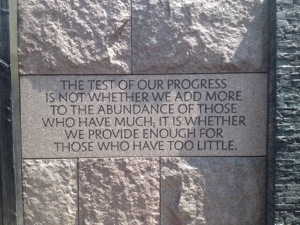
Personally, I think Scott is a sleazy scam artist who picked a politically lucky year to buy himself a state with a personal fortune partly accrued by defrauding taxpayers. But I don’t think that most folks feel quite so vehemently about him.
Yet his numbers are consistently in the toilet. It’s a boost for him when his approval numbers creep into the 40s and when his disapproval numbers are only a little bit above 50.
My suspicion is that he’s suffering from the same malaise that struck former New Jersey governor, Jon Corzine. I was working on some races in South Jersey in 2009, when he lost to Chris Christie and got a pretty good feel for what happened.
The best way I found to explain what happened is that the people of New Jersey were ‘over’ Corzine. They didn’t hate him. Didn’t think he was bad guy. Or even necessarily a bad governor. But they were over him. And that’s why nothing Corzine did could move his numbers into a place where he could win. Jersey voters had moved on.
Arnold Schwarzenegger (speaking of him as a movie star, not a politician) was the biggest star in the world for a while. His movies were sure fire hits. Then, that stopped. Sure, doing another Terminator movie could always bring ’em in, but the days when whatever he did was a hit were over. Moviegoers hadn’t started disliking him. But in their hearts, they’d already moved on.
If that’s what has happened to Scott, his options are narrow and, no matter how much he spends (or how much companies and groups with Tallahassee interests spend), he could find it impossible to get above 45-47%.
This doesn’t change what we already know: that Floridians are not fans of Scott the Governor and that Scott and his allies will focus all their fire on trying to render his opponent so repellent that he squeaks by in a low turnout election (which will be harder than you might think if the opponent is Charlie Crist; yes, Crist has baggage, but Florida knows Crist; all the stuff he’ll be blasted with – flip flopper, etc. – won’t be news to voters; they know it, they’ve already heard it, and they’ve already decided that the still find him to be an okay guy; that’s the problem with figures with such wide name recognition: they’re already defined in the public’s eye before the ad men have had a chance to do it for them).
 What a disappointment.
I’d read so much about this book the Romania-born, French-writing Cioran, but all I read was a shallow combination of a Nietzsche wannabe and a Camus wannabe. And it was translated by Richard Howard, whose poetry collection, Inner Voices, has to rank as one of the most boring books I have tried to read.
Listen to this:
And this nothing, this everything, cannot give life a meaning, but it nonetheless makes life persevere in what it is: a state of non-suicide.
The book is series of aphoristic segments, between half a page and two pages, usually. That bit I quoted above, from a segment entitled Coalition Against Death, sounds to me like little more than someone who decided to write some stuff within minutes of glancing at the first page of Camus’ The Myth of Sisyphus.
But mostly, it is warmed over Nietzschean aphorisms. Except that Friedrich’s aphoristic bits were sandwiched between much better scholarly writing. No, he wasn’t usually a rigorous philosopher, but there is some real stuff in there (think The Birth of Tragedy).
I am going to include one longish quote just because it was damn near the only bit that stuck with me.
(The implicit plural of ‘one’ and the avowed plural of ‘we’ constitute the comfortable refuge of false existence. Only the poet takes responsibility for the ‘I,’ he alone speaks in his own name. He alone is entitled to do so. Poetry is bastardized when it becomes permeable to prophecy or doctrine: ‘mission’ smothers music, idea shackles inspiration. Shelly’s [sic] ‘generous’ aspect cripples most of his work; Shakespeare, by a stroke of luck, never ‘served’ anything.
And a paragraph later…
How then to fail to turn to poetry? It has, like life, the excuse of proving nothing.)
He’s very taken by the idea of art for art’s sake. And his idea of prophecy (insofar as he has consistent ideas) seems to be more about political engagement than anything else. He is very much an interior writer, to the extent of rejecting the exterior. Let’s just say that he was never in danger of becoming a civic activist.
Anyway. It’s off my list. I can now saw I’ve read Cioran.

 the coffee philosopher