Tea & Orwell


As part of my continued effort to restrain the urge to dive back into my old coffee addiction, I am drinking more tea. Non-caffeinated or low caffeine teas seem somehow less heinous, less abominable in the eyes of nature and all that is holy than decaf coffee (which I will still not drink). Luckily, down at Eastern Market there is a nice lady who sells teas and honeys.

With my brand new coffee pot and new, small cups – all recently bought from Cost Plus World Market (Restoration Hardware/Pier One Imports for people with less money) – I set about trying to make, not a perfect cup of tea, but at least better than I usually.

I know I don’t make a perfect cup of tea, because I never quite manage to follow all of the tea-related edicts laid down by the great one himself, George Orwell.

Eric Foner Wins Bancroft Prize


Eric Foner’s The Fiery Trial: Abraham Lincoln and American Slavery just won the Bancroft Prize in history. When I studied history at college, I specialized (informally) in the history of slavery in the America and Foner, naturally, came up. His lengthy volume, Reconstruction: America’s Unfinished Revolution is the best work on Reconstruction out there (though John Hope Franklin’s Reconstruction After the Civil War is the best short history of Reconstruction).

Foner is often characterized as a Marxist historian, but let’s honest. All “Marxist” often means in an academic context is writing books that address the issue of class.


Hauntology


Just came across the most lovely neologism – “hauntology.” What beautiful word to be able to use to demonstrate the melancholy within certain philosophies and cultural criticisms.

The word is redolent of Jacques Derrida’s mournful spectres.

The Function of Philosophy


I am not here preparing to offer some sort of be all to end all. Rather, I am commenting on a particular work.

I recently took advantage of a Barnes & Noble gift card to download Georg Simmel’s The Philosophy of Money to my Nook. The author’s preface gives a very persuasive (at least to this reader) argument for the intellectual function of philosophy in understanding the world. It is all the more interesting in that this does not come in the context of a book about spiritualism or the meaning of life or finding one’s “purpose.” Rather, it opens up a lengthy discussion of money.

Simmel writes that any topic of study has “two boundaries making the point at which the process of reflection ceases to be exact and takes on a philosophical character.” He points to the first boundary as being the “lower boundary of the exact domain.” Now, I admit to not being too clear what he is saying here. Perhaps a reference to the philosophy that pre-dated modern science (the ancient Greeks, for example).  But the real meat is what he considers to be the philosophical domain that comes after the upper limit of the “exact domain.”

Philosophy, he says, is what can turn the disparate fragments of scientific and empirical knowledge in a world view. Essentially, philosophy as the science of hermeneutics. These things cannot be fully determined, he writes, by science. To get past this upper limit of scientific knowledge requires philosophy.

As to whether philosophical interpretations can ever be replaced by ever growing empirical knowledge… he compares that to the idea to the idea that photography could replace painting and sculpture. Purely mechanistic depictions are beside the point.

Simmel tries to explain the “essence [of money] and the meaning of its existence.” This is, to him, a purely philosophical exploration. Thus, no matter who often it might have recourse to the science of economics, it remains a philosophical study.

On another note, it appears that Routledge Classics is publishing a new edition of The Philosophy of Money for just $29.95 retail – a far more affordable from the $67.95 (plus tax) that I paid. The high price of the book was one reason that I took so long to purchase it (having desired the tome since 1997).

A Recovering Atheist’s Take on the Rob Bell “Controversy”


For those of you who haven’t heard, Rob Bell is the charismatic pastor of a Michigan megachurch with a national following. Like most megachurches, it began as part of a conservative, evangelical tradition. Certainly, it appears that Bell was raised (theologically speaking)  in that tradition. But he now appears to be going the way of many religious minded young people, who take a far more progressive view of politics and religion (the best covered issue from this trend is the movement towards an evangelically oriented environmentalism – which is causing something of a schism with the older generation, who fear that an attachment with environmentalists will damage their close relationship to the Republican Party and the political right).

Rob Bell’s fame has skyrocketed with his latest book (due to be published in March 15), Love Wins: A Book About Heaven, Hell, and the Fate of Every Person Who Ever Lived. The book is accused of flirting with the concept of universalism – the idea that everyone will eventually be saved.

American evangelicals tend towards a far more limited and deterministic view of salvation.

Pope John Paul II once wrote that it is possible that there is no one in hell and that there is not necessarily a reason to believe that there is anyone there. This was no written ex cathedra (from the seat), so it does not carry the weight of papal infallibility. That said, when I read that, it was one the concepts that led me to the Roman Catholic Church.

The Church views hell not so much as a Dante-esque place, with fires and demons. Rather, hell is the state of being completely removed from God. Taken from this point, hell requires God to be willing to deny his light to one of his children. Personally, I have difficulty seeing a truly merciful and loving God being able to so deny his love to anyone. I base this on the belief that though I have no children, I also have trouble imagining anything my child could do that would cause me to stop loving him or her. I could be disappointed or angry. I could even hate would they had done and support their punishment (though I follow the Church’s teachings on capital punishment). But deny my child my love?

If you believe in God, do you believe he could deny his love to one his children.

What A Founding Father Thought Constitutional Originalism


Some men look at constitutions with sanctimonious reverence, and deem them like the arc of the covenant, too sacred to be touched. They ascribe to the men of the preceding age a wisdom more than human, and suppose that what they did to be beyond amendment. I knew that age well; I belonged to it, and labored with it… I think moderate imperfections had better be borne with; because, when once known, we accommodate ourselves to them, and find practical means of correcting their ill effects. But I know also, that laws and institutions must go hand in hand with the progress of the human mind. As that becomes more developed, more enlightened, as new discoveries are made, new truths disclosed, and manners and opinions change with the circumstances, institutions must advance also, and keep pace with the times…

Thomas Jefferson, from a letter to Samuel Kercheval, July 12, 1816


Sorry, Scalia, but it appears your originalism is actually against the original intent of this Founding Father.

Liberalism


This is a little embarrassing, but I’m about to quote an article from Slate.com.


Liberalism, at its core, is not so much a doctrine as a disposition, a habit of mind, and it’s compounded of two principal elements: An abhorrence of cruelty and a sense of the provisional nature of human knowledge.


Despite my lingering shame at admitting to reading Slate, I was struck by this particular phrase, within a piece about the French essayist (arguably, the original essayist) Michel de Montaigne.

I was struck by how well that sentence encapsulated my own sense of my ideology – and how it is not truly an ideology. Perhaps it is more truly something closer to Kantian categories than a true ideology, or doctrine, as the author write.

Free Will


I have been having conversations with some friends about the existence of non-existence of free will.

The conversation was begun, in a cliched fashion, on Facebook. A poet of my acquaintance was arguing against free will and in favor of determinism.

While initially participating in the Facebook thread, I switched to a longer form discussion and wrote a letter to a friend of mine with a philosophical bent, but also with far more of a scientific bent than I.

My initial thesis was that, scientifically (at least based on my limited understanding of science), was that determinism is a powerful argument. In truth, I felt trapped by it. The argument for free will that I could see successfully contradicting that was a theistic god.

In Jamesian, pragmatic terms, I agreed that we must act as if free will exists. But once one moves beyond pragmatism into more metaphysical questions, I had trouble seeing free will exist except as something granted by a beneficent god.

When I met with my friend, I was surprised to find him not being an advocate for scientific determinism. For the most part, he felt a deep need to believe in free will. The philosophical basis was primarily pragmatism, though he also provided me a possible, scientific way out in the idea of “emergent phenomena.” I would explain it better, but frankly, I am just now reading up on it myself.

More Marginalia


Apparently, this whole effort to keep marginalia alive is still rolling alone – at least in this New York Times piece.

I am very sympathetic to the idea, but I admit to also being one of those people who cringe at writing in their books. Perversely though, I love finding old books at used bookstores with notes written in it by a prior owner.

One of the few books I have personally marked up is Deleuze and Guattari’s Anti-Oedipus. It has been badly battered (I used to drag it to my favorite LA bar, the Pig and Whistle and read it while drinking and eating their nachos [their secret – using wonton chips instead of tortilla chips]). It’s also filled with tons of bookmarks, with little notes written on them. But I have also done a little scribbling of some marginalia.

The reason that particular book got special treatment is that it has been a real struggle for me. I don’t pretend to truly understand many of the concepts described (the “body without organs,” for example).

I should also mention a exhibit held at the Folger Shakespeare Library called “Extending the Book” about something called grangerizing. In the nineteenth century, folks used to expand their books by adding new pages to them. They would have them rebound to allow for the new, larger size. Often, the additions were illustrations that they thought had some correspondence to the action within the text. While not, technically speaking, marginalia, it is certainly the ultimate in book owners not holding their tomes sacred in its original form.

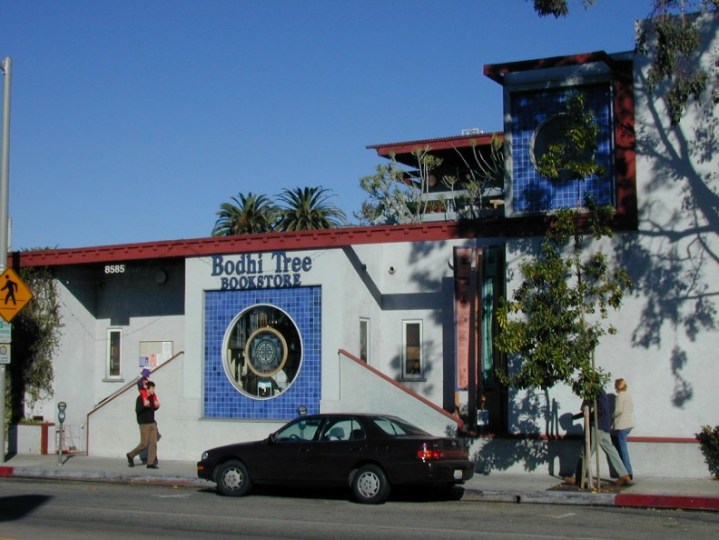
My Favorite Bookstores: The Bodhi Tree


I have only rarely done yoga. I’ve never been particularly spiritual. I don’t believe in New Age theories. Yet I am fascinated by the collection of spiritual and New Age books at the Bodhi Tree Bookstore in Melrose in Los Angeles. I discovered it quite by accident, just exploring the town one weekend, but came back frequently.

Unfortunately, the Bodhi Tree is in imminent danger of closing. Right now, it is only guaranteed to be open through the fall of 2011, though they are working hard to find a new owner who will keep it alive in the manner which it deserves.

For the moment, though, it is a wonderful community gathering spot.

Even if, like me, you are not into New Age stuff, they had a solid poetry section, a wonderful selection of primary texts in Asian philosophy and thought. Also, as a historian, I find Theosophy fascinating and they had a great many primary texts by Blavatsky and here successors, students, and followers. And they did not ignore Christian, Jewish, and Islamic thought and texts, either.

I don’t know what will happen to the Bodhi Tree, but I pray it can survive in a form which can continue to serve those who seek some sort of solace from its shelves.