…but in its main ideasAristotle’s philosophy is Plato’s philosophy. The one clothed in poetry; the other in formulae; the one had the more entrancingvision, the other a clearer and more exact apprehension; but there is no essential divergence.
What else? It’s an excellent primer, but, to be frank, I’m not sure I needed one. He does a nice, short survey, starting with the Milesians and going through to Epicurians, Stoics, and Academics/Skeptics. Those last three are better known for their popularity in Latin philosophy and Marshall is oddly disdainful of them. It’ almost like he felt compelled to wrest them from the Romans, but still felt things should have ended with Aristotle.
‘Theory’ (in the context of the humanities) and ‘critical theory’ (and especially ‘critical race theory’) find themselves frequently despised. Well,Anne Anlin Cheng’s Ornamentalism falls squarely into that camp.
Though short, if you do not like those categories, you won’t like, even if it won’t take you long to read.
I am always trying to be a ‘good’ white man and especially to be a good, white father to an non-white appearing daughter and I try to welcome challenges to my understandings (and, yes, prejudices).
The author struck me to the heart of the unseen biases within myself. I was most impacted by an off-handed line criticizing Elaine Scarry’s On Beauty and Being Just, a book that I adored, for failing to recognize how beauty can be terribly, damagingly racialized. It is so easy to see ‘my’ truth (a white, heterosexual, college-educated, middle class, man in America) as being everyone’s reality. Like Kant, I am constantly being awakened from my dogmatic slumber. It’s not always fun, but it is important.
Beyond that, it is about the Asian, female body. The body as clothed in exotic dresses, jewelry, headwear. The body stamped by prejudices (the assumption of the late nineteenth and early twentieth centuries that unaccompanied Asian woman coming to America must be sex workers). The body as skin and flesh (naked, like sashimi; or, compared to porcelain). The body appropriated by white females.
An interesting work, though perhaps not more interesting than just going back and pulling some Plato and Aristotle off the shelves. Despite the author’s explicit claim that this is not a book about Neoplatonism… it kinda feels like a book about Neoplatonism. At the very least, a key argument for why we should not view Aristotle as being so much in conflict with his erstwhile teacher, Plato, is that, well, a lot of ancient and late ancient philosopher who wrote after Aristotle, viewed Aristotle as being part of Platonism. Especially the Neoplatonists. And no, calling them ‘harmonists’ (those who believe that Aristotle is, in some ultimate sense, in harmony with Plato, as opposed to the antiharmonists [no hyphen]) does not help and, in fact, that term needs to not become a ‘thing’ and should not be used in that context ever again, because it’s cloying.
His best argument for this actually came very early in the book and was the bit that my mind kept coming back to: he referenced a philosopher named Pierre Hadot (who I had never heard of before) who (he says) proposed that the philosophers of the ancient world and their schools should be viewed primarily as positing a way of life and only secondarily as positing philosophical doctrine. Under this rubric, it does become easier (for me, at least), to see the author’s point.
But Gerson rarely seems to speak for himself. Every time I think that he is offering his own interpretation, I read that sentence more carefully and see that he’s actually paraphrasing what he believes Porphyry or Plotinus or Simplicius or Iamblichus has said. But basically, the thesis is that Aristotle’s ontologies (and epistemology, especially and his and Plato’s are deeply informed by their onologies) are not so different from Plato’s after all.
To briefly give one example, Gerson both recognizes (yet also avoids, in many ways) what is usually taught as the basic and most important distinction between the teacher and his student: Plato’s theory of forms. Plato believed in their reality and Aristotle did not (though yeoman’s work is done to suggest that Aristotle’s theory of the intellect (I am being vague here, because there are several kinds of intellect and much back and forth over what in the name of all that is holy it all means and if you’d like to learn more, I recommend learning Medieval Latin, because a lot mainly, but not exclusively British monks spent several centuries arguing about this and you’re welcome to read it all, I’m sure) could be considered as being compatible with the forms). Plato, through the mouthpiece of Socrates, argues for knowledge as recollection Aristotle makes statements that support that epistemology. Since Plato’s theory knowledge as recollection emerges from the forms and Aristotle can be seen to accept Plato’s theory of knowledge, therefore he implicitly accepts, at least in part, the forms, if not in a so explicitly realist fashion.
My first impression after reading this is that I should brush up on my Plato and Aristotle. More so, Aristotle. I’ve been reading a bit of Plato recently (though no amount of references to it by Neoplatonic philosophers will convince me to read the Timeausagain), but have a copy of Aristotle’s Categories that I started but never finished.
Early in the book, in the second chapter, he quotes from the slightly unorthodox conservative, Andrew Sulivan, from his book, The Conservative Soul: Fundamentalism, Freedom, and the Future of the Right:
All conservatism begins with loss.
(Of course, I tend to think of Sullivan as rather a wannabe Hitchens, but lacking that better writer’s adventurous spirit and mordant wit. Of course they both did quit national magazines on account of feelings of ostracization stemming from more liberal colleagues disapproval of some of their positions.)
As a rhetorical tool, Corey Robin’s best move is to quickly go after Edmund Burke and place him squarely in the lineage of modern conservatism. ‘The priority of conservative political argument has been the maintenance of private regimes of power,’ he writes. Burke, by virtue of his commitment to keeping Westminster in narrow, elite hands, even as he believed in gifting a degree of economic security, falls under that rubric, the author argues. There is much more on Burke, early on, which makes me want to read more of Burke because I have an instinct to want to defend him (perhaps on account of my own elitism). But I cannot deny the efficiency of placing Burke in a lineage that leads directly to Trump, because otherwise, that esteemed eighteenth century thinker is the there to be pointed to, as an example of noble, intellectual conservative thought, implying that the current crudeness is an aberration. Robin seems to point at Burke’s thought and say, to quote Joseph Conrad, ‘And this also, has been one of the dark places of the earth.’
But to go back to that idea of loss… Buckley stands athwart history and shouts stop because something is being taken away from him. Race certainly being part of it, as desegregation and civil rights took a certain dominion from white men. While not his purpose, he gives a beautifully succinct explanation for why the Civil War could be about slavery (it was) even though most white men in the South did not own slaves. Under slavery, every white man was an aristocrat. With emancipation, man white men became merely poor and wanted their aristocratic privilege back.
Always though, he rows ceaselessly back to Burke. He take a trip earlier to visit Hobbes (the conservative as counterrevolutionary), but Burke is always there. He is what Thomas Jefferson is to me, I think: an admired figure who he knows is also dangerous and deeply unadmirable. To paraphrase a movie, he just can’t quit him.
He enjoys long, discursive, excerpt heavy footnotes… especially about Burke. I think he understands that Burke is figure at the beginning who no one (including, arguably, me) can accept as truly being part of the lineage of Trump. And he can’t let that (or him) go. Burke, you might say, is living rent-free in his head.
He’s now living in mine, too. I’ll have to find my copy of his selected writings and revisit. Especially his Thoughts and Details on Scarcity which sounds like a fascinating (and, yes, deeply conservative) defense of the rich and their capital against the needs of working people, disguised as an economic treatise.
The takedown of Rand (intertwined, somewhat inexplicably, with Nietzsche) was delicious. The author was incredulous as to how a writer of such ridiculous prose and philosopher of such shallow depths (who seems not to have read much philosophy) could be have become so… influential. In the end, I don’t think we know. I blame Paul Ryan.
Similarly, his critique of the late Supreme Court Justice Antonin Scalia’s frankly rank hypocrisy (hint: he only adopted his textual originalism when it was useful to buttressing his decision, rather than always letting his originalism lead him to the decision) was nice to hear, because paeans to his supposedly principled legal stance have always rankled. Like so many leading 20th century (and now, 21st century) conservatives, his politics and philosophy were rooted in a culture of victimhood.
So, did this book, as a blurb attests, predict Trump? There is a chapter on Trump, clearly written post-election. But it feels understandably tacked on. Yes, he appealed to the sense of aggrievement, of victimhood, that is chronicled throughout as a key factor in conservatism. But Trump himself is so vacuous (he makes Ayn Rand look like Hannah Arendt) that the chapter is jarring. He’s a cipher, but in no way a thinker who added anything to the conservative movement beyond, perhaps, a little daylight (which has not proved to be as a good disinfectant as one might like).
Every one knows that judicious manner and charms of style have rendered Hume’s history [of England] the manual of every student. I remember well the enthusiasm with which I devoured it when young, and the length of time, the research and reflection which were necessary to eradicate the poison it had instilled in my mind… It is this book which has undermined the free principles of the English government, has persuaded readers of all classes that these were usurpations on the legitimate and salutary rights of the crown and have spread universal toryism over the land.
My all time favorite fictional party is the one at Holly Golightly’s apartment in the movie Breakfast at Tiffany’s (I read the book, indeed, it is the only Capote novel that I have, as yet, read, but the movie made a more startling and powerful impression on me).
My new second favorite might be the one in Cicero’s De Natura Deorum or, On the Nature of the Gods. Intelligent men having deeply thought-out conversations on ideas passionately held. It’s like one of Plato’s dialogues, but not everyone gets railroaded by Socrates, which, let’s be honest, would probably not be that fun to experience. Just ask Gorgias.
This book has been on my list for years, but was almost impossible to find, but there it was at Solid State Books. Even more amazing, after I bought it, they replaced with another copy on the shelves!
For a critic famous for his defense of the traditional canon, the pre-post-colonial canon, as it were, The Anxiety of Influence is a brilliantly, desperately sincere text of postmodern play.
Is Romanticism after all only the waning out of the Enlightenment, and its prophetic poetry only an illusory therapy, not so much a saving fiction as an unconscious lie against the difficult human effort of holding the middle ground between instinctual existence and all morality?
I was caught by the quote because the question of Enlightenment and its successor, Romanticism seems to keep coming up, though this answer seems inadequate in terms of history, if not literature.
If here were a poet, his bête noire (or perhaps, I should say daemon) would be Milton (he wants it to be Dante, but it’s Milton). While he praises and respects poets like Walt Whitman and Wallace Stevens, his idea of poetry was forged between Milton and Keats. In the end, the whole book is about how the sublime is achieved by the great poets. While we can talk about the sublime today, he means it in a sense in which we rarely speak of it – the way Burke spoke about it.
I do not know if I ever will (my to be read stack is quite high), but the highest praise I can give this book is that I want to read it again. Not right away, but when I am older, to sit down in a comfy chair and read this dense, slim labor of love one more time.
Such a brief book must, necessarily, be swift in its progress. But there is, as always, such a thing, as too much. Amply endnoted, it nonetheless feels shallow. The Enlightenment influenced thought behind America’s founding is dealt with in less than twenty pages. An opening chapter, which subtitled itself ‘Precontact-1740,’ managed to make most of what was said about indigenous people’s thought about Europeans proselytizing to them, which feels more than a little icky.
Transcendentalism, the second most interesting moment in American intellectual history, to my mind, after the Founding period, actually subsumed in a chapter about first half of the nineteenth century, so that an alien who magically read English, but knew nothing about American history, would think that Ralph Waldo Emerson, rather than being a towering figure in the creation of a American intellectual tradition, was more of just a guy who was around and maybe wrote one or two essays that are pretty good.
I would say that the author has a conservative bent (even though she completely fails to give any details about conservative thinkers like Russell Kirk and William Buckley believed, despite spending several pages on them), and perhaps because many of America’s most important thinkers were liberal (or even radical) in some way: William James, Thomas Jefferson, John Dewey, Ralph Waldo Emerson, etc.).
The most egregious sin, I think, is that it’s just an assemblage. The book advances no thesis, it just breaks up American intellectual into some distinct time period and gives a breezily brief description of each. Without that, how can you claim these ideas made America?
So,I guess it’s a nice, short primer of some kind, but perhaps not useful for much beyond brushing up on a couple of things to drop in conversation to make yourself sound smart (but hopefully, you don’t encounter anyone who actually read the thinkers, because then you might be caught out, because you won’t have learned that much).
My little one was not in the mood for our usual bedtime reading (Amulet, Narnia books, Lord of the Rings) and frankly, being a little cantankerous. So, I told her that we could either read Prince Caspian or daddy’s book. What’s daddy’s book. Plato, I said.
She was into it.
We had ‘met’ Plato in one of her Magic Treehouse Books and after that, I showed her a copy of some of Plato’s dialogues in the study. Now, I wasn’t reading that edition, but a slightly smaller one. I then grabbed a Dover Thrift Edition that contained Gorgias and Timaeus but that wasn’t it either. Finally, I found it. I showed her, written in neat cursive in black ink, was the nameof her grandfather. I told her that meant this book was older than her father and once belonged her grandfather.
Then we read. Over two nights, we read Crito, a short dialogue between Socrates in his prison cell, awaiting execution and his friend Crito, who was encouraging him to escape (Crito and other friends of Socrates would bribe the guards and arrange travel).
The long and short of Socrates’ conclusion comes to something similar to favorite quote of mine from a fantastic adventure novel, The Prisoner of Zenda: ‘God doesn’t always make the right man king, but I am the king’s man and have eaten of the king’s bread.’
What I mean is that Socrates says that because he accepted his role as citizen of Athens, he must accept what comes with it, even when it’s justice comes to the wrong conclusion. Of course, by this time, she was asleep.
In his intro, Fleming explains that the ‘dark side’ of his title is a kind hearted pun, rather than a hint that reader is about to enter the gloomy, sordid, and evil underbelly of eighteenth century France.
Various figures who are almost part of a Counter Enlightenment (and appropriate phrase, considering how often he alludes to the Counter Reformation) drive the stories he tells. It’s not an overarching thesis which drives him, so much as curiosity about certain individuals and ideas who seem so different from our idea of what the Enlightenment was.
Most were new to me or provided new perspectives (I knew about the Port Royal movement as an intellectual school, but not about some of the spiritual healers and relic veneration around it). I was disappointed, I will admit, at how little space the Rosicrucians got. I used to be a reader in conspiracy theories of a certain sort (the sort mocked in Eco’s Foucault’s Pendulum) and would have liked to have seen it gone into a bit more. But a minor quibble, surely?
A larger quibble is what I hinted at a moment ago: how does this connect to the Enlightenment, beyond happening at roughly the same time? The occult strain within the Freemasons is real, but a chance to firmly connect them to the intellectual ferment of the age is sadly missed (just connecting it slightly to the gentleman’s club or the coffeehouse, the latter of which, predates modern Freemasonry, is not really doing it service).
In general, I confess to a general, though slight, feeling of disappointment. Disappointment because the book also feels a little slight. So many sections manage to feel undercooked (if always interesting). Alchemy is such a fascinating subject with a luxurious iconography and from this book I learned that… 18th century alchemy is a fascinating topic, with interesting iconography. Cagliostro is undoubtedly a fascinating and elusive figure and relevant to the topic… but did such a plurality of the pages theoretically devoted to him actually have to be an explanation of the history of L’affaire du collier (the infamous Affair of the Necklace)? I understand he was charged (and acquitted) in the matter, but is his distant involvement stupendously relevant to the history of spiritualism, occultism, alchemy, etc. in the Enlightenment? Similarly, there are two chapters on Julie de Krüdener, a writer who I confess to have never heard of before, and while her story is interesting and maybe relevant because she appears to be an early literary figure in the transition from Enlightenment to Romanticism, but that’s kind of a stretch (though he attempts to bridge the gap by tendentiously connecting her to a series of semi-mystical writers who she… met? read? as well as to a later obsession with numerology which he also connects to Tolstoy and… wait for it… The Hitchhiker’s Guide to the Galazy).
So, in conclusion (I sound Phillipa Chong now), I learned a lot, but a lot less than I would have expected about the supposed topic of the book.

 An interesting work, though perhaps not more interesting than just going back and pulling some Plato and Aristotle off the shelves. Despite the author’s explicit claim that this is not a book about Neoplatonism… it kinda feels like a book about Neoplatonism. At the very least, a key argument for why we should not view Aristotle as being so much in conflict with his erstwhile teacher, Plato, is that, well, a lot of ancient and late ancient philosopher who wrote after Aristotle, viewed Aristotle as being part of Platonism. Especially the Neoplatonists. And no, calling them ‘harmonists’ (those who believe that Aristotle is, in some ultimate sense, in harmony with Plato, as opposed to the antiharmonists [no hyphen]) does not help and, in fact, that term needs to not become a ‘thing’ and should not be used in that context ever again, because it’s cloying.

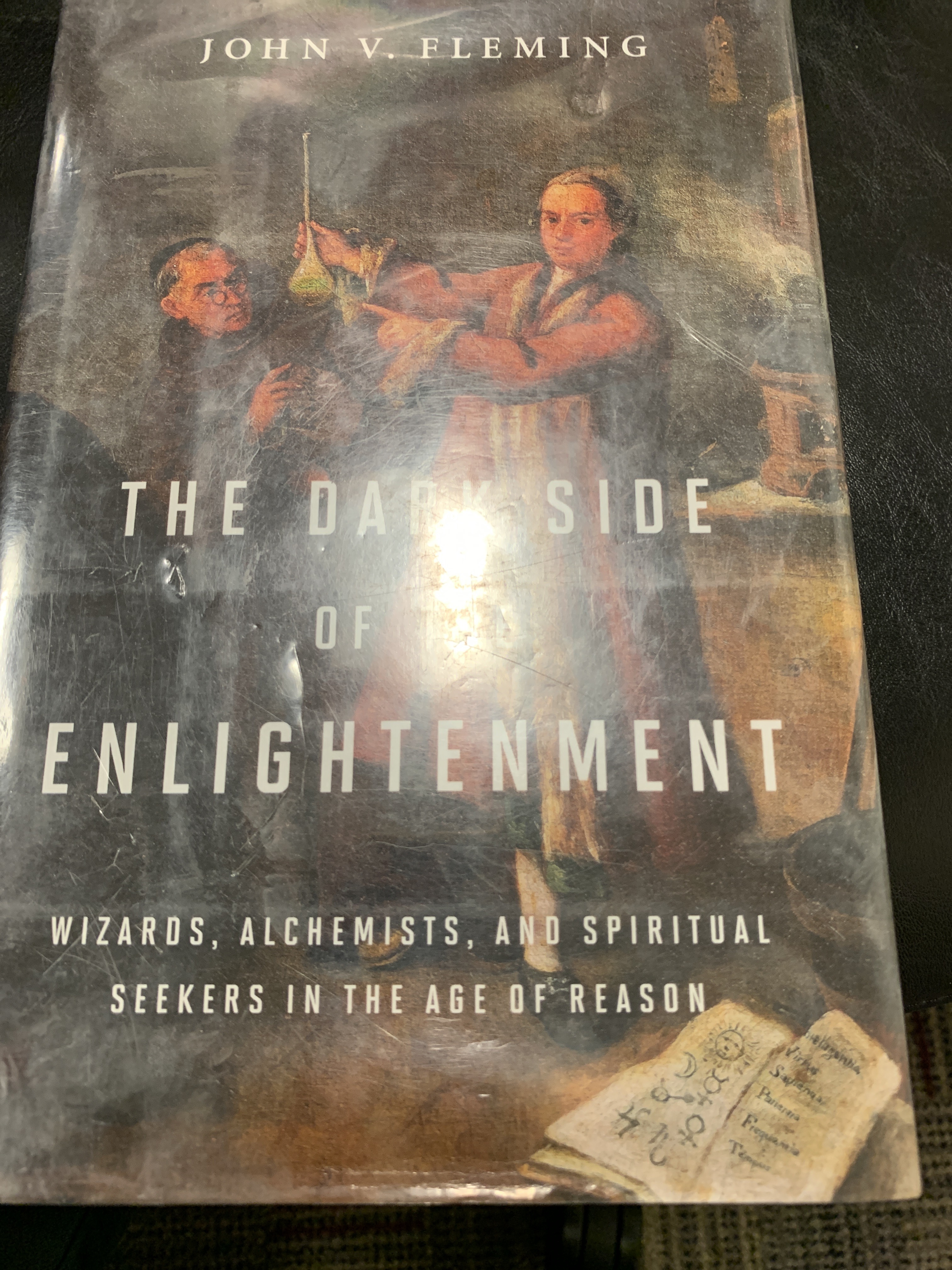 In his intro, Fleming explains that the ‘dark side’ of his title is a kind hearted pun, rather than a hint that reader is about to enter the gloomy, sordid, and evil underbelly of eighteenth century France.
 the coffee philosopher