Dead Sea Scrolls


The Dead Sea Scrolls are now digital so read up!

I visited an exhibit containing many of the scrolls (fragments of scrolls, really) several years in San Diego. They were touring the country while their regular home was being refurbished, I believe. Worth seeing, definitely.

Philosophy vs Neuroscience


Consider my posting of this article to be a little shout out to my friend Ryan, who introduced me to the writing of the Churchlands, the reigning power couple in the field of ‘neurophilosophy.’

No – Adam Smith Did Not Actually Believe in Unfettered Free Markets


No. Really. He didn’t.

Read this.

And when you’re done, actually read The Wealth of Nations.

And when you’re done with that, read Adam Smith’s The Theory of Moral Sentiments.

And you might actually read something by David Hume (this year is the three hundredth anniversary of his birth, if anyone’s counting), who is far closer to the spirit of the founding father (intellectually speaking) of capitalism than Ron Paul, Michele Bachmann, of the fellows residing at the Cato Institute or the Heritage Foundation.

Major Movements in Philosophy as Minimalist Geometric Graphics


Major Movements in Philosophy as Minimalist Geometric Graphics

Tarot Cards


The other day, I read this article, The Querent, about the writer’s relationship with tarot cards and fortunetelling.

I don’t believe in tarot cards or any other form of soothsaying. But I don’t deny it’s appeal. I don’t deny having had readings of various kinds done nor of having looked for meaning in them. It all sounds contradictory, I know.

A long time ago, I even bought a deck of tarot cards. A fairly “traditional” deck, the Rider Waite Tarot Deck. There’s a funny story about that. My father’s wife wanted to have an exorcism on me in order to prevent the devil from physically manifesting in the house via the cards. Those were interesting times.

The article struck my fancy because of the way the  author struggled through the cards to find some meaning and understanding. Though he clearly has a sort of belief that I lack, we both share an affection for the trappings and ideas associated with New Age bookstores (like my beloved Bodhi Tree Bookstore). Despite the fact that belief separates us, he seems to view the value of tarot cards in much the same way I do.

Ok. Soccer season has started in Europe and there’s an election coming up. Time to refocus.

Happy Birthday Borges!


Today is the 112th birthday of Jorge Luis Borges.

He’s dead, of course, so the celebrations will be a little muted.

My father gave me a copy of his collected stories (he never wrote a novel – just poems, essays, and short stories) many years ago. I confess that I have never read his poetry.

He was certainly a writer’s writer. Or perhaps a reader’s writer.

Yes, he wrote all those stories about gauchos, but it’s all those stories about Casaubon-esque authors, archivists, and librarians trying and ontological inability to contain all the knowledge one desires. Even when a character seemed to achieve something like that goal, the melancholy knowledge that, in life, one couldn’t, hovered over it all.

“I have always imagined that Paradise will be a kind of library.”
– Borges

Is Postmodernism Finally Dead?


That’s what this article says.

And an exhibition in the Victoria & Albert Museum on postmodernism does sound like it has been relegated to history.

But if so, will I miss it a little?

Yes, I suppose. I was certainly born and raised during its apogee. Whatever follows or is already following will be something intrinsically more foreign to me than postmodernism was, even if postmodernism was itself intrinsically inexplicable.

Library Book Sale


While wandering Eastern Market with my father on Saturday, I saw a sign taped to a trash can that spoke of a book sale at the Southeast Library, just across Pennsylvania Avenue.

When I was twelve years old, my mother took me to a sale at the Dunedin Library where we found a lovely three volume history of mathematics. It was actually a huge collection of essays by various folks, rather than a chronological history by a single author. Unfortunately, every other sale at that particular library was nothing but disappointing.

Fortunately, this one did not disappoint.

For the low, low price of four dollars, I picked up copies of the following:

Hestia, by C.J. Cherryh
Childhood’s End, by Arthur C. Clarke
Possession, by A.S. Byatt
Middlemarch, by George Eliot
Triton, by Samuel R. Delany
Spy in the House of Love, by Anais Nin

Middlemarch, in particular, excited me. For some reason, I had lately been struck by the desire to read it. Many years ago, I went through a nineteenth century novel phase, but someone, George Eliot’s oeuvre had escaped my attention (partly because I was a boy, so was much attracted to Dumas’ tales of derring do and partly because I was a moody boy, so also much attracted to Dostoyevsky’s architectural novels of philosophy leavened with hearty helpings of despair and Christian proto-existentialism).

And a funny little story about Anais Nin. My first introduction to her actual writing (I knew of her as person because of her association with Henry Miller) was from MTV. Yes. MTV.

In the early nineties, they used have actors and actresses read brief segments of famous novels and very alluring literary environments. Sherilyn Fenn read a brief segment from Nin’s Delta of Venus and I also remember Aidan Quinn reading from The Metamorphosis. Back when it seemed like MTV might actually be something cool and occasionally constructive. Sigh. Not anymore. Or maybe I’m just growing old.

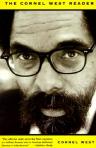
 

Cornel West, Caricature


I first became aware of Cornel West some ten years ago. I was living in Atlanta, Georgia and, being an inveterate nerd, was watching Book TV on C-SPAN2 while the interviewed Professor West about the publication of The Cornel West Reader. Naturally, I went out and bought the book and began diligently reading it.

Later, I found a copy of the old, out of print book, The Ethical Dimension of Marxist Thought and then Democracy Matters.

As an idea, he deeply appealed to my desire to be/fascination with/jealousy of the figure of the public intellectual. In this case, the public intellectual as a philosopher. While he’s rarely a rigorous philosopher (particularly these days), like say a John Rawls, but neither is he some Ayn Rand figure.

Probably the closest equivalent is Slavoj Zizek. A scholarly figure, with strong academic credentials, but whose place as a public intellectual depends more on his output for popular consumption than on his output for the specialist community. But isn’t that what a public intellectual does?

Like Zizek, West is always in danger of becoming a caricature of himself. His affectations – the afro, bushy goatee, glasses, and insistence on always wearing one of his identical three piece black suits (Einstein famously filled his closets with identical copies of the same suit, as well) – always border on caricature, but so long as he maintained some vestige of his reputation for rigorous scholarship and kept his tendency towards outlandish hyperbole in check, he never tipped over.

Has that changedIs he tipping over now?

Bookstores: ‘A Space For Cultural Dilettantism’


That said, the aspect of Borders’ implosion that troubles me is that there will be 399 fewer places to take part in the communal act of book buying, which is a completely separate activity from reading (see: regular bookstore lurkers who never purchase a thing). As corporate as it has become, Borders began as an independent bookstore in Ann Arbor, Michigan in 1979. Tom and Louis Borders bought out the aging Wahr’s store at 316 South State, and they hired a local rare books restorer to stock it lovingly with unique reading material. The restorer kept a binding workshop upstairs. It expanded into the impersonal, sprawling latte experience that we know today, but Borders started small, and it grew out of a love for the shared browsing experience.

Bookstores are very special places, even the behemoths. They provide a space for cultural dilettantism. You can get lost in them for hours, perusing covers and picking up obscure titles. They are dedicated to discovery and are curated by some of the most dedicated retail employees around (even to get hired at a large corporate chain, one is still required to exhibit a sharp passion for reading).


I love that phrase, ‘cultural dilettantism.’ Yes, I am a cultural dilettante (is that the same as a ‘cultural omnivore?’) and yes, I treasure spaces that welcome the practice of cultural dilettantism. Even Borders was capable of providing that space. Often when accompanying my better half on shopping expeditions, I would take refuge in a chain bookstores like Borders or Barnes & Noble or in a Starbucks. I also actively browse the shelves of my neighborhood used bookstore just to experience the sensation of being surrounded by so many examples of the written store of our civilization’s knowledge or will make an expedition to one of my favorite independent bookstores without a particular book in mind, but just with intention of finding a new book of poetry or a poetry ‘zine or some heretofore unknown to me book of history or philosophy. I will sit in a comfortable coffeehouse just to spend an hour reading from a book and taking some notes away from the distractions of home and television.

I am a cultural dilettante and I must mourn whenever a space for me to practice my particular form of mediation and contemplation (or perhaps mediation between the world and my understanding of it) disappears.