Note:
I wrote this several days and was basically saving it for another day, but then I learned that Christopher Hitchens died yesterday at the age of 62. He was suffering from esophogeal cancer.
Like many liberals, I have mixed feelings about Hitchens. Great respect for him as a stylist and a polemicist. But, like many, I diverged with him over the Iraq war. But, unlike say an Irving Kristol, he did not allow his break with the left on a particular issue lead him to become a right wing figure.
For Christmas, some half dozen years ago, my Aunt Millie gave me a copy of his Letters to a Young Contrarian, titled after Rilke’s Letters to a Young Poet. Hitchens’ book is almost certainly more enjoyable to read, not in the least because you can’t shake the feeling, when reading Rilke’s book, that the young poet to whom he addresses himself is probably also a very bad poet.
I don’t know how he will be remembered. For the next decade, probably as an English speaking, more biting and more witty equivalent to France’s Bernard Henri-Levy (though Hitchens did not wear his shirts unbuttoned nearly to his navel, like Henri-Levy, and generally stopped at a sufficiently rakish spot at the base of the sternum; he was also not nearly as much an unjustifiably pompous an ass as Henri-Levy and also, Hitchens did actual research, while there is not prove to Henri–Levy does any before spouting off). In decades to come, I suspect he will placed with figures like Arthur Koestler who were influential and much read in their day but whose relevance was more timely than timeless.
But I still loved his magazine pieces and watching him stab and barb debate opponents on CSPAN-2 on the weekends and I am very sad to know he is gone.
So soon after George Whitman’s passing, too. We are losing figures whose personal importance to my time I will never be able to explain to those that follow me.
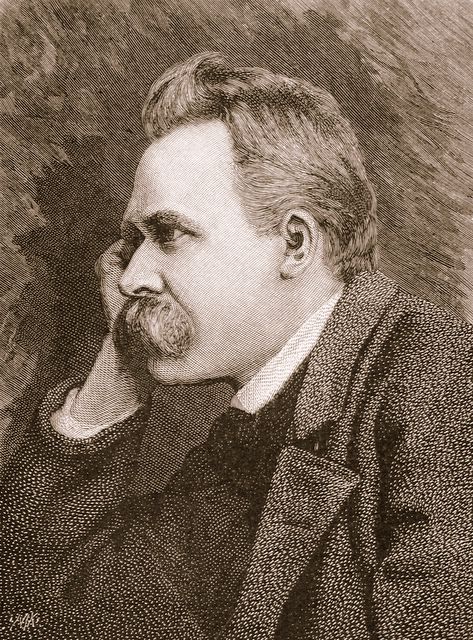
There are various translations, of course. But it occurs in Nietzsche’s Twilight of the Idols in a section of aphorisms. It is one of the more enjoyable of his books to read (I prefer to the more novelistic style of Thus Spake Zarathustra; and I should note that Nietzsche is one of the easiest and most enjoyable philosophers to read and is supposedly known in Germany less as a philosopher and more as a literary stylist ), but does not hold so well, intellectually speaking, compared to works like The Genealogy of Morals or his first tome, The Birth of Tragedy.
Christopher Hitchens recently wrote about that phrase, which he said he often used before but now that he is living very close to death’s edge (achieved a relative state of being-there as regards understanding of being-approaching-death, to needlessly throw in some references to the great German obscurantist philosophy, Martin Heidegger) he sees its flaws.
Of course, one wonders if Nietzsche was really referring to things that lead up to the final death. The weakening of the body and mind. Or was he speaking more about the potential to take wisdom from suffering?
But it is easy to read it literally. It wasn’t written with any real context. Also, like many Americans my age, I first encountered it within the opening credits of the 1982 movie, Conan the Barbarian, where it was taken somewhat literally – since Conan did not die of exhaustion pushing that great wheel in circles, he was able to become impossibly strong, almost as if he were actually a semi-articulate Austrian body builder.
This is the problem with Nietzsche, that most literary of philosophers. Because literature, even more than the majority of nineteenth century German philosophy, lends itself to a certain ambiguity of interpretation.
 I am a big fan of the Loeb Classical Library with their distinctive red and green volumes (red for Latin works and green for Greek). Now they HUP is putting out a new imprint focusing on the works of medieval Europe.
 I still think he’s a better philosopher…

 the coffee philosopher