Saint Anthony


Today is the feast day of Saint Anthony, also known as Anthony the Great (partly to distinguish him from a later but still popular saint also named Anthony who was a Franciscan brother).

He was, perhaps, the quintessential desert father – the church figures of the Patristic period who went into the desert and became hermits and whose example laid the foundation for the church’s monastic tradition.

While much of what we know about him comes from Athanasius’ Life of Anthony the dedicated reader might find the thoughts of that syphilitic genius, Gustave Flaubert, more interesting and instead chose to read The Temptation of Saint Anthony. Be warned however, if all you have read is Madame Bovary, know that Flaubert is a weird dude.

Weekend Reading – The Sunday Book Section


The Year in Reading Poetry, courtesy of the New Yorker.

The Nation reviews poets in the context of systems theory.

A review of The Fossil Chronicles.

Interview with conceptual poet Kenneth Goldsmith.

A book about a guy who wrote a book about Hitler who later screwed up on some Hitler stuff (but not in a pro-Nazi kind of way).

Acedia and the noon time demon.

God wanted. Must be atheist friendly.

The Sorrows Of Young Werther


Some time ago, at a library book sale near my apartment, I purchased a copy of Goethe’s The Sorrows of Young Werther, the quintessential book of the sensitive young man and the unobtainable woman.

It’s a short book and a swift read, but for the modern reader, it takes some getting used to. Werther is a one of the most emblematic products of German romanticism, of sturm und drang (storm and stress). Consequently, the raging, unconcealed emotionality of Werther, which seems overwrought and a little embarrassing to the modern reader, was far less so a couple of centuries ago (though the other characters make it clear that they find Werther a little over the top). And I’m not so young as I used to be (though younger than I will be) and am a little removed from the inner sensations that roiled me at age nineteen or twenty or even twenty-five.

Werther is a little disturbing to read. You can see the coming storm and no one seems to be doing anything about it. Certainly Werther has little idea of what’s going on (as evidenced by his apparent social faux pas while serving as the personal secretary to a high ranking official while trying to forget his unrequited love).

Charlotte, to the outside eye, seems as a far more predatory character than Werther views her. Encouraging affections she knows she cannot return and always doing just enough to keep the young man hanging on. And her poor husband Albert, who both pities and is terribly frustrated by Werther’s ignorant innocence and who knows he is being victimized by a form of emotional cuckolding.

And when poor Werther tries to kill himself and fails, only to die slowly and, frankly, embarrassingly, over the course of several days.

Which is genius of the novel, in the way it subverts expectations. Werther fails to manage a beautiful, moving death, like the famous statue of the poet Shelley. An epistolary novel, Goethe suffuses the reader with the urge to write back to Werther and call him a foolish a prat. Werther writes of himself as a romantic hero and the when we see the plot through Werther’s eyes, we can see where he’s going with it, but Goethe repeatedly smacks us about with his foolishness.

But Goethe also told his secretary, ‘It must be bad, if not everybody was to have a time in his life, when he felt as though Werther had been written exclusively for him.’

A very true statement, but one that also makes me somewhat sad. What would it have been like if I had read Werther when I was nineteen or twenty? How would it’s meaning have changed? Surely, it would have been different. And Goethe wrote it as a twenty-four year old. How wrong am I to impose the world view of someone whose age is as close to fifty as it is to twenty-four?

This is undoubtedly a book that should be read by young men.

Not to long ago, I wrote a post about books one ought to read before one is thirty, which prompted a nice little back and forth with a friend (and a crackerjack labor communicator, I should add). One issue that came up, and which my mother also kindly pointed out, was that my list could be viewed as a list for young men rather than young people. Does Werther fall into that category?

And isn’t Werther primarily for very young men? Not just under thirty, but an adolescent or someone in their early twenties?

A few years ago, my nephew started burying himself in books that were both challenging and also intended to challenge dominant worldviews, but I suspect that, before he was nineteen or twenty, this wasn’t the case.

It’s been something I’ve mourned that young people aren’t reading the great works of/for rebellious youth these days. Of course, this may all just a version of old man griping, that what really bothers me is that young people aren’t behaving like I behaved nor doing the things I think they should be doing.

But damn, it was fun huddling over coffee in Denny’s and whispering about the copy of The Anarchist Cookbook that one of us had acquired and wondering if it were true that bookstores reported to the FBI the names of anyone who ordered one (and it wasn’t on the shelves in the bookstore in Countryside Mall, I can promise you that). Or reading aloud from the sideways copy of Naked Lunch. Or comparing notes on Nietzsche. Or giggling over Fear and Loathing in Las Vegas.

My own ‘rebellious youth’ reading was still far from adequate. I’m fast approaching forty and haven’t ever read Howard Zinn’s A People’s History of the United States, the bible and textbook of the historically minded leftist. And, as I’ve said, only now have I read Goethe’s classic novel for tormented young men in love.

We are all failures, in our way, are we not?


P.S. – To compensate for my andro-centric reading list, here’s an article on a writer known for her influence over young women.

Weekend Reading – Hume


Science, causation and David Hume.

David Hume, John Rawls and justice.

Ten Books You Should Read Before You Are Thirty (Also, You Should Read Them This Year)


I was inspired by this, frankly, not at all bad list.

In fact, it’s something of a dialogue with that list. But this is a reading list for over-read, over-intellectualized people under thirty. It won’t give you the broadest possible liberal education, but it’s still a damn fine list. And I’m going to keep it under thirty. Maybe just ten. And you should just read them this year. Even if you’re over thirty, like me.

Besides the classic American mania for list making, I have thought about the idea of a group books, that if you read them, would allow one to pass one off as a well rounded individual of the mind. Many years, there was a series called Great Books of the Western World and it was conceived of as a course of study for businessmen to help turn them into well-rounded, intellectually aware thinkers, something similar to when Bell Labs sent a group executives to a crash course in the liberal arts, culminating in a reading of Ulysses.

A more extreme instance is L’abbé Faria of The Count of Monte Cristo who determined that by reading 150 books, he could acquire virtually all the knowledge available to a man of his day (granted, this was in the very early 1800s, arguably the last time a person might acquire a relative expertise in all the knowledge generally available). In truth, it was that scene from The Count of Monte Cristo that inspired my own mania for putting together such a list and when I was younger, I filled up pages with my own estimates of what a modern day list of that nature would look like (my own lists were rather light on math and science, though).

Steppenwolf , Herman Hesse
You should read this instead of Siddhartha because every cool, intellectual kid will be reading Siddhartha and reading Steppenwolf  instead will be give you a world weary cachet that a young man’s book like Siddhartha just can’t pull off. And though the Steppenwolf himself is a man in his late middle age, I still think of it as a young man’s book – a young man asking what is the value of all this education and reading that just makes me question my existence, my choices, and my meaning? How can I escape the Hamlet-like paralysis of the educated person in the modern world?

1984, George Orwell
I shouldn’t even I have to list this one. You should have already read it. Someone should have shoved it in your face at age 12 and then someone should have made you read it again at ages 16 and 24. And no, reading Animal Farm does not excuse you from reading 1984, so don’t even try to wiggle out of it. Geez. Lazy little bastards.

A Farewell to Arms, Ernest Hemingway
Hemingway is such an important figure in American literature and his style is still enormously influential. But For Whom the Bell Tolls is crap. Hemingway will never be known for his portrayal of female characters, but Pilar is just a masturbatory fantasy. I like The Sun Also Rises best, but A Farewell to Arms represents the logical conclusion of the Hemingway style. And though, in many ways, Katherine is as much a fantasy as Pilar, so much of what makes the book great is the intensely limited narrative point of view. The main character has no idea who Katherine is or why she does what she does, so all these questions get turned around and flipped upside down into issues of epistemology and the limits of knowledge, rather than getting stuck on gender politics in the first half of the twentieth century.

Great Expectations, Charles Dickens
Because, for heaven’s sake, you ought to read some Dickens. And if you’re going to read only one book Dickens, you should absolutely read Great Expectations. It’s a no-brainer. And don’t get fooled into reading A Tale of Two Cities because here’s what no one tell you: it’s not that good. Dickens should have stuck with nineteenth century England. Sure, go ahead and memorize that ‘far better thing’ line from it, but actually read all of Great Expectations.

The Wasteland and Other Poems, T.S. Eliot
That other lists recommends Four Quartets but that’s just silly. Four Quartets is very, very good. It’s genius. But The Wasteland is on a whole ‘nother level. It the defining poem of what one might term ‘high modernism’ (the modernism of Joyce, Proust, Woolf, Pound, etc). So just read it, already.

The Great Gatsby, by F. Scott Fitzgerald
He hit right on the nose with this one. I think The Great Gatsby is the ‘Great American Novel.’ The way it captures how class and ‘old money’ insert themselves into our supposedly egalitarian, ‘pulled up by your bootstraps’  society is as fractured and class-ridden as any old world monarchy. In the current age, when America is one of the most economically unequal societies you’ll find outside of tinpot dictatorships, it rings with more truth and more sadness (and when you read the final chapters, as the illusion of the American dream collapses for Nick, you’ll feel a deep pit open in your stomach, like you’ve just been punched by life harder than any junior high bully could have done) than we like to admit.

The Odyssey, by Homer
The Iliad is, in many ways, a much more foundational document. It was certainly a much more important document to the ancients and was a religious document in a way that The Odyssey was not. But as tale with contemporary pyschological meaning, you should really read The Odyssey. It inspired books like Ulysses and movies like Ulysses’ Gaze (my favorite movie) and is great metaphor for things like the journey towards adulthood or the return home after a traumatic event or even the failure to truly go home again (hat tip to Thomas Wolfe).

Ulysses, by James Joyce
Yes, you should read this book. Yes, I know it’s a hard read. But damn it, you’re supposed to be an educated person! It’s a critical work of twentieth century fiction and it’s either Ulysses or Remembrance of Things Past and the latter is something on the order of four or five times as long, at least, so consider yourself lucky.

The Count of Monte Cristo, by Alexandre Dumas
Because it’s a more focused novel than the brilliant but rambling adventure of The Three Musketeers. And because reading a nineteenth century French novel should be de rigeur but I don’t want to subject you to Balzac. And it’s a ripping good yarn. It’s a great, old fashioned adventure, so you can use phrases like ‘ripping good yarn’ when talking about it.

Democracy in America, by Alexis de Tocqueville
I thought putting something in the tenth and final spot by Emerson or Thoreau or perhaps The Federalist Papers but it seemed that Tocqueville’s stranger’s eye view of America is something that one should read and be familiar. Many of his insights remain valid today and it provides much needed perspective that a book by an American cannot offer.

BHL


I can buy everything in the article but this statement:

…[Bernard-Henri Lévy] was once an important [philosopher].

Seriously? When was he ever an important philosopher? Is this during the same period when Newt Gingrich and Paul Ryan were ‘intellectuals?’

More American Nietzsche


I still haven’t read American Nietzsche, but I did stumble across another review of it, slash, a meditation on the concept of it.

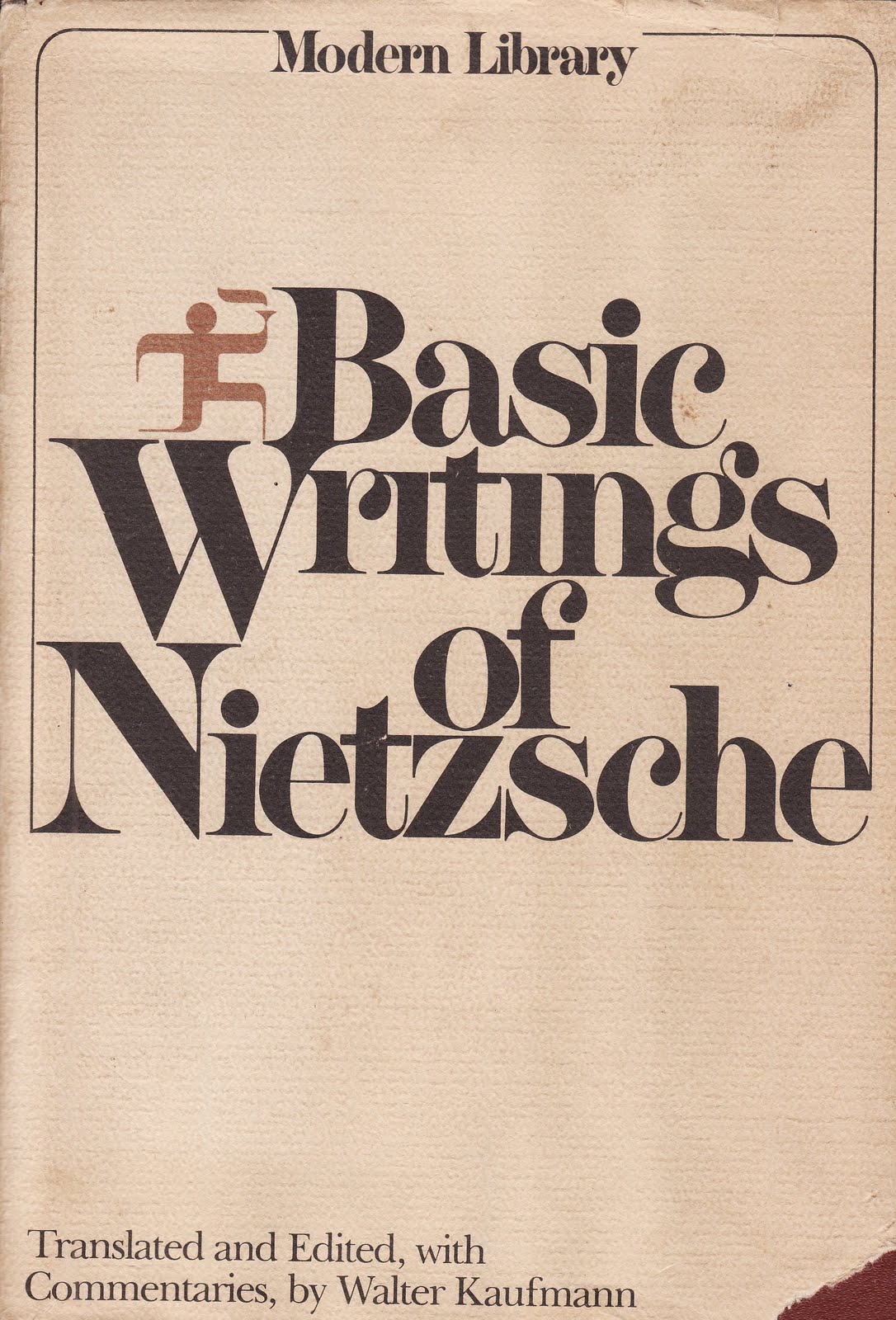
Methinks I really need to read this book. A couple of items I had read about before was Mencken’s role in promoting Nietzsche on this continent and the other was the accusation that Walter Kaufmann ‘sanitized’ Nietzsche. Because, yes, I came to Nietzsche through Kaufmann and his ubiquitous translations (particularly the one pictured).

What People Get Wrong About Hume


According to Simon Blackburn, it’s a lot.

The sad thing is, David Hume is an easy read. I don’t mean that his ideas are necessarily easy to fully comprehend nor that you can breeze through him, but that his writing style is clear and concise, which is all the more amazing because he was writing more than two hundred and fifty years ago (we are almost at the end of the third centenary of his birth). His An Enquiry Concerning Human Understanding (generally considered the foundational book for his particular brand of philosophical empiricism) is a wonderfully lucid read compared to your average philosophical tome (more so even than Locke) and it’s sad that it’s not more widely read as a means to provide a solid grounding in a significant thinker and provide one with, for lack of a better term, ‘food for thought.’

Habermas & Religion


Is Jurgen Habermas experiencing an intellectual conversion to religion/spirituality?

Religion seems to be creeping more and more into his thoughts.

But don’t let that think he’s no longer constantly wrestling with the nature of a just and rational society.

Marcuse’s Occupy Comeback?


The question of John Rawls and the Occupy Movement has already been asked.

I guess, now it’s Herbert Marcuse’s time.

Of the leading figures of the Frankfurt School, also known Critical Theory, Marcuse, like Theodor Adorno and Erich Fromm, wrote much of his most influential writing well after the group’s first gathering in the thirties. Indeed, it seems like only Walter Benjamin and Max Horkheimer peaked before the fifties – and Benjamin died in 1940 and Horkheimer was of a slightly earlier generation than the others.

Anyway, yes I was one of those college students who read One Dimensional Man with trembling awe. I devoured books by the Frankfurt School (and tried to understand them to the best of my ability) as a young, would be rebel (revolutionary?), but now I have mixed feelings about most of the original Critical Theorists, Adorno excepted.

With the exception of Adorno and, yes, including One Dimensional Man, there is something too facile about them. Too much polemics and too little critical philosophy. One Dimensional Man, like Fromm’s Escape from Freedom, seems too much written to appeal to the growing counter  culture movement. Trying to tie into the zeitgeist artificially, rather than organically. Or perhaps trying to latch onto it, rather than create or drive it.