Midweek Staff Meeting – Montmartre Edition


Though my high school buddies and I singularly failed to recreate the creative and artistic atmosphere of the cafe culture in Paris from 1900-1929 at a series of diners and coffeehouses in Florida in the early nineties, at least we can read about the real thing.

‘Live Like a Poet’

Do writers intend to by symbolic?

Vienna was cool, too.

Remind me again, what was Modernism about?

It wasn’t about forgery, was it?

Of course, if literature has died again, it might not even matter.

Friedrich Nietzsche Is Dead


Sunday Book Review – Academic ‘It’ Books


The latest big thing in philosophy.

The latest big thing in European philosophy.

A bad review of Nietzsche in America?

Tuesday Morning Staff Meeting – Beware Of Poets And Online Retailers


Amazon is the new Wal-Mart.

I’ve really got to read that new Nietzsche book (but definitely don’t buy it from Amazon).

I still don’t recommend the lifestyle, no matter how good their poetry.

Monday Morning Staff Meeting – Luther Was An Early Adopter


Martin Luther, zealot, reformer, revolutionary… blogger?

The e-book is never finished.

What is neo-chartalism? Funny you should ask…

Play ‘Greek Mythology Punishments’ for fun and edification (but not for the graphics).

Mad Love


In case you were worried, I am not writing about some future rom-com starring the latest pretty blonde actress, but rather Andre Breton’s meditation on… well, what?

On Jacqueline Lamba, a painter and also Breton’s second wife?

Sort of. But to my mind, not really.

Certainly, she is an object of desire. And that’s the real focus, desire and desire’s object. And sometimes, the fading of desire for the object.

Lamba is less clearly to focus here in Mad Love than the titular Nadja was the focus of Nadja. Mad Love is also much more autobiographical. In fact, it’s not a novel in the way Nadja is. It’s poetry, prose, prose poetry, and a running commentary on desire.

Certainly, it picks up where Nadja left off, with the convulsive nature of beauty.

But Lamba doesn’t even appear until a third of the way into the book. Before that, boding poorly for the couple’s future, Breton is walking with the sculptor Alberto Giacometti and suddenly Breton must purchase this spoon he finds in a market, but then later admits to losing most of his interest in it.

A short read and easier to understand than Nadja and more easily enjoyable to read than a full collection of his poetry, it’s a great introduction to the writing of the leading surrealist.

The forms range from the dreamy, gauzy prose of Nadja to more manifesto-like writing (he did write the two manifestos of the surrealist movement, after all) to actual poems inserted whole cloth within the book.

This bouncing between forms goes to the point of how this book is not about Lamba in the same way that Nadja was about Nadja. If I were to say what it is about, I would come down on the side of it being an aesthetic manifesto. Breton was always the most dogmatic of the surrealists, expelling from the movement those he felt betrayed the values and politics (surrealism was closely tied to the pro-communist left) set down (and generally set down by Breton), so it is hardly a surprise  that this work would so often take that form.

Another Brick In The Wall, Another Neighborhood Bookstore Gone


I used to live in Midtown Atlanta, right across the street from Piedmont Park. I lived in a crumbling, narrow building filled with studio apartments. I rented mine for $525 a month. For that money, I got a parking spot and a place to live within walking distance to my work (the Democratic Party of Georgia) and to Outwrite Books.

As you have perhaps guessed, Outwrite Books was an LGBT bookstore and coffeehouse, but so what? I could buy poetry by Adrienne Rich and Mark Strand, fiction by Oscar Wilde and Marcel Proust, and philosophy by Judith Butler. And having it so close by was a blessing and cemented by desire to always live in walkable, literate, and cultured communities.

As of today, Outwrite Books is closed for good.

The Cathedral


It was a bit of a slog, but I finally finished The Cathedral by J.K. Huysmans.

Unlike the works from his Decadent period, namely Against the Grain and The Damned, The Cathedral lacks that tasty frisson of sex and evil. It actually continues the story of Huysmans stand-in, Durtal, that was begun in The Damned. If you think of the four Durtal novels as a tetralogy, than The Cathedral is the third novel in the series.

Durtal is a writer of modest success but good connections who, in The Damned embarks on an affair with an upper class woman and the two of them explore the world of satanism and Black Masses.

Apparently, the second book, En Route, features a re-conversion by Durtal to Roman Catholicism. The Cathedral finds him living in Chartres, beneath the shadow of the great Cathedral, Notre Dame de Chartres.

The novel lacks much resembling a traditional plot. Mostly, it is a series of conversations between Durtal and himself and Durtal one or both of a pair of priests on Catholic symbolism, particularly the symbolism of the art, statuary, and architecture of the titular cathedral.

The long, constant discussions of odors, animals, gems, etc. and how they relate to particular saints, angels, and virtues can get tiring. There’s even a discussion of how to plant a garden to symbolize various attributes of the Virgin, Christ, and saints and apostles.

But beneath all that is an interesting story.

Durtal is bitter and restless and can only truly see meaning in art and literature and a particularly medieval style of Catholic worship. For all his efforts to be holy, everything is through this filter that stands between him and world. It should be noted that Chartres, cathedral aside, is depicted as a gray, lifeless, industrial town. Durtal seems to enjoy the self flagellation that living in such a lonely, culture-free locale entails for a man of art and learning.

It should be noted that the book ends with Durtal traveling with one of the priests to a convent and adjoining monastery where Durtal retires in the fourth book.

The Cathedral was actually one of the first books I purchased for my nook.

Tuesday Morning Staff Meeting – Amazon Is Coming For Your Children


“We’re in Amazon’s sights and they’re going to kill us.”

Will the Kindle wreck book markets overseas?

Overseas bookstores try to adjust.

Indie bookstores should stop trying to compete with Amazon (but no one is saying they should quit).

Trying to physically measure the humors of love & sex and thinking one had succeeded (but actually being a little crazy).

Parking tickets are almost as bad in Los Angeles as they are in DC.

Do we want to be punished?

Cicero


I enjoy undersized old books. Hardbacks slightly larger than a trade paperback. That kind of thing.

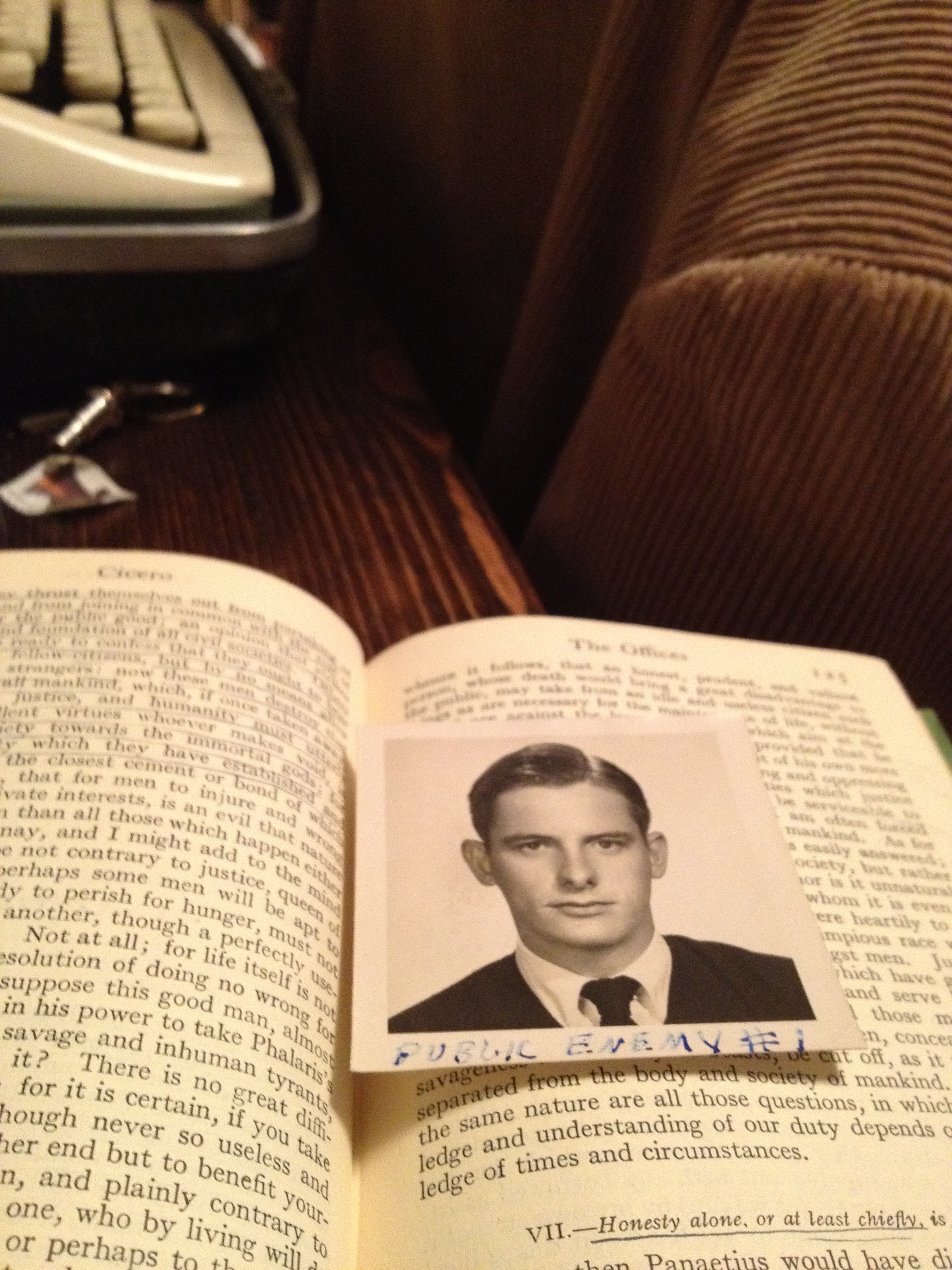
One of them is a copy of Cicero. In this translation, it is called The Offices, though it is more often called On Duties. This one is a particularly fortunate copy. Partly because the introduction is by the Romantic writer Thomas De Quincey, who famously wrote Confessions of an English Opium Eater (in the old days before the internet, I searched for months for a copy before finding a big old folio style one).

Secondly, within it was a small picture, like a school picture, on page 125. The young man, comicly identified as ‘PUBLIC ENEMY #1’ looks like an ordinary, handsome young man from the fifties (this edition was printed in 1949). The book is inscribed with the name ‘Katherine Laule’ (in truth, I am unsure about the last name). Was this young man her boyfriend? Her brother?