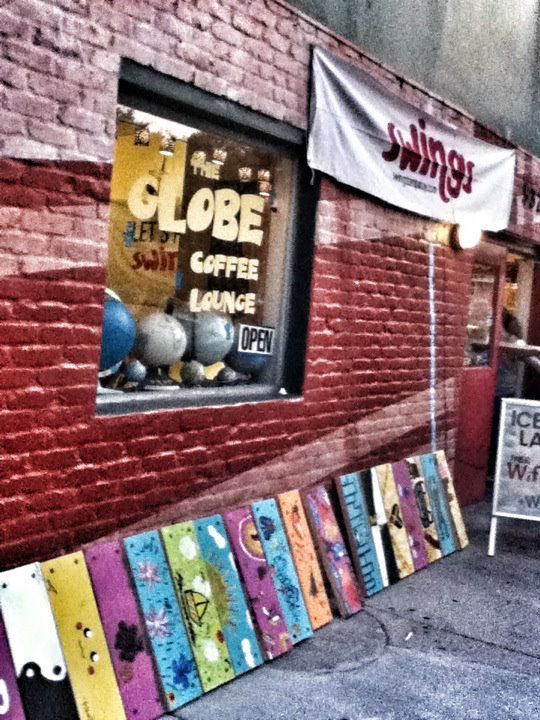
Tea House Culture & Dissent


There’s something of a throw away line in this interview with Chinese poet-dissident Ran Yunfei:

There is this teahouse culture here—you have these places where you can meet publicly. Not a lot of Chinese cities have these. Everywhere there are tea houses and people meet and talk.

Ran is explaining why the Sichuan province is known for its disproportionate number of dissidents.

But it does get one thinking, doesn’t it?

Like most people, I tend to idealize portions of the time of my youth. In this case, it is the coffeehouse culture that grew up in the early nineties. I’m also love reading about the early coffeehouse culture in England in the seventeenth and eighteenth centuries, as well as cafe culture in France.

Right now, America does not have a cultural venue for discussion of the type Ran describes in Sichuan.

Starbucks is a place to get coffee and go. Even places where one hangs out are primarily venues for wireless internet.

We don’t have a place where the primary beverage is non-alcoholic (we want discussions and debates, not sloppy brawls), even if some alcohol is served, where discussion and debate, including with relative strangers, is fomented.  And that has to be hurting our national political and intellectual culture/capital.

I will give a shout out to the Globe in downtown St. Petersburg which makes a special effort to engender that sort of environment

Weekend Reading – Actually, I Think It’s Supposed To Be Spelled ‘D-O-G’


Actually, I never called it the ‘God Particle.’

Evolution is just a theory. You know, like gravity and anti-biotics.

Neuroscience not yet up to the task of disproving free will.

Selma To Montgomery


The Freedom March from Selma to Montgomery began on this day in 1965.

I lived in Montgomery, Alabama for a number of years and actually have fond memories of that city – the museum of fine art was free, the state archives interesting (if poorly curated and documented), and the Alabama Shakespeare Festival (you can bet I took full advantage of the student rush tickets, just ten dollars starting thirty minutes before curtain). Plus, a one-time pornographic theater turned venue for independent and foreign films. I have never seen so many movies as I did then, catching nearly every film (there was only a single screen, so it was a movie a week, basically) that played there.

You also could not escape the history of the civil rights movement there, nor could the cultured veneer cover up extant inequalities.

The picture attached is of the Civil Rights Memorial outside the Southern Poverty Law Center. It was designed by Maya Lin, the same sculptor who also designed the Vietnam War Memorial. By the way, the white haired woman just left of center (next Roy Blunt) is my old boss, Congresswoman Grace Napolitano.

The memorial lists important events in the Civil Rights movement, as well as a quote from the Book of the Prophet Amos: ‘Until justice rolls down like water and righteousness like a mighty stream.


Midweek Staff Meeting – Walking With Billy Collins


This almost makes me want to read him. Almost.

“…artistic form is never philosophically neutral, that it always embodies some identifiable ethical or cosmological perspective in itself, without any reference to the content of the artwork…”

Some poetry reviews.

I can’t believe Seth Abramson gave all positive reviews! What were the odds? (Read: sarcasm)

Ralph Waldo Emerson


On this day in 1841, Ralph Waldo Emerson published his first book of essays.

While I know that we read a poem of his and probably a brief essay in high school, that was the extent of my contact with him until I moved to Atlanta in 2001. At Chapter 11 Books, I picked up a copy of The Essential Writings of Ralph Waldo Emerson for several weeks, simply devoured it.

That copy got lost in one of my moves and I recently picked up a nice hardback edition of his collected essays from a used bookstore (I also picked up a collection of his early poems, but he’s not a great poet, to be honest).

One thing that very much struck me, once I actually got around to systematically reading him, was how sophisticated he was. I had read some Kant a few years previously (most of the first Critique and the entirety of the second) and was, like many readers of Emerson, very aware of the great debt he owed to Kant.

In school, he was presented as a sort of homespun caricature of American pragmatism, so to see him in such correspondence with (arguably) the greatest philosophical mind since Aristotle was a revelation.

Sigh. Another reminder of the inadequacies of the American system of education (and no, the fix does not include breaking teachers’ unions or giving out vouchers, but yes, it probably does involve paying and treating teachers like respected professionals and also less testing).

Tuesday Morning Staff Meeting – Ideologies


Dawkins style atheism as a cult.

I’m not so convinced this guy is actually up on contemporary philosophy.

Was Poe a bad writer?

The Offices


The Offices, as it is translated in my copy (more often translated as On Duties) is a pleasant enjoyable work.

Cicero was known as a great stylist as well as great orator and the translator has taken pains to try and convey a enjoyable and readable style.

Early on, the author identifies himself as a philosopher. The conceit is that Cicero is writing a letter to his son who is studying with a (then) famous Greek philosopher. While exhorting his son to not ignore the Roman style of philosophy while studying under a Greek, Cicero consistently refers to himself a prominent Roman philosopher.

This sparked in me the contrast between classical Roman philosophy and virtually ever other ‘philosophy.’

Though I have read deeply in philosophy for a dilettante, I am still a dilettante, so I will accept criticism from those who know more. But to me, Roman philosophy has always seemed more of belles lettres than true philosophy in the academic sense. I suppose I could also compare it to drugstore philosophy books that are more pseudo-spiritual self help than any real philosophy, but that would be unkind to a major and influential thinker.

That said, should we look at this particular work by Cicero more kindly? It is, after all, a not unrigorous book of practical ethics? But it’s not all that rigorous, though, is it? The ‘what one ought to do’ is well put, but the ‘why one ought to do it’ is a little more fuzzy, is it not? Or do I, as a contemporary man, simply fail to empathize with Cicero as a man of his times and my failing to respect appeals the gods is, in fact, a real failing on my part?


Thursday Staff Meeting – Please Don’t Kill The Library!


I always suspected that Elaine Pagels maybe wasn’t the best place to start learning about Gnosticism or the early church.
Unsurprisingly, the Vatican isn’t Facebook friends with her either.

A side effect of state and local budget cuts – as libraries are needed more and more, the money for them gets less and less.

Tuesday Morning Staff Meeting – Libraries, Spaceships & Steve Jobs, The Well Meaning Fascist


Yes, there is quite a bit of arrogance in this man’s description of his library, but as e-readers become more prevalent, the fetishization of the book seems almost a necessary response.

How big is a ‘Firefly’ class space ship?

But when it comes to the T.A.R.D.I.S., it’s what’s inside that counts.

Steve Jobs’ philosophy was, ultimately, paternalistic authoritarianism.

Weekend Reading – Who’s Your Favorite Sociopath?


My favorite idiot sociopath.

Actually, I’ve always suspected Charles Murray of being a little sociopathic, too (seriously, have you read the Bell Curve?).

Real men read Homer.

But I don’t want to be a pirate!