The B Spot Jazz Trio; Or, Is Cornel West Drunk?


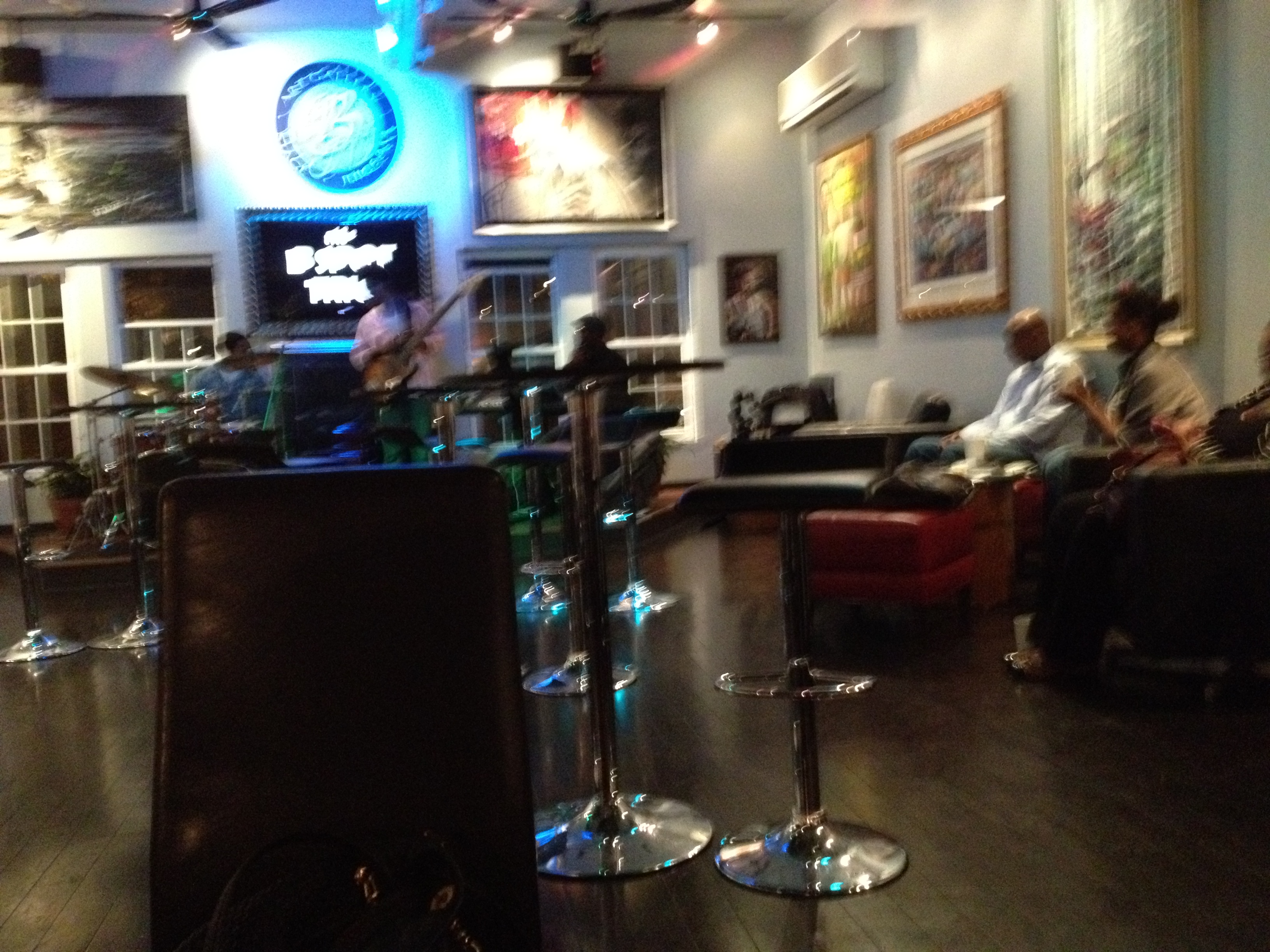
Last Saturday night, my better half I ambled over to the B-Spot, a teahouse on the second story a building on Pennsylvania, just above a pizza-by-the-slice shop.

I haven’t been there in a while, but I keep on meaning to go for their regular, Saturday night jazz sets, usually featuring the B Spot Trio, the teahouse’s aptly named house band.

The place serves quality tea (the owner takes his tea very seriously), is swankily decorated with modern looking furniture and paintings by local artists (the place also does brisk business in framing, which seems odd, but what the heck).

So I convinced her to come with me and listen to some tunes and drink some tea.

The Trio plays some good music and the crowd skews older – forties and up. With the more mature audience and the lack of alcohol, the vibe really was one of the coffeehouses I remember from my adolescence and early twenties, back when the main draw was not Starbucks latest attempt to serve a sixteen ounce cup of frothy milk, cut with a little coffee, nor even a place to bring one’s laptop, but rather music, poetry, and conversation.

And while my camera took a fuzzy picture, in the corner, next to the window, is a painting that looks for all the world like someone painted a portrait of Cornel West as if the philosopher was just coming off a two day bender and wearing a wife beater and drinking a warm bottle of beer.
Thursday Staff Meeting – The Man, The Myth, The Marx


Myths about Marx.

Poets against austerity.

Article that uses Damien Hirst as a means to criticize modern art.

Tuesday Morning Staff Meeting – Your Weekly Poet


New work from poet David Morley.

Dreaming in Chinese.

The theology of war.

Militant atheists practicing ‘evangelical scientism.”

Weekend Reading – The Bonds Of Poetry


What are the social bonds of poetics?

Bill Mohr chronicles West Coast poetry after WWII.

IKEA gets creepy.

Weekend Reading – Have A Happy Easter


Is Umberto Eco an overrated, bloviated blowhard?

The letters of Sigmund Freud and his second most famous disciple.

A cinematic ode to the owner of Shakespeare & Co.

Tuesday Staff Meeting – I Said ‘Oannes’ Not ‘Onan;’ Very Different Things


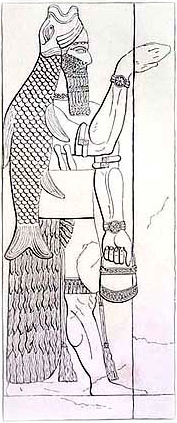
Oannes, the founder of civilization.

‘Planet Patrol,’ one of the high points of western civilization.

The best philosophy journals.

Monday Morning Staff Meeting – The Magazines Of High Modernism


The Modernist Journals Project is dedicated to digitizing the great journals of the modernist era – check out ‘The Egoist’ and ‘The Little Review,’ both closely tied to my boy Ezra Pound.’

We are all children of the Enlightenment.

What purpose poetry?

Neurophilosophy


I was living in a suburb of Minneapolis with my good friend Ryan.

Part of our relationship is based on shared appreciation for literature, science fiction, and philosophy, but also on our appreciation coming from different directions.

In short, I am am humanities geek and he’s a hard sciences geek.

During this time, I read a book in his collection called Neurophilosophy by Patricia Churchland.

Neurophilosophy indulges in a contemporary brand of scientific reductivism that I cannot accept on a very visceral level. On a more rational level, while I accept that we may one day understand all the problems of consciousness and free will within a scientific framework, I believe that the terms under which they are resolved and the extent to which science will have advance will have the effect of rendering all the claims of neurophilosophical reductivism as meaningless as Churchland finds most efforts by traditional philosophy to address these issues to be.

These memories were brought up when I read this essay debunking the claims and efforts of Churchland and her colleagues. Unfortunately, I can’t say I’m pleased to have the author on ‘my’ side, mainly because he’s tendetiously strident, without showing much in the way of rigor and spends most of the piece tearing straw men without bothering to address the very real issues brought up by applying modern neuroscience to the old questions of philosophy and religion.

I fully understand and participate in the subjective desire to believe in something transcendent – something inside us as conscious beings connected to art, beauty, creation, the divine. But, dude… not the way to make the argument! Thanks for setting us back.

I should also add the my friend’s views have softened and he is, dare I say, closer to ‘my’ side of the argument (‘our’ side?) than where his opinions used to fall. Getting soft in his old age?

Translating Sacred Writings


I am sympathetic of the criticism’s Leon Wieseltier voices in his review of the translation, New American Haggadah.

He laments the declining literacy in Hebrew among American Jews and how that necessitates translations of holy texts that, like the Qu’ran, are inextricably and spiritually tied to their original language.

Latin does not have quite the same importance in Catholicism. Though it is deeply bound up with the liturgy, it does not have the same ‘originalist’ aspect that Arabic and Hebrew have in the faith traditions of Islam and Judaism. That said, ‘Logos’ (ironically, a Greek work) is a crucial concept.

Also, the critic’s broader critique of the translation brings to mind my own mixed feelings of the newly released English language liturgy. It’s not exactly a new ‘translation’ – translation not being the right word. It is part of a continuous process of incorporation of theological understandings into the liturgy.

One thing that paved the way for a, not easy, but less us say ‘less difficult,’  transition to the Catholic church was my childhood in the Episcopal Church. Many of the wordings were similar or the same. While the Catholic Church, naturally, does not use the King James Bible, neither does it use one of those stylistically abominable ‘modern’ translations.

But now, the wording is moving further from my childhood memories and feeling less familiar and more alien.

On a much more personal level than even my childhood memories, the old phrase, spoken before communion, ‘I am not worthy to receive, but only say the word and I shall be healed,’ was infinitely comforting while I struggled with a life threatening and debilitating illness. While I understood that the promise was not that God would necessarily physically heal me – some live, some die, some suffer, some do not – but the words themselves were reassuring. The new wording ‘and my soul shall be healed,’ feels almost like a betrayal of that earlier comfort. Irrational, I know. And ‘soul’ betters reflect what the sacrament offers. But nonetheless…

Midweek Staff Meeting – What’s Your Happy Place


College towns are happy towns.

Actually, I’m okay with you dismissing Ayn Rand.

Hoping to make this part of East Tampa a little bit happier.