TOUT VA BIEN by Suzanne Stein – FUGITIVE STATE


The second part of TOUT VA BIEN is entitled FUGITIVE STATE and is a more traditional poetic form.

Actually, the first page and a half consists of three line stanzas, with relatively lengthy lines, focusing on forms and framework and things that limit. It’s all very good and I wish she’d kept it up. Not that the rest of FUGITIVE STATE isn’t good, it just isn’t as good. The changing formal nature (shorter lines, longer and shorter stanzas, prose poem paragraphs) doesn’t add anything for me. Partly, this is because I was so wrapped up in that initial bit that the shift was disappointing for me. It’s like reading a novel and discovering that the guy you really liked at the beginning is not actually the main character. Sure, maybe you’ll like the rest of the book and this new, real protagonist, but you were really into that first guy.

The focus also shifts to identity. Now, that’s a complete break, because, after all, isn’t identity a limiting agent? And Stein definitely explores that, but also gets into the meaningless of identity (the repetition of a line about an ‘anti-terrorist’ who is financed by terrorists), but that subject is a little worn over for me. She does take it over to the subject of political alienation (as you can guess by the ‘anti-terrorist’ bit).

I should note that she does go back into (mostly) using the long lined, three line stanza structure, but even then, it’s broken up with other forms and the spell (a repetitive spell that brings attention to form) is broken (though breaking the spell also brings attention to the form), or leastways it was for me.

Stein also has tendency to let cool sounding phrases take the place of lines and stanzas that actual move the poetic project forward.

I was an American correspondent in America, who could no longer correspond to anything…

I don’t know. Too me, that’s cool thing said in a coffee house to a friend after too much coffee and collegiate philosophizing (or after too much time in the bar after too much alcohol and barfly philosophizing). Not so sure it belongs in a work of poetic creation.

But credit where credit is due. The ending, the final page of FUGITIVE STATE is magnificent and could stand as a fine poem in its own right:

so How long until How make long the lost bucolic?
there’s a descriptive act and a de-descriptive act
surface-oriented slippage I wanted to Ask
internal Organ failure internally
accurate and externally Sordid
as gestures that aren’t That didn’t
make
I wanted to Make
it was building it was irreparable
taken    apart    Under    Accidentally    Right    on    Target
with the script flipped I once               there was
Absolution, once        Have you taken stock of your Conduct?
The crowds inside, or the Trap as, we were well before
the fact
Desire’s a Tool to put to use I wanted to

That’s a great bit, and also crystallized for me the implicity touches from Gilles Deleuze and Felix Guatari’s book, Anti-Oedipus, with its ‘bodies without organs’ and ‘desiring machines.’

Speaking of which, did you know that Anti-Oedipus is now being published by the Penguin Classics imprint? Seriously. I feel old.
Depression


David Foster Wallace wrote, in the pages of Infinite Jest, about it being

a nausea of the cells and soul

Marvelously apt, but also reminds one of the great ancestors in the literature of depression, Jean-Paul Sartre. I hadn’t thought about it at the time, but more than misanthropy, aren’t plays like Huis Clos (No Exit) really about the alienating features of depression? But, really, what that phrase drove me to was Sartre’s Nausea.

We are trained to look at it from a rarefied angle: Kierkegaardian anguish of the soul (though not ‘soul,’ this is Sartre, but anguish of the ‘being’ isn’t so Kierkegaardian as of the soul) and anger at the shallowness of other people and their inability to comprehend the absence of outside meaning in the world.

But the red-haried protagonist and his writer’s block (he can’t finish a book about Gustave Flaubert) and his inability to connect with a past lover he desperately wants to re-connect to… isn’t he depressed? And lashing out at his former flame, sabotaging their connection, that pained combination of pushing away and begging for someone not to be pushed away by one…

Sartre would probably hate this comparison.

Marxism On The Rise?


Maybe. But’s not so simple. Or rather, it’s not so much Marxism as a political movement (which, arguably, it never really was), but rather as place from which to identify faults in the system and seek guidance for remedies (which is, arguably, closer to what it was, but still isn’t really it, is it?).

Jacques Mauritain Explains The Teleological Argument


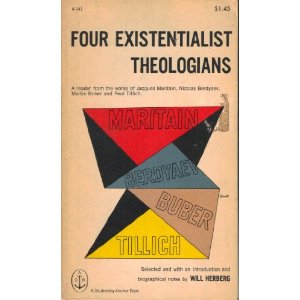
Some time ago, I picked up a book at Capitol Hill Books (I can’t remember whether it was filed under theology or philosophy) on existentialist theologians (the cover design, for all you fans of those Masterpiece Mystery title sequences, is by Edward Gorey). It began with Jacques Mauritain.

I first came across his name in a book my father got my some two decades ago called Inventing the Middle Ages, a fascinating work of historiography (which also led me to read The Waning of the Middle Ages by Huizinga and a couple of others).

Mauritain was a dedicated Thomist for most of his intellectual life. Now, I can’t pretend to have read much by Aquinas and I understood not all of what little I read (though I’ve read plenty about his writings, so I understand the basics, unless everyone I’ve read who wrote about Aquinas was lying to me).

Anyway, he (we’re back to talking about Mauritain) puts a nice spin on Aquinas’ teleology, making it far more palatable.

If, like me, you were taught about Aquinas spin on Aristotle’s ‘unmoved mover,’ you were probably less than impressed. Purely philosophically, I don’t think I’m generating controversy by saying that it’s lacking.

But Mauritain is looking at things as more of a hybrid theologian/philosopher (I don’t mean that he was necessarily trained or studied theology; but that hybrid role could, perhaps, could be said of all philosophers who come at their studies from a specifically religious-minded position; also, this rather suggests that if the book wasn’t filed under theology, maybe it should have been, except the theology section is a lot more Purpose Driven Life and a lot less I and Thou). He comes at his teleological argument implicitly tolling the primacy of faith. For him, likely as it was for Saint Thomas, the ‘unmoved mover’ is not so much a way to ‘prove’ the existence of God as it a way to create a means for fellow men of faith to improve their understanding of God; not by truly ‘understanding’ God (impossible, surely?), but by rather by providing a framework to understand one’s relation to God.

Is E-Reading Reading?


This guy doesn’t necessarily think so (though he also admits to owning a couple of e-readers).

Like most critiques of e-readers (critiques I don’t necessarily disagree with), the focus is on the physical, because that is, isn’t it, the real, or perceived, point of difference.

You are not holding a copy of Notes from Underground. You are holding a sort of computer that may or may not hold Notes from Underground. But that can’t be it. Not really. Words, letters, sentences are still just a form of coding, just like the mystical sparks that hold the codes for Notes from Underground on an e-reader (I don’t actually have that book on my Nook – but it’s a great book, one of those things angry young men should read in their teens and twenties before graduating to The Brothers Karamazov).

No, where the essayist (Andrew Piper, I should name drop him, or hat tip him, or whatever the proper yet hip terminology is for giving him credit here) gets it right is in referencing the estimable and readable Saint Augustine of Hippo:

Augustine is sitting beneath a fig tree in his garden, and upon hearing the voice he takes up the Bible lying near him and opens a passage at random and begins reading (Romans 13:13-14). At this moment, he tells us, “I had no wish to read more and no need to do so. For in an instant, as I came to the end of the sentence, it was as though the light of confidence flooded into my heart and all the darkness of doubt was dispelled.” Augustine closes the book, marking his place with his finger, and goes to tell his friend Alypius about his experience. His conversion is complete.

Generation Theory


One of the more interesting things I remember reading by David Foster Wallace was an essay where he noted that his generation of writers was the first to be as influenced by theories of writing as by writing itself. Specifically, French structuralist and post-structuralist, but I don’t think that specific is as important nor as revelatory as the notion of the influence of theory on ostensibly non-theoretical work, i.e., not works of philosophy or literary criticism.

Anyway… read this cool essay from the pages of the always enjoyable N+1.

Midweek Staff Meeting


They also have a great collection of Pre-Raphaelite paintings.

Benjamin’s afterlife.

What are we supposed to have learned from the Dead Sea Scrolls?

Chief Justice William Rehnquist: An unreconstructed, hypocritical, pill popping racist or a left handed albino Eskimo pipe welder?

Saturday Post – President Heidegger


Goes straight after John Ashberry, doesn’t he?

What if Heidegger had become leader of Germany?

The ultimate in existentialist blogging.

The myth of the ‘Liberal Media.’

WTF?!


Really? My home state of Florida, under the guidance of Rick Scott and his Republican ouija board, is now dissing both my college major (history) and my minor (philosophy)?

Governor Rick Scott, you lack the basic self control God gave to an infant monkey suffering from projectile diarrhea, you ignorant c–p weasel.

You are an amazing combination of ignorant and embarrassing. Congressman David Rivera (R-soon to be indicted, just lost) is five seconds away from looking at you and saying, ‘Dude, you have lost the plot.’

Ugh.

The Sunday Newspaper – Death & Poetry


The dying poet.

If you want a confessional, read his books, not his diaries.

The (not so) secret radicalism of Paul Ryan.

Has she seen Episode II?

Send someone you know (or someone you don’t know) a book of poetry.