That Hideous Strength (New Year’s Resolution, Book Seventeen)


I finished the final book in C.S. Lewis’ Space Trilogy – That Hideous Strength.
I was trying to figure out what it reminded me of; even more than its predecessors, it felt derivative. But derivative of what.

Then it hit me. Madeleine L’Engle.

But that really means that she was derivative of Lewis (it should be noted that, like Lewis, L’Engle was a devote Anglican).

But… I think L’Engle was better.

Frankly, Lewis muddles up what makes him good. He references (and acknowledges) some ideas stolen from his friend J.R.R. Tolkien. Specifically, the ancient race of ‘Numinor.’ Of course, Tolkien, when he eventually published his opus, spelled it ‘Numenor.’

Lewis inserted a bunch of faux Arthurian ideas which, frankly, muddled his Christianity with a bunch of ideas and plot devices that he simply was not in control of. That, and the climax was… I don’t know. What did it have to do with the rest? What actually happened? A bunch of magical rules never before referenced were, apparently, the cause of the good guys winning. And a pretentious reference to Trahison des Clercs (Treason of the Intellectuals) was pointlessly inserted. Don’t know why that bothered me, but it did.

And the hero of the two previous books is transformed from a more fully fledged man of early middle age into a permanently handsome and young icon and a nearly perfect messianic figure. Ugh.

Look. Read the first two books and call it day. Skip this one and, instead, go back and read my favorite Narnia novel, The Horse and His Boy.

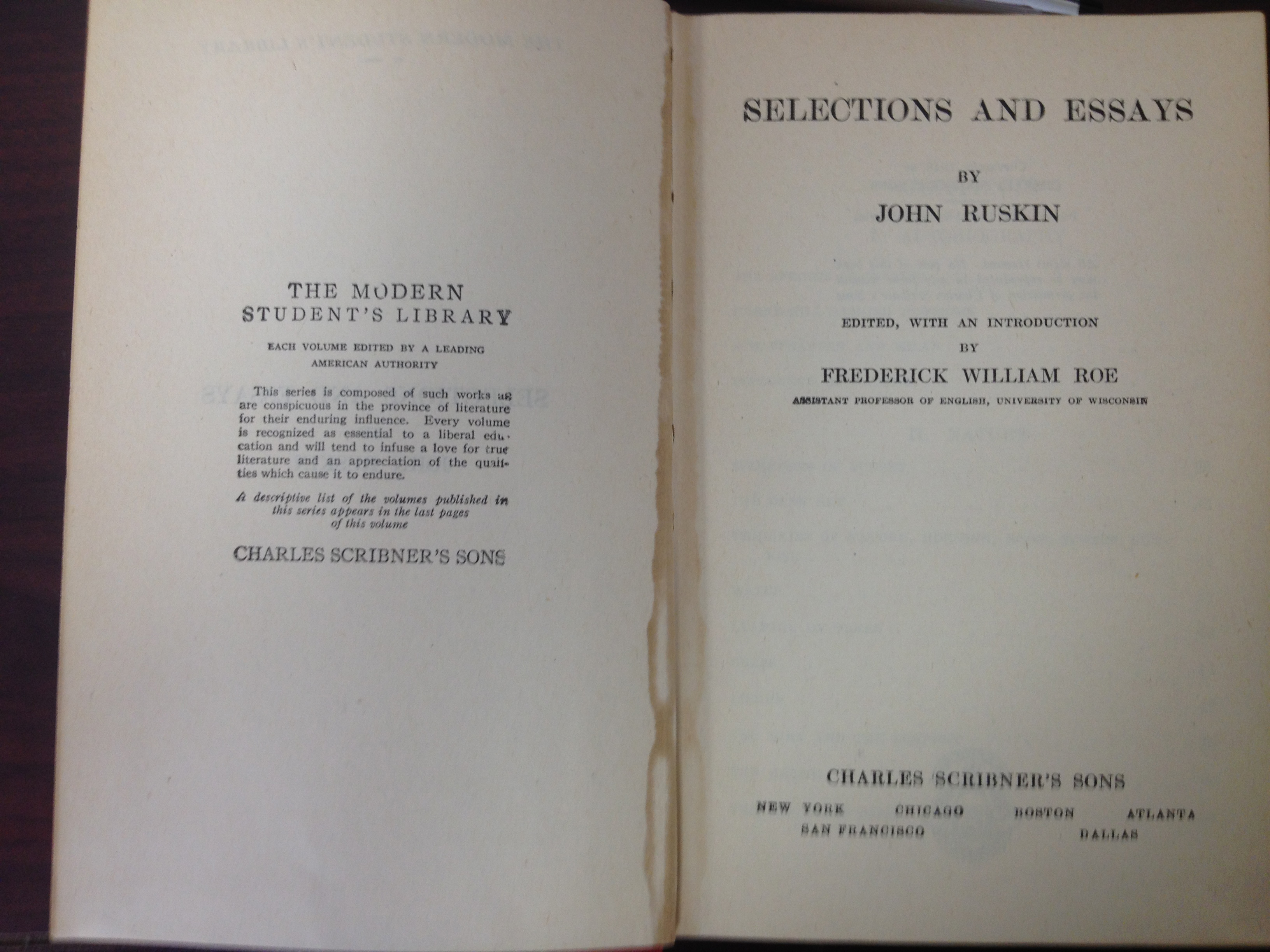
‘Selections and Essays’ (New Year’s Resolution, Book Sixteen)


photo (1)At the Lantern, in Georgetown, a fantastic (and cheap!) used bookstore filled with high quality, interesting books, I gathered up a whole mess o’ reading, including this collection by the nineteenth century art critic, John Ruskin.

Ruskin was a cheerleader for the Pre-Raphaelite painters.

In fact, when I was buying the book (books, in truth; five to be exact), the sweet young girl (I’m guessing a Georgetown student) at the desk and I got into a conversation about him and the Pre-Raphaelites. She was planning on seeing the exhibit and asked, rather pointedly, where I found the book. I think she had been looking for a collection of Ruskin’s writings and was a little miffed that I, a stranger to this place, had found it first. Then the conversation moved to Andrew Lloyd Webber (the older woman who runs the shop joining in at this point). In case you were wondering, I like Jesus Christ Superstar and that’s it. The rest is trash.

So, Selections and Essays dives very quickly into selections that get into the heart of what informed Ruskin’s taste and his theory of art.

Firstly, in some autobiographical pieces, he returns again and again to how his mother required him to read deeply into the Bible, memorizing passages and reading the whole thing from cover to cover several times as a child. There’s also some stuff about reading Sir Walter Scott’s Waverly novels over and over again as a family, but I think that’s less relevant (which no doubt means it is the coda to all of Ruskin’s later thought).

Then, in his rapt discussions of the appearances of nature in nature (first, the thick, creamy, curdling, overlapping, massy foam, which remains for a moment only after the fall of the wave), you can see how Ruskin could have appreciated Turner’s later and more impressionistic (small ‘i’ – Turner was no Impressionist) landscapes.

Ruskin believed that personal, moral feelings were imparted to art (and therefore necessary for art?) and that art called for an accurate, yet also naturalistic depiction of the natural world, by which I mean, the rural world (no urban cityscapes, for him, no thank you, please). The moral is especially critical. He ultimately see aesthetics as a moral science (he even prefers to call it theoria or the theoretic faculty to distinguish it from traditional aesthetics).

He is almost prescriptive. When ostensibly writing about art, he is actually writing about nature, but, really, he is writing how artists ought to depict nature by describing how nature appears to the viewer (sometimes, from several different viewing angles).

Let us have learned and faithful historical paintings – touching and thoughtful representations of human nature, in dramatical painting…

Because of his relation to the Pre-Raphaelites, I noticed that he called Michel Angelo [sic] the ‘Homer of Painting,’ Michelangelo being, as it were, Raphael’s immediate predecessor, a true ‘Pre-Raphaelite.’

To ramble a bit, have you read Elaine Scarry’s On Beauty and Being Just? Because she must have read Ruskin. They’re coming at from different angles, in the sense that Scarry begins with the idea that, these days, there is a need to justify beauty and uses moral reasoning to do so. Ruskin, of photocourse, is not justifying beauty, but he still finds its core in moral reasoning.

I didn’t quite know what to think about his political writings, which, apparently, were his obsession (in an early essay he is clear that he comes from a family of lifelong Tories and also so self-identifies, though he sounds to me like an advocate of what today would be called democratic-socialism or European style socialism). He claims to hate liberalism, which seems confusing (because he is surely advocating liberal ideas) until you remember that in the nineteenth century ‘Liberal’ meant more a sort of middle class libertarianism.

These were the days when ‘economics’ was called study of ‘political economy’ and he clearly shows the difference that makes (and also how poorly understood much of economics was; this is not a criticism of Ruskin, but things got a lot clearer post-Keynes). He rightly understands that wealth (riches, he says) is actually about power. I don’t know how widely understood or how widely stated that was, but if it was neither, here’s a fine example of how the mindset taken when the field is called ‘political economy’ can lead to some good insights.

I noted one passage on page 340 that stuck out because he seemed to be advocating for Glass-Stegall!

…that the private business of speculating with other people’s money should take another name than ‘banking.’

The most shocking passages are when he writes critically, dismissively of Greek art and architecture. I had never heard of a nineteenth century Englishman writing less than admiringly, fawningly about the glories of Greece. Frankly, I don’t know what to think. I mean, I like ancient Greek art and architecture and poetry and culture. I feel like I’ve been found out as some sort of Dwight McDonald style midcult bourgeois fraud. Once again though, you can see that connection to the ideas that inspired the Pre-Raphaelites, this deep love, almost to the exclusion of all else, of the art and architecture of the period in western Europe from the eleventh century until just before Raphael.

Sunday Paper – Dissentnik


Last of the old guard ‘Dissentniks’ retires.

A theory of whiteness.

I knew it!

A regular constitutional is good for one’s creativity.

Weekend Reading – West Virginia Leads The Way


A Republican politician in West Virginia wants to put science fiction in schools.

A magical time, with sexual fetishists, future mass murderers, and radical intellectuals (sometimes, all three at once).

Decline of a once (surprisingly) great art museum.

Takeaway quote: ‘Philosophy – it’s a bag of d–ks.’

The bookishness of books.

Your Daily Derrida


The idea of the book is the idea of a totality. It is the encyclopedic protection of theology and of logocentrism against the disruption of writing, against its aphoristic energy and … against difference in general.


Monday Morning Staff Meeting – Overrated Wonks


Wonks gone wrong.

Through the eyes of the ‘other.’

Still dead, I guess.

Better dead than red.

On Human Work (New Year’s Resolution, Book Fifteen)


$(KGrHqR,!p!E-1L86h)cBP6sI!wBFw~~_35This is the official translation of Blessed John Paul II’s Encyclical Letter, On Human Work. As someone who works in the labor movement (and especially as someone who is working to help adjuncts at a well known Catholic university form a union), you can well imagine this might interest me.

Also, I bought it at Pauline Books and Media, a little Catholic bookstore in Old Town Alexandria, run by the Daughters of Saint Paul who, so far as I can tell, model themselves after Paul the Evangelist in focusing heavily on communication and evangelization. I’m guessing they have the most active twitter account of any order of nuns. But I’m just guessing.

It’s a very comfortable and contrary to images in movies, I have always found nuns to be very friendly and welcoming. It’s got a selection of devotional stuff, similar to what you might find at any Christian bookstore, but, this being a Catholic establishment, it also has a great many volumes of scholarly and intellectual interest. And a rack devoted to papal letters and other Vatican documents.

I like to go there when I play D&D on the weekends, but since we often play on Sunday, I can’t always (the store is, naturally, closed on Sunday). The other week, we met on a Saturday.

On Human Work, as one would expect of a document by the notably anti-Communist, Blessed John Paul II, speaks out strongly against ‘historical materialism.’

But reading this critique, one can’t help but notice that it is arguing for remedies for what can only be described as man’s alienation from his labor. In other words, it is the same problem as that illuminated by Marx.

Derrida wrote a book called Spectres of Marx, about Marx’s writing’s relationship to ghosts and spirit. I mention that because, the way I see it, this alienation is only an issue if it is also a spiritual alienation.

Implicitly, both Marx and Blessed John Paul are concerned with how changing attitudes and treatment of labor injures the soul.

The language used could also have come from a socialist workers conference: ‘capital,’ ‘solidarity,’ ‘technology,’ etc.

Since Marx wasn’t terribly prescriptive, I guess I am mostly referring to later Marxian thought. Both Marxian thinkers and Catholic social teaching is looking at the same issue when it comes to much of work. How the fruits of labor are unevenly and, in many cases, unfairly distributed. How technology leads to dislocation that is traumatic the dislocated (and their families and communities). And how human workers become alienated from their the fruit of their labor and how this alienation is both material (someone on an assembly lines very often does not physically see the completed product emerge, further down the line) and spiritual (though atheist Marxians may resist that terminology; but whether you call it spiritual or psychology, it is something within the worker that is suffering).

On Human Work writes about work as something uniquely human – and therefore connected to our uniqueness amongst creation on Earth, and by implication as being connected to the fact that we are made in God’s image, that, through work, we share ‘in the activity of the Creator.’

When looking at work, Blessed John Paul writes, it is important to remember the guiding view of the church is that labor has priority over capital.

Let quote that:

In view of this situation we must first recall a principle that has always been taught by the Church:

Did you get that? Reading that in these days following the economic collapse and the unequal and unjust recovery that rubbed our noses in the failures of rampant, runaway, unfettered (and unchristian) free market capitalism… well, it’s a reminder that the questions raised aren’t new and that figures ranging from Karl Marx to anti-communist Popes have thundered about them.

There’s lot to love in this if you’re a labor activist. Exhortations for the state to fulfill a moral obligation to protect worker’s rights and also to work towards ‘suitable employment for all who are capable of it.’ Unions are called ‘mouthpiece[s] for the struggle for social justice.’ Good stuff. Good stuff, indeed.


Sunday Paper – Buying Banned Books In China


They’re not banned in Hong Kong.

Starting Tuesday, you can read your Ray Bradbury on e-readers.

Theology is silence.

Monday Morning Staff Meeting – Forgiveness


Forgiving Schnabel.

Renata returns.

Theism for the atheists.

Perelandra (New Year’s Resolution, Book Ten)


I finished reading Perelandra, C.S. Lewis’ sequel to Out of the Silent Planet.

The religious aspect comes much more to the fore here, as well as an idea you’ll see a lot within Lewis, that of this war between God and the Devil (though still not so explicit).

Also, you can draw a straight line, I think, between Lewis’ Space Trilogy and Madeleine L’engle’s trilogy, beginning with A Wrinkle in Time. I believe that L’engle was also a devout Anglican, too, though that’s not what I’m talking about. And Lewis isn’t writing children’s/YA fiction here, though the style is very similar to Lewis’ books for young people (which maybe is testimony to his not talking down to children or a testimony to a certain childlike nature in his writing in general).

Out of the Silent Planet was a more subtle book, in a way. Perelandra is far more theological, by which I mean that it expressly advocates for and against some specific theological positions. Rather unexpectedly, Lewis (or his stand-in, Dr. Ransom) fiercely opposes, on theological grounds, the idea of humans colonizing other planets. In the context of this system he’s created, it makes sense. Planets and species are born, grown old, and die. This, it is implied, should be accepted as part of God’s plan. But it was surprising and pulled me up short when Ransom was so vehemently opposed to the idea. I thought of 2010, when the alien intelligence told humanity not to colonize one of the moon’s of Saturn, because that was intended for new, burgeoning life. But, in 2010, humanity did the go ahead to spread across other planets and moons in the solar system. Lewis doesn’t think we should be leaving earth, at all.

He also makes an argument against… I would call it evolutionary deism. But a certain kind of non-denominational spirituality. I’m sure it’s referring to something of particular vogue when he wrote it (was Bergsonianism big at the time?).

The idea of God, Jesus, and the Devil are much more explicit here. There’s even a some very real demonic possession (which Ransom is irritatingly slow to wise up to).

The most interesting bit actually occurs fairly early on, when Ransom intrudes upon an edenic moment and appears as if, unwittingly, he will play the role of the serpent, introducing death and evil into the paradise that is Perelandra (better known as Venus). The edenic theme continues, but with a more traditional antagonist.

When I wrote about Out of the Silent Planet, I noted its debt to planetary romances like Burroughs’ beloved John Carter of Mars novels, where half the pleasure is the author’s development and the reader’s discovery of a new, amazing world. But the world of Perelandra is less joyfully explored than that of Malacandra (Mars) and the book itself is far more grim for it. Theology trumps discovery.

As a Catholic, the idea of the devil has always been hardest aspects of dogma for me to wrap my head around. But C.S. Lewis is determined to remind readers of his existence.

Did you ever see the movie, The Usual Suspects? If you haven’t, shame on you. It’s a great movie. I saw it with my friend Ryan in Minneapolis in 1995. Kevin Spacey’s character has a line: ‘The greatest trick the devil ever pulled was convincing the world he didn’t exist.’ Or something like that.

He might have been quoting from Lewis.

This was on my mind when I went to confession the other day. The priest behind the screen was not my usual confessor, but a more experienced, but perhaps also stricter and less forgiving (though, of course, he granted me absolution) priest. He said that what I was attributing to my own laziness actually had a deeper cause: the devil attempting to keep me away from God. His discussion with me very much focused on the devil, the idea that, lifting up the skin of our faults would reveal a very real and evil spiritual presence (not that this excuses us for not resisting and doing what is right).

I won’t get anymore into what goes and happens in there, but C.S. Lewis would have appreciated my confessor’s words. He was someone who truly believed, in a way I still struggle to do, in the reality of the devil and the evil that emanates from him and infects the world.

Perelandra is ultimately about the reality of evil and the necessity of resisting it.

There is a lot of didactic dialogue, characters going back and forth over the universe, God, God’s plan for things, creation, evil, necessity, freedom, predestination, etc., etc., etc., etc…

Then. After a ton of that, there’s a fight scene and a climactic chase. Then there’s some more theological discourse. Then, a Burroughs-esque exploration of a strange, underground realm within Perelandra, lovingly described – alien, frightening, and beautiful.

Then, there is a lot of talk by some angels (okay, eldila is what Lewis’ calls them here). Then he safely goes home (which we already knew would happen, because the opening is by a character named Lewis who is helping Ransom on this end, making sure someone is there to open the crystal casket, which is the device by which he travels from earth the Perelandra, who notes that he helps Ransom out of the casket after his return back, but that’s actually okay, because did you really think Ransom would die, because it’s not that kind of book).

Next up, That Hideous Strength. But not just yet. I’m a little tired of this trilogy and don’t intend to start on the final volume for a bit. I’m reading Knife of Dreams, the final Wheel of Time wholly written by the late Robert Jordan (and it already looks an improvement on the last couple of books; it opens with a sword fight and looks like people are going to get down and dirty indulge this fantasy loving boy’s desire for things like battles and magical duels), and Mary Jo Bang’s poetry collection, Elegy, is looking lonely and ready to read in my study.