You still have a few days left to catch a performance of O Magnum Mysteriumat the Folger.
The collaboration between singers Roger Isaacs, Rosa Lamoreaux, François Loup, William Sharp, and Aaron Sheehan, and instrumentalist Joseph Gascho and the hilariously named ‘Piffaro the Renaissance Band’ was surprisingly great fun.
The use of period instruments was both enlightening and entertaining and the obvious joy the performers took in the music was wonderful. The way they bobbed and swayed to some of the music could have fooled you into thinking they were playing the latest catchy song on the radio, rather Spanish music from the 1500s.
All in all, a welcome respite from the hurly burly goings on at work and the sadness of the news of George Whitman’s death.
George Whitman, the owner of Shakespeare and Company, the fabled Paris bookstore, died today. For months, he sheltered me in his bookstore as a vagrant teenager just out of high school. He was crazy and wonderful. He was 98 years old.
When he is buried with proper in Paris’ famed Pere Lachaise cemetery, he deserves to have his memorial made a site of pilgrimage every bit as much as Wilde, Balzac, and Morrison. Actually, much more than Morrison, if we’re honest.
I have been complaining about the struggles of bookstores for some time, but I’ve neglected another industry in a similar situation – record stores.
Anecdotally, I gather that some indie record stores are reversing the slide and building their business through a focus on vinyl records and a focus on the community (hosting events, supporting and promoting the albums of local bands, etc).
However, the one I remember from high school, RTO (Record & Tape Outlet) in Dunedin, Florida, closed down. It was a cool kids hangout, with classic record store geeks both behind the counter and browsing in the aisles (yes – you can be both cool and a geek, as long as we’re talking about music).
And when I lived in Hollywood, slipping down the boulevard to the Virgin Megastore at Hollywood and Highland was a great way to spend a little time, but the last Virgin Megastore closed down in 2009, so that’s gone now, too.
The Folger Shakespeare Library kicked off its 2011-2012 poetry series last night. Naturally, I attended (I actually invested in a subscription for the season – a deal, really, if you attend more than five of the eight events, which I certainly did last season).
I had not heard of the two Irish poets reading – Paula Meehan and Theo Dorgan – but surely part of the point of these things is to learn about new (to me) poets?
Of course, there is nothing quite like good poetry being read in a true Irish accent. Both poets talked about the song tradition in Ireland and Paula Meehan, in particular, was very musical in her reading style – though both were amazing readers and Dorgan, as he got into the swing of things, was a very engaging (and openly political) personality as he read.
Naturally, I purchased a book. I went for Greek by Theo Dorgan (don’t you love how the cover alludes to those inexpensive Dover publications of classic literature?)
Meehan was a beautiful reader, with mesmerizing sing-song intonations and a great ebb and flow to her speech. Her poetry is also peppered with alliterations which, to the ear, made for Emily Dickinson-like slant rhyme effect. Her poems were also often very sexual. Not explicit, but filled with sensual language and references to sexual activity (a field being described as having been the place of first “smokes, tokes and gropes” for example).
But I went for Dorgan for several reasons.
Firstly, the way his poems grew on him. Though not as obviously an appealing reader, he had a certain fiery, political passion that slipped out, as well a certain fumbling for meaning that fitted my sensibilities better. I also like his allusions to ancient Greek and Roman literature, with references to Odysseus (though he actually used the Roman formulation, Ulysses – fitting for a post-Joycean Irishman, no?) and Cicero. Yes, I am a sucker for that kind of thing (I’m reading the Cantos, aren’t I?).
Also, I do not comprehend things orally. By which I mean, when I read, I do not ‘hear’ the words in my head. The reverse, actually. When I listen, I ‘see’ the words written in my head.
Meehan, to me, sounded very much a poet who had to be read aloud to be properly appreciated (she even writes radio plays), while Dorgan, I feel, translates better to the page.
Dorgan was unfailingly polite when signing my book and spoke with me briefly about our mutual love of Cavafy and Seferis (he even admitted to having appropriated from Seferis).
The National Endowment for the Arts (NEA) suggested in their report on attendance at cultural activities that it is not perhaps that the creature known as the cultural omnivore is dying, but that their preferred medium is changing. In other words, they interact with the arts through television and the internet.
This is not actually reassuring.
Ballet and live theatre cannot be maintained exclusively through YouTube clips nor opera exclusively through broadcasts of the Met onto movie screens.
A separate NEA report concluded that half of all attendees at arts events (live performances of classical music, art openings, etc.) come from two groups that the author classifies as ‘high brow’ and the aforementioned ‘cultural omnivores.’
Omnivores dropped by a third – from 15% to 10% of the population – between 1982 and 2008 and high brows dropped from 7% to 5% over the same period.
What is to become of our culture? I have been attending the opera at least once a year for a decade and have gone at least three times a year since 2006. I regularly attend performances of classical music and even dated a violinist for a while when I lived in Los Angeles. And that’s not even to speak how this might impact my great love, poetry!
NPR recently ran a piece about the decline of the “cultural omnivore,” though the title was more hopefully entitled In Praise of Cultural Omnivores.
The premise is that so-called high art (ballet, classical music, literary fiction) is declining in popularity not because the number of people who prefer “highbrow” cultural declined, but because the number of people straddling the middle declined. People who watch reality television and listen to top 40 radio, but also make not entirely infrequent appearances to listen to their local symphony or some other example of highbrow culture.
I’m not entirely sure where I fall. I suppose I am an omnivore – I love my genre fiction (fantasy and sci-fi) and popular television (Castle, Family Guy). Though I wonder if I don’t fall a little closer to the highbrow side. I also wonder if it’s not the case that I want to fall closer to the highbrow side and so view myself through that lens without necessarily being correct in that assumption. Do I really prefer classical and jazz, densely written literature and poetry, opera and foreign fills – do I really prefer them more than pop music, genre fiction, and summer blockbusters?
It can be hard to distinguish image from reality, even in one’s self.
Revolt for a Cause was last night (I did not make it to the Emily Dickinson event, after all). Wayne Kramer did a great acoustic set. And we raised a good deal of money (I think) for Jail Guitar Doors. My addition to the whole set up was bringing a local fashion designer and pixie-looking tattoo artist (who I was hoping to introduce a punk rock impresario of my acquaintance – but no luck there).
Brother Wayne closed out the night, to our delight, with the MC5 classic, “Kick Out the Jams.”
In lieu of a traditional holiday party, the AFL-CIO hosted a small concert in the Samuel L. Gompers room last night. They brought in a couple of hard core, activist musicians – the Boston-based celtic punk band Street Dogs and the godfather of punk, Wayne Kramer. Street Dogs rose from the ashes of the Dropkick Murphys. Front man, Mike McColgan, actually left the Dropkick Murphys to become a firefighter and only returned to playing music full time about six years ago. Wayne Kramer, of course, is the former guitarist for MC5.
The show was pretty damn awesome. Both sets were fully acoustic, but the Street Dogs still rocked it like it was plugged in. And a middle-aged AFT member showed up carrying a vintage MC5 album from the early 70s and we got to see Bob Creamer, Congresswoman Jan Schakowsky’s husband, get his groove on near the front of the audience.
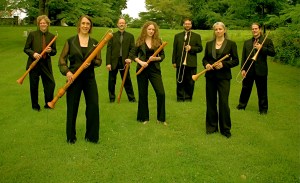 You still have a few days left to catch a performance of O Magnum Mysterium at the Folger.
 the coffee philosopher