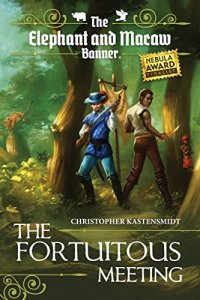
 An alternate history ‘novelette’ (that’s what the good folks at Tor call it) taking place in a 17th century Brazil, but with magic and monsters. It’s the intro to a series called The Elephant and Macaw Banner and to two characters, the improbably named Gerard van Oost and the freed (by Gerard) slave Oludara. I found the style to be a bit stilted, to be honest and have little desire to read more.
The Black Tides Of Heaven
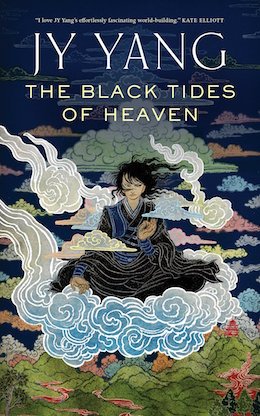 This was an interesting book, but it is, perhaps, hard to untangle those facets that make it interesting as a hybrid fantasy novel (with some elements of science fiction; I have heard the genre described as a ‘silkpunk’) with its sexual character, which is entangled with the author’s non-binary sexual identity. Characters are genderless until they make a decision (which, it seems, usually occurs in the late teens or very early twenties) to choose it and then there is some sorcery (the term used is ‘slackcraft,’ the ‘Slack’ being an all pervasive something that rather resembles the Force). The main characters are twins who choose different genders and different paths (one becomes a revolutionary, associated with a group that seeks to use technology to give the ordinary people more power, making them less dependent on ‘slackcraft’ practitioners, known as Tensors; the other marries an abbot, which, I guess, is ok in this world). The society is also matriarchal.
I am torn on this. I enjoyed it, but did I enjoy it enough to read more in the Tensorate series?
Forging The Darksword
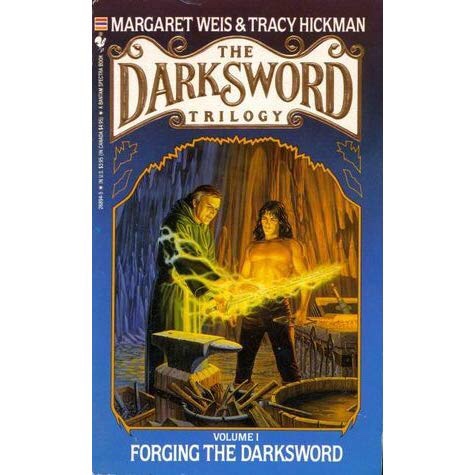
If you are of a certain age and a certain neediness, you probably recognize the names of the authors as the duo behind the Dragonlance novels. Like me, you probably read them several times. And you are probably a little afraid of re-reading them because you suspect they really aren’t very good.
On the evidence of Darksword, maybe it would not be that bad. Not great. And maybe not even good. But not that bad.
After The Crown
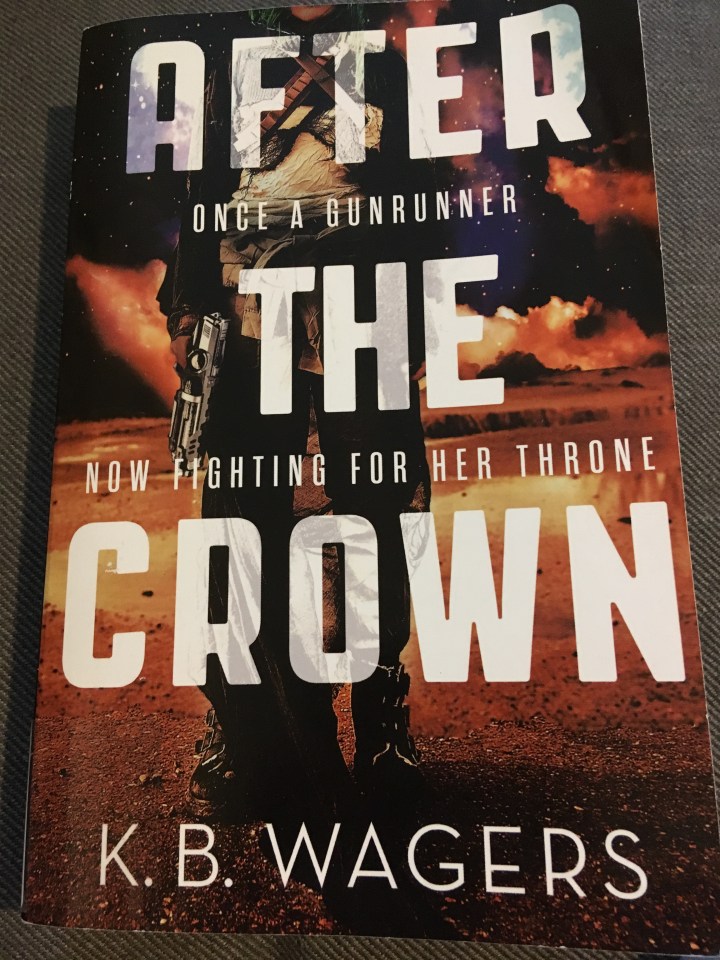 So it’s a marvelous space opera. Somewhat on a lark, I requestioned this from the library, remembering having enjoyed the first book. Now, I remember how good the first book was and this is, if not better (though it could be), more exciting. It truly is a classic space opera. Read more
Journey To The Center Of The Earth
 I read this book when I was in elementary and it was a little lost of me, not in the least because Verne almost always have a pedagogical goal, in addition to wanting to tell a roaring good yarn (which he did).
When I read 20,000 Leagues Under the Sea, I was somewhat disappointed in how the desire to educate got in the way of an exciting tale. Journey to the Center of the Earth had no such problem.
Though I will add, though I hope it’s superfluous, that much of the science has been… superseded by more recent discoveries.
If you have primarily seen the various movies (as a kid, I remember one with James Mason and I was inspired to reread the novel by having my daughter watch the surprisingly fun version with Brendan Fraser), you may be surprised by the lack of dinosaurs. There is a fight between a plesiosaur (of some kind) and an ichthyosaur (of some kind), each of a size that I think rather exceeds that of known members of those groups. There is also a herd of mastodons who are, apparently, being herded by a twelve foot high prehistoric man of some kind. Exciting stuff, but not really what I was looking for as a child. This would have been better for me to have tried to read in middle school.
But if you do want dinosaurs and want to stay in this sort of genre, Arthur Conany Doyle, of Sherlock fame, wrote a novel featuring Professor Challenge called The Lost World. Try that one.
Magician’s Land

So, I finished the trilogy.
It wasn’t bad. I get why people liked it. But I feel like it became more like just another fantasy series, as it moved away from the question of “what is worth doing if you are a rich and powerful magician under 25 who literally can just mess around, drink, and fornicate more or less indefinitely?” Read more
The Magician King
 As a sequel to The Magicians‘ strange and fascinating tale of magicians as lost and debauched trust kids, The Magician King fails to build effectively on the asked question: what do you when you can do anything? Read more
The Magicians
 I suppose I am rather late on this one. The Magicians came out long enough ago to have had three or four seasons of an adaption on basic cable, yet isn’t (and probably never will be) some kind of classic that future generations will discover.
But, credit where credit is due, some two thirds of the book is a very good, very interesting take on the school for magic. In this case, a college. And like real college, the stakes can feel unimaginably high for the students, but everyone else know that they are really not. And real life is invariably a bit of a disappointment. Because, we all know that if Harry Potter were real, he would almost certainly have spent his first half decade after Hogwarts drinking and doing copious quantities of drugs to both medicate his PTSD and to recreate the feeling of being the ‘chosen one’ again.
The Last Argument Of Kings

There is a genre of fantasy known as grimdark, to which this more or less belongs. Game of Thrones would among the list. The granddaddy, to my uncertain knowledge, would probably be Glen Cook’s Black Company. Basically, things don’t always end nicely for everyone and many folks don’t turn out to be so nice. A bit of the old ultra violence, as Alex of A Clockwork Orange might say. Read more
The Warded Man
 Enjoyable, but with notable caveats.
The world and the not too large cast of point of view characters is well done. The main conceit is that demons or ‘corelings’ manifest from under the earth from a ‘Core’ (the center of the earth) every night. Sunlight is fatal but they are nearly impossible to kill otherwise and the world must work around that. Buildings and property are protected with wards, which are usually carved, but a scratch to the carving or some other small disruption can make it useless, so families and whole villages are killed on a regular basis. A cultural effect of this is an emphasis on early marriage and procreation, because humanity is more or less in constant danger of being wiped out if not constantly replenished. However, this is no excuse for a male writer to have his female character talk about their ‘flower’ so often or even, really, ever.
Also, I was often disappointed in the action scenes. But the small things, like trade being done by Messenger (capital M), who use portable warding circles but are still respected for being willing to be outside at night for weeks at a time. Aspects of matriarchy creeping into societies, because motherhood is more than usually key to a locale’s survival.
Will I read the next one? Maybe. I’m not one hundred percent sold yet.
 the coffee philosopher