 Pound, Lorca, Berryman in Poetry.
We should be emphasizing the classics more (though alongside, not instead of, new work).
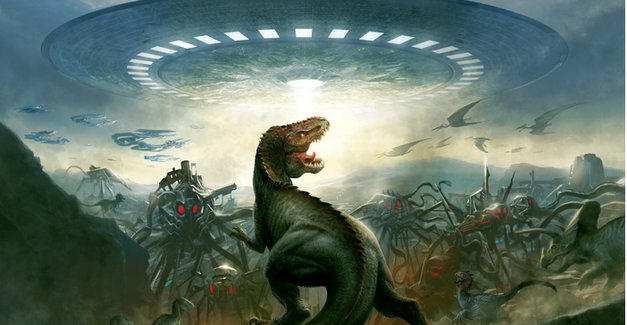
This proposed Barry Sonnenfeld movie will undoubtedly suck, but I’ll undoubtedly see it because, come on… dinosaurs versus aliens.
Still waiting for that Devil Dinosaur movie, though.
No. The Weeping Angels are not the scariest nor the best Doctor Who villain. All these people are wrong. Horribly, horribly wrong.
EXTERMINATE! EXTERMINATE! EX-TER-MI-NATE!!!!!!!

Those aren’t books. A book has got to smell. You have to hold it in your hand and pray to it. – Ray Bradbury
 Warlord of Mars is the third of Edgar Rice Burroughs’ martian novels. For completists, pulpy goodies like Thuvia, Maid of Mars and Chessmen of Mars await.
Warlord is, frankly, weaker than the other two. Burroughs, at his heart, is a frustrated travel writer. His plots have a sort linear propulsion, but his real love is describing the fauna and culture of his fictional Mars (or Barsoom, as the martians call it). Warlord lacks the wonder-eyed newness of A Princess of Mars and theological/cultural fun of Gods of Mars.
Yes, there are some jungle dwelling barsoomians and the long lost, glacial dwelling Yellow Men of Mars (which, by the way is less racist than it sounds; they are described as being literally lemon yellow and seem to be inspired more by Russian kossacks than sinophobic fears of the Chinese). But overall, he didn’t seem to find anything to really capture his curiosity. At least it starts pretty quickly, beginning in media res and rarely halting.
 I just finished reading David Brin’s Sundiver, a bit of a rarity in that it is a space opera that is also very much in the realm of ‘hard science fiction.’
As a rule, hard sci fi tends to be more near future, allowing the writer to be more careful about their science and go out on less of a limb. But not Brin, who placed his story in a fairly advanced and well detailed future, with a complicated galactic cultural system.
That cultural system is the centerpiece of his Uplift universe.
Basically, status in the universe is achieved by ‘uplifting’ other species. Guiding their evolution and introducing them to technology like space flight and the like. These species become ‘client’ races to their ‘patrons,’ which roles come with certain responsibilities from each. Eventually, a ‘client’ becomes independent.
Humans are unusual in not having been uplifted and achieving space flight on their own, which slightly upsets that galactic apple cart and also leaves human uncomfortably outside the galactic social strata (though we try to move up anyway by uplifting chimpanzees and dolphins).
The plot involves the discovery of life in the sun – life that some folks theorize could be our ancient ‘patrons.’ After that, there’s lot of politics, some action sequences, some murders, etc.
It’s good stuff. And it also has an obscure reference to the character of Tom Bombadil from Tolkien’s Middle Earth: “Imperturbable as Bombadil…”
I’m looking forward to reading the sequel, Startide Rising.
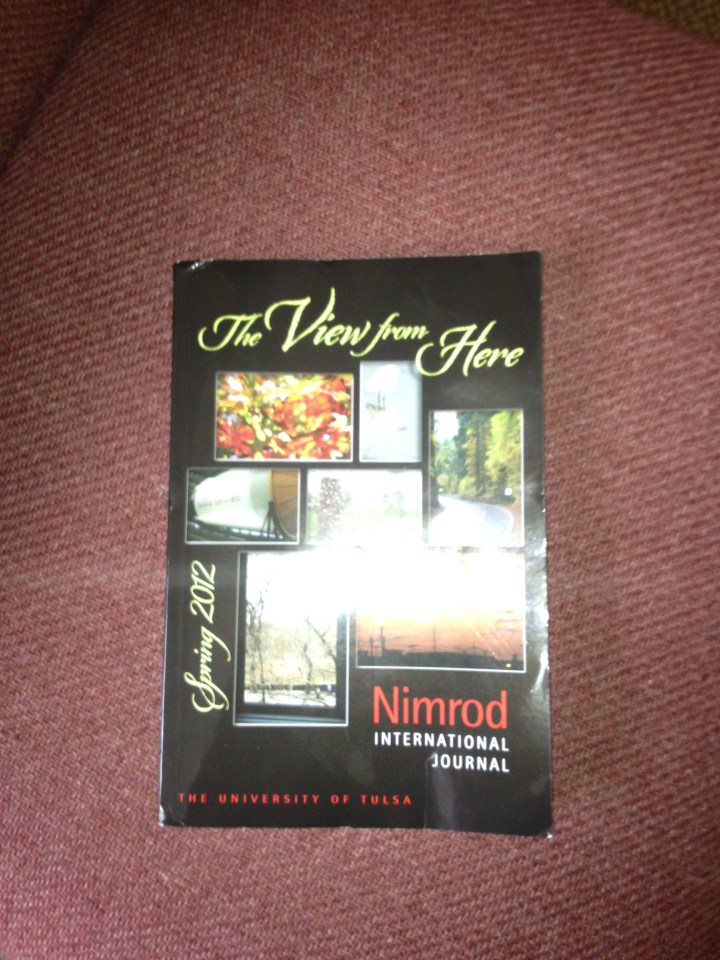 Not as in an insult, but rather the unusually (unfortunately?) named lit mag of the University of Tulsa.
From my point of view, it’s a good bit of work. Heavy on the poetry, which is always my priority (to the extent that I tend to read not to read lit mags that have anything but poetry, excepting those focused on sci fi, Asimov’s or Analog).
Overall, it’s good, rather great. Some well known poets published in this issue (Grace Cavalieri, for example), but the overall sense is of safety in the editors’ choices. Not a place one would go to see who is pushing the envelope nor what the coming trends will be.
I did actually read some of the fiction and read into it a certain aesthetic. Oklahoma is, geographically, a big place, but not densely populated and still with a lot of farm land. There was a recurring theme of isolation in the fiction that I related to Oklahoma’s flat and lonely geography. But maybe that’s just me or even if it wasn’t, maybe it was just a one off. Nonetheless… and the issue’s theme was ‘the view from here.’ From where? Just saying – a theme like that could make editors unconsciously think of their state’s many mostly empty spaces.

 the coffee philosopher