‘A Memory Of Light’ Arrives Today


9780765325952The wait is over. Kind of.

I mean, it’s over for other people, just not for me.

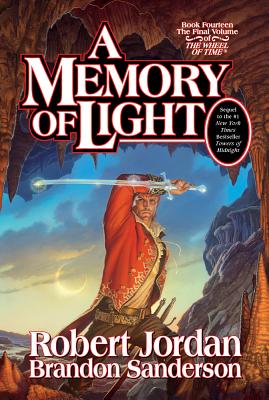
The final book in the Robert Jordan’s epic fantasy fourteenology (completed by Brandon Sanderson of Mistborn fame) came out today. I’m excited. I almost wish I were done with book thirteen instead of still buried in number nine so that I could participate in the festivities. And I’m not kidding, either. There’s even a big party in New York, but it would be wasted on me (and pricey, and I have family staying with me). This sort of thing may not come around again in my lifetime, at least not until George R.R. Martin finishes his Song of Fire and Ice.

On the plus side, by the time I reached A Memory of Light, it will be out as a $7.99 mass market paperback, same as all the other editions I’ve read.

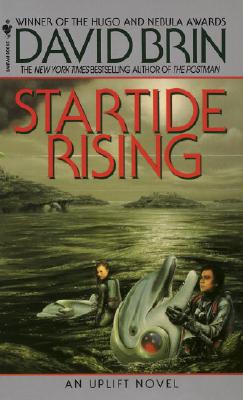
Startide Rising (New Year’s Resolution, Book One)


9780553274189Sundiver was an Asimov-style sci fi mystery, but it’s ‘sequel’ (it takes place in the same universe, so it’s a sequel in the same way that a book about the sixteen century is a sequel to one about the fifteenth century), Startide Rising is more like an old fashioned space opera (though definitely with deep roots in Asimov’s hard sci fi style).

I had trouble finding this one in bookstores, so I ordered this one from a bookstore (not Amazon! not Amazon!) and had it shipped to my office to hide my book buying habit from my best gal (Peg at the front desk was very understanding of this need).

Brin’s characterizations are good for genre writing (not great, but more than adequate), but sometimes his dedication to a carefully crafted, scientifically sound (he does have an advanced degree in applied physics) universe gets in the way of writing an exciting yarn.

But, he’s clearly head and shoulders above most sci fi out there.

Some of his most space opera-y moments come in brief, italicized chapters or interludes that capture a space battle going above the surface of watery, earth-like planet where a small group of intelligent, genetically modified dolphins (who make the bulk of the crew, including the captain), a few humans, and an intelligent, genetically modified chimpanzee scientist seek ways to: repair their crashed space ship; escape from the angry hordes of warring galactic fleets above them; and take back to Earth their scientific/archaeological discoveries (lost artifacts and space ships from the Progenitors, the first space faring race and the source of most of the universes’ scientific and engineering knowledge).

In those interludes, he quickly dives into a particular aliens’ ship and their efforts to win the battle for the planet on which the Earthlings are trapped so as to acquire whatever information the Earthlings have uncovered. Though short, they are a marvelous way to describe the space battle going on and also to give the reader a glimpse at various alien societies in Brin’s ‘Uplift Universe.’ It also provides the reader understanding that the battle is long and complicated, so that no one starts questioning how the stranded dolphins, chimps, and humans are able to hang out on the planet for weeks without being, you know, captured and killed.

When he drops some of the dedication to hard sci fi and starts in on some really fascinating fights and escapes in a metallic sea and between warring varieties and between warring allegiances of dolphins… well, things get good. His characterization may not be great (frankly, I couldn’t really distinguish the personalities of several of the dolphins ; generally, the ‘good’ dolphins were pretty similar to each other, and likewise the atavistic, ‘bad’ dolphins were sometimes hard to tell apart). He just needed to start that sooner. He’s not skilled enough at the building up process to wait two hundred pages (almost half the novel) to really kick into gear. By the end, it’s moving very, very quickly. Frankly, too quickly. It’s exciting and well done, but I can’t help but keep harping on the pacing issue.

Will I read the final novel in his first Uplift Trilogy, The Uplift War? Probably. Will I read his second Uplift Trilogy? Maybe, maybe not.
Belated 121st Birthday, Professor Tolkien


I can’t believe I missed his b-day.

John-Ronald-Reuel-Tolkien

Rejection


The great Ursula K. Le Guin saved this rejection letter (though when she made it public, to save the editor some embarrassment over having rejected the greatest science fiction of the second half of the twentieth century, she hid the editor’s name).

Dear Miss Kidd,

Ursula K. Le Guin writes extremely well, but I’m sorry to have to say that on the basis of that one highly distinguishing quality alone I cannot make you an offer for the novel. The book is so endlessly complicated by details of reference and information, the interim legends become so much of a nuisance despite their relevance, that the very action of the story seems to be to become hopelessly bogged down and the book, eventually, unreadable. The whole is so dry and airless, so lacking in pace, that whatever drama and excitement the novel might have had is entirely dissipated by what does seem, a great deal of the time, to be extraneous material. My thanks nonetheless for having thought of us. The manuscript of The Left Hand of Darkness is returned herewith. Yours sincerely,

The Editor

21 June, 1968

http://www.ursulakleguin.com/Reject.html


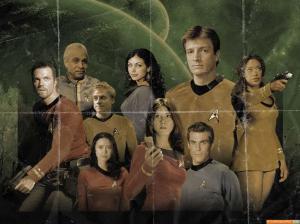
I Would Watch This Star Trek Movie, Too


firefly-star-trek

The E-Book As Spirit


Theory of the E-book puts forward (in an overdramatized fashion) the idea of the e-book as essentially being an object of spiritual existence. Basically, exhuming the body of Rene Descartes for some old fashioned mind-body dualism.

But, of course, this isn’t inspired by the Cartesian demon, but rather by the modern ‘brain in jar held be aliens’ formulation.

Actually, I like to think of it as the manga formulation – the e-book as the literal ghost in the shell. Meh.

It’s A Learning Experience


Player's HandbookThe last time I wrote about my D&D’ing, I said that making the characters roll straight 3d6 in order was a mistake. And I sort of still agree, but I am seeing some benefits – the players are very aware that their characters are relatively powerless.

This has created a situation which has made things interesting, in that the characters are fairly wary of engaging and are more likely to find ways to avoid combat. While it’s caught me off guard a couple of times, it has added an element of randomness to the game that I like, the randomness, for me, creating a sort of naturalism.

Of course, as the characters rise in level, that’s changing a bit… I may have to pit them against something really brutal…

I am still struggling, I fear, to paint a clear picture of the world. Partly, this is because I am not very good at drawing maps that could provide an overview of what the world looks. I did do one map, but it was laughably simplistic and bad. Simplistic, in that was I was clearly trying to paint over my inadequacies with crudeness. And bad, because, well, it was bad.

The consequence of this is that the players don’t have as clear a picture of the world their characters exist as they should.

I sometimes fear I am making the ‘plot’ too complicated. Partly, I have gone somewhat overboard in creating options. Having been too directed, at first, I go into each session with, in essence, at least three different adventures for the players to choose from.

The last time we played, I allowed a random dice roll to let them explore a tomb that opened up a whole bunch of plot options. This absence of direction, I think, sometimes makes it difficult for the players to keep up with what’s going on and who’s connected to who. But, then again, maybe that’s how life is?

I Don’t Know If I Want To See ‘The Hobbit’


You would have thought that I would have bundled myself and the family out of the house at 11 pm in order to have seen it at 12:01 am on its opening day. After all, I did that with The Lord of the Rings films.

But I felt myself reluctant.

What I have read about the movie makes me uneasy. Turning it into a trilogy. Apparently, making the raid into the dungeons of the Witch-King of Angmar part of the story, rather than a tale told by Gandalf within the story. In general, making The Hobbit more epic, when the joys of the novel were in its slightness.

Built on a great, mythic foundation, but ultimately the story of friendship and the story of a sedentary man (or hobbit, actually) growing into himself as a resourceful and (when necessary) brave traveler. And the book within the book – the book that Bilbo Baggins writes about his adventures (and which Frodo completes) is titled There and Back Again. ‘Back Again.’ Not an epic. Not really, half the title of Bilbo’s book references the joys of returning to family and friends, hearth and home. Coming back changed, but coming back, nonetheless. In fact, it was only after this adventure that Bilbo adopted his cousin/nephew, Frodo, as his heir. He left a solitary bachelor and came back appreciating the family one makes for one’s self.

This is a very different kind of thing than an epic and that’s just fine.

So, I fine myself reluctant.

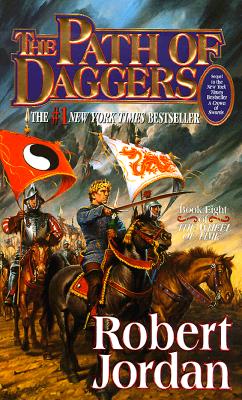
The Path of Daggers


9780812550290So, I finished it. It helped, of course, being able to start around the midpoint.

I was reading it while helping out at the Downtown Holiday Market, using my usual sales pitch of ignoring customers while burying my nose in a book. I think this tactic works because people feel compelled to actually buy something, because otherwise they’ve risked interrupting me in the midst of expanding my mind whilst reading for absolutely no purpose.

A man in his late thirties (good Lord, my age!) stopped, after having bought a onesie and a dress for his fourteen month old daughter, to talk with me about the book and series.

His feelings seemed similar to mine. It’s not that it’s great series, but there is something compelling and addictive about it and once you’ve invested something in what is, really, a huge investment overall, you feel like you have to see it through to the end.

The Path of Daggers is a pretty good. The best in a couple of books, at least. It is quite sprawling and Jordan doesn’t have the feel for sprawl that George R.R. Martin has. Martin is able to create and maintain a wide variety of very interesting secondary characters, but Jordan isn’t as able to make them compelling. But, he does give some good space and good story lines to several of the main companions. Also, the main character, Rand al’Thor, is allowed to be less grating and depressing to read.

It’s the Lord of the Rings effect. Frodo, on his own, would be insufferable to read about. Thankfully, he is always in the company of more enjoyable fellows (Samwise Gamgee, mainly) and plenty of column space is devoted to the always fun to follow adventures of Merry and Pippin and the gentle ribbing and budding love (yes, love; not romantic love, of course, but The Lord of the Rings is ultimately about the great love between friends and brothers in spirit) between Legolas and Gimli.

Tolkien possibly could write about romantic love, but chooses not to, on the whole (I have always suspected that he lacked the talent for romance, knew it, and so chose not to; but he does do some good depictions of comfortable, conjugal love, as between Tom Bombadil and Goldberry). Jordan can’t write romance, but chooses to do so anyway.

All that criticism, I know. But I did say that ‘The Path of Daggers is a pretty good.’ And it is. The propulsion of the plot picks up and you can start to feel as if he’s not just adding plot threads to drag this out, but is starting to pull things together. Conflicts are coming to a head and you can taste resolutions in the air.