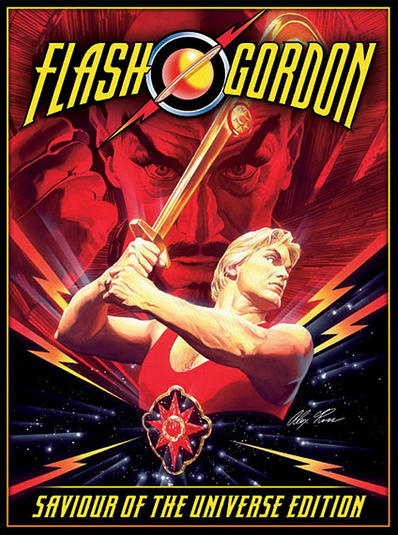
Flash Gordon is the greatest comic book movie ever made. It also contains one of the finest action sequences ever put to celluloid.
Yes, it’s high camp, but the strong actors (Max Von Sydow, Topol, Brian Blessed) chew the scenery appropriately and the merely adequate ones take the movie just seriously enough, but not too seriously (all in the proper spirit, is what I’m saying) that it doesn’t degenerate into something too ridiculous to watch.
And I will put the early action set piece where Flash defeats the elite guard of Emperor Ming using his skills as a running quarterback (with intergalactic fabrege eggs as footballs). No big stunts or wires or special effects needed. Just good ole American gridiron ingenuity.
Almost is good is when the hawkmen attack the space ship. Yeah, hawkmen, led by Brian Blessed, no less. Imagine the Battle of Agincourt from Kenneth Branagh’s Henry V, except that instead of playing of the Duke of Exeter, he’s king of the hawkmen, and that instead of wearing armor, he’s wearing leather hot pants and has wings. It’s that freaking cool.
Oh, and Queen did all the music. (‘Flash!! Ooohhoohh…’)
Reading the first book in C.S. Lewis’ trilogy of Christian science fiction, I realize how huge his debt is to the planetary romance of early pulp writers like Edgar Rice Burroughs and his Mars and Pellucidar books.
Lewis certainly gets his theological apologetics in, but the descriptions of his hero (Dr. Elwin Ransom, professor of philology) exploring the planet (which is Mars by the way!), encountering native flora and fauna, and his interactions with the native life, including quickly learning their language… well if you replaced Dr. Ransom with John Carter and added a couple of sword fights (though, there is a harpoon hunt of a giant, freshwater monster in Out of the Silent Planet) you could probably have sold this as a long lost novel of Barsoom, especially since it even takes place on Mars, though the natives here call it Malacandra, not Barsoom. It also uses the trope of having this story be Ransom’s unbelievable story told to Lewis so he can sell it as a novel, because it would otherwise be too unbelievable if sold as fact.
The apologetics come in the time honored fashion of presenting a fictional (or fictionalized) society as expressing the utopian ideals of the author’s religion or philosophy. There was one little throw away line where Ransom wonders whether it is his duty to evangelize to the alien hrossa and then realizes they more truly represent the ideals of his High Anglican Christianity than whatever he could express in their alien tongue.
The (more or less) climax is a little preachy and Lewis lays it on too hard in one area. Ransom must translate the arguments being made by the villains of the novel (Devine and Weston, if you must know) into the native language of Malacandra. Because of both the limitations of the language (having a relatively utopian society, they don’t have words for some negative things) and his own understanding of it. The result is Ransom giving the Malacandrans such a straw man version that it becomes irritating.
Despite that Caveat, Lewis is always and engaging and earnest writer, though never as good a writer as his fellow Inkling, Tolkien (upon upon whom, apparently, Ransom was based). This book is not as good nor the world as well thought and engaging as that built in his Narnia books, but it is still a good book by an important twentieth century writer.
I read this book years ago, but this time, I will go on and read the rest of the trilogy (though not next week, I’m thinking Alexander Pope for next week). In fact, I have the complete trilogy already downloaded onto my Nook. So, maybe sometime in March… Perelandra.
They’re getting longer. Book ten clocks in at almost forty pages longer than book nine. If I was reading this in hardback, I could kill man or stop a bullet. As it is, the paperback barely fits in my copious coat pocket, and a genre novel that were incapable of so fitting would seem like a betrayal of the trust between the reader and the author/publisher/editor.
As you may recall, after finishing the last book in the series, I was so excited that the taint had been cleansed from saidin (I don’t have time to explain all this to you; read about it on wikipedia). And while Rand may have become less of a whiny little punk, he’s also kind of absent. He gets a girl pregnant and not much else.
Crossroads of Twilight also reminded one of how Jordan loves to drag things out. In particular, I was reminded of the terrible absence of communication between people who, if they could have just spoken, would have solved a number longstanding, thorny issues in good order and moved on with saving the world from evil. To make matters worse, many of these people actually grew up together and have known each other their whole lives. Others actually meet and talk, yet somehow manage not to share the key data points that would illuminate things for each other. I know that this is medieval fantasy and there are no telephones, but I think that making a greater effort to explain things to your friend since infancy who also happens to be the prophesied savior of the world… well, it just makes sense.
Following that long rant, I’m going to give some credit to this book, the penultimate novel by Robert Jordan.
He left us on a rip roaring cliffhanger. I could tell you what happened, but it wouldn’t sound special out of context (Egwene is captured, I think by supporters of Elaida in Tar Valon; see, I told you it wouldn’t sound special). For some reason, this particular cliffhanger really struck me. I thought to myself, this is exciting. I want to know what comes next and not just because sheer volume of pages and books has bludgeoned me into wanting to doggedly finish. But, instead, actually kind of wanting to know what the heck is going to happen.
I feel sure that the next book will ruin that for me.
While I will be finishing the Wheel of Time this yearand more than that, probably before the end of April, I’m not going to be reading book eleven (The Knife of Dreams, if you must know) for next week. I’m leaning towards a happy medium between genre fiction and literary fiction: C.S. Lewis.
I made my occasional trip to the comic book store and bought issues #16 of Batman and Action Comics.
The New 52 Batman is still compulsively readable. In fact, I’m probably going to go back and re-read a few issues back and re #16 again to make sure I’m getting all the little details.
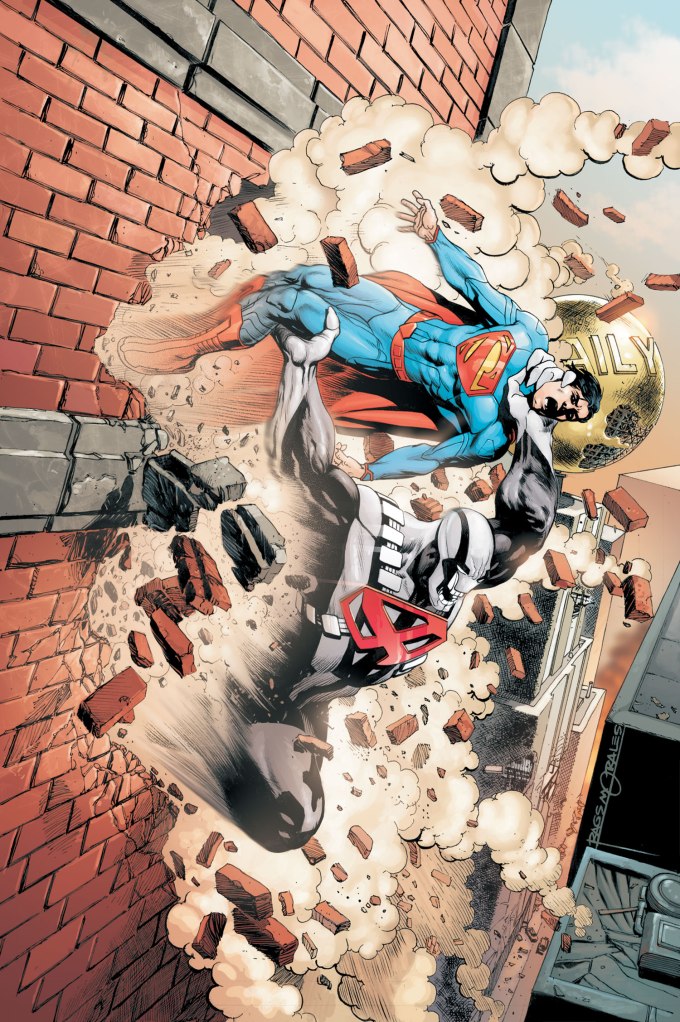
But Action Comics can suck it. I have no freaking idea what is going on. None at all. The chronology has completely eluded me at this point.
The earliest issues, with a new and interesting look at Superman’s early career, as a young man, fresh from the Kansas countryside, trying to figure out what kind of (super)man he wanted to be, were interesting. The art work was compelling. Now, I don’t care anymore. It lost me and I’m calling it quits.
Winter’s Heart is an improvement over its immediate predecessor (which also represented something of an improvement). The tension has been ratcheted up and the story benefits. In fact, if there is a complaint, it is that there is not enough of a lull for readerly breathers. Jordan doesn’t do clean; he does cluttered. And with so much urgent clutter, well… I could use a little of the literary version of the clean, untroubled geometries of Scandinavian Modern.
More than in the last book, Jordan lets us spend longer stretches at a time with characters, with more chapters focused on the third person limited perspective of a single hero or (more frequently) heroine.
The first few books had most of the major characters together much of the time, but now, they are splitting up more and more and I’m not sure that Jordan always got the balance right (in the previous book, for example, Mat Cauthon, one of my favorites, seem to drop off the face of the earth).
While I haven’t given the Wheel of Time thorough analysis using the Bechdel Test (which is intended for movies, actually: are there at least two women characters, who talk to each other, and who talk about something other than a man?), Jordan gives plenty of time to his female characters. More than to his male characters, in truth. I’m not sure how deliberately feminist this is: he probably realized that Egwene and Elayne, in particular, are far more interesting than the main hero, Rand, and one of his two friends,Perrin (Mat, his other friend, I think is a pretty interesting and enjoyable character and it’s good to see him given a solid run out in this book).
He likes to insert chapters from the third person limited perspective of certain villains, often letting us see how their plans will muck up those of our heroes or how said heroes are walking into a trap. This has the effect of ratcheting up the tension but also of appearing to be just another means to avoid moving the story closer to completion. Certainly, one can’t blame Sanderson for taking three books to finish the series (supposedly, Jordan intended to complete the series at twelve volumes, but having spent at least five of the eleven books he wrote in the series dragging things out, it seems unfair to expect someone to reasonably and fairly to the readers wrap it up in just one) on account of this kind of behavior.
There’s been a sort of Tantric Sex thing going on in the last few books, with Jordan denying me a climax. But, this time, he does deign to give the reader a pretty significant climax. Too bad he mucks it up.
Rand cleans the taint from the male half of the One Power, saidin. This is not, actually, a kinky sex thing (mother, if you’re reading this… ask my cousin), but kind of a big deal, since not only does the taint (giggle) give men who use saidin debilitating nausea, it also drives men mad.
And the worst thing is that its effects appear to have transformed the hero of prophecy, the man who will save the world from the Dark One at the final battle between good and evil, Rand al’Thor, the orphaned son of a Spear Maiden, into a whiny little b—h.
While cleansing the taint from the source of men’s magical power makes me look forward to the next book more, it was handled poorly in this one.
First of all, it was a surprise. Sure, we’d read about his desire to do so, but the reader was kept too much in the dark as regards the studies, plans, and preparations to do it. Frankly, I felt cheated and disrespected by what was, essentially, an ill-conceived authorial trick.
Secondly, there was a big battle surrounding the actual cleansing ceremony, but it was described in such a disjointed and muddy fashion that I finished with little feel for what actually happened, who was involved, and where they stood in relation to each other.
But I do have hope that things will start moving again and the mere narrative fact of cleansing saidin opens up a lot of opportunities for improvement in the readability of the next book (which I already have in my hot little hands).
Jordan knew he was dying. Did he, I wonder, see the constant extension and expansion of the epic that must e considered his life’s work as a means of extending his own life? Unconsciously feeling that not finishing the series being a way to keep his own story from being finished?
While this whole New Year’s resolution thing has definitely gotten me to settle down and focus on getting some real reading done, the one book a week test I’ve set myself has some downsides. Mainly that, in order to meet my weekly goal of finishing a book, I’m somewhat discouraged from diving into more works that are both challenging and lengthy.
I’m currently reading Rimbaud’s Illuminations, which is challenging, but not long. This book, of course, is long (750 odd pages), but not challenging. And you saw that last week I rather cheated and read a chapbook. But, I did get myself a copy of Crossroads of Twilight, the next book in The Wheel of Time. At this rate, I may finally finish the series before the end of the year and put this part of my life behind me.





 the coffee philosopher