They’re not banned in Hong Kong.
Starting Tuesday, you can read your Ray Bradbury on e-readers.
I read three different DC Comics: Aquaman (which I am about to give up on), Batman, and Action Comics (which I was going to give up on, but I have decided to power through).
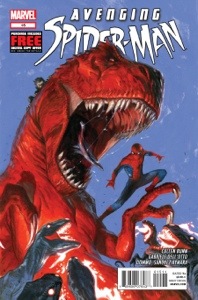
So while I was buying a bunch, catching up after two months of inattention, I saw a familiar looking shape on the cover of an Avenging Spiderman comic.
Devil Dinosaur was a later seventies, Jack Kirby comic. It never really caught on didn’t even make to ten issues. And it’s my favorite.
He and his pre-human companion, Moon Boy, are occasionally introduced into other comics from the Marvel Universe, but too often, it seems, as a sort of joke.
But in this two issue, Spider Man story arc, he’s treated (though it’s also suggested that Devil is a woman) reasonably respectfully.
I can only hope this repeated.
 Unlucky thirteen? Maybe. After hitting a rough patch, Jordan’s final books in the series have gotten a bit more compelling. This one was the last he completed before passing. Not his masterpiece perhaps, but a good way to go out, nonetheless.
I’m feeling more forgiving and almost appreciative of Jordan’s tics. Actually, they’re pretty good tics, it just that they’ve all been used a lot in the last ten books. But maybe because I can feel the end approaching, I am able to enjoy them again.
Mostly, I talking about this horror movie trope, where he shows you someone saying let’s go through that door and then shows the monster behind a door and then a show of someone turning the door knob.
Except, what he does is show the heroes prepare a cunning plan and then switches to a shot of some villain explaining how the hero is walking into her (and many of the villains, and certainly all the best villains, are women in these books – read into that what you will) trap.
The more or less hero, Rand al’Thor, the Dragon Reborn, is still kind of a whiny b—h. It’s really annoying, too. While using his magic, he still tends to get mopey and also car sick (I thought that when he cleaned up the male half of magical power, that was supposed to end?). And just in case he was in danger of becoming less irritating, Jordan burns his left hand clean off, so that everyone has an excuse to feel sorry for him and he can be an annoying tough guy. Ugh.
Mat, once again, figures prominently, but he’s in love and that makes him much less interesting.
Logain, the former false dragon gets some semi-prominent appearances. I can’t really explain who Logain is in the context of the story and mythology. I mean, this is book eleven. Eleven. I simply can’t go back and explain a whole muckety series of events and characters dating back ten books and roughly 8,000 pages. I have a life beyond this blog, you. I have hobbies. I have friends. Not many, but, you know, one or two. And I’m not a total nerd. I play D&D with real people. Grown ups, no less.
But my point: Logain is actually kind of cool, a little bad a– and seems relatively bright, competent, and good (morally speaking).
He almost makes up for Lan. Lan has been with us since the beginning, but Jordan has mostly ignored since the second book or so. Small scenes, but there’s been a definite effort to limit his importance. Which is good, because Lan is clearly a cheap knock off Tolkien’s Aragorn. I mean, a knock off to the point that, after reading the first book, you feel like Jordan should write a large check to the a charity of the Tolkien estate’s choice. As the series has progressed, Jordan has successfully created his own world, separate from Tolkien’s epic fantasy. But now, Lan as Aragorn is back. And, I guess it’s fine, but, it’s just irritating.
This volume’s immediate predecessor ended with a big set piece. Knife of Dreams ups the ante by incorporating several big set pieces in the last two hundred or so pages – and much less confusingly described so that the pay off feels much more worth the wait. Even better, some issues and concerns that have popped up over the last couple of books are resolved. Elayne becomes Queen of Andor. Perrin leads an army into battle to rescue his wife. Mat (as usual) has the best stuff – a couple of decently described tactical skirmishes and ambushes, culminating in a marriage to the heiress to the Seanchan imperial throne. Rand captures one of the Forsaken (that’s when he loses his hand), but (as usual), his set piece is less fun to read than the others. A couple of baddies get their comeuppance. Even better, almost every ongoing storyline but one gets resolved. I’m referring to the storylines of the main characters. Obviously, the final battle for the fate of the world hasn’t happened yet. It’s as if Jordan knew he would never complete another book and wanted to take responsibility for tying up a few fictional loose ends. And now I’m sad, because he’s gone.
I won’t lie. Some of my books lately have been shorter than others. Knife of Dreams is my return to something a little longer. And frankly, the last two books I read were disappointing, so it’s not like this is somehow less challenging or interesting. I’ll even say it’s better. Though I’m also hoping that the next book I read is better than Robert Jordan, in general.
Last weekend’s midnight movie at the E Street Cinema was the 1980 classic, Flash Gordon.
And it freaking rocked. Here are just a few reasons why:
It stars Max Von Sydow, prancing around in a pink satin pantsuit and a haze of psychosexual weirdness that would have made Ingmar Bergman commit ritual suicide, had he seen it.
Topol, best known for Fiddler on the Roof, never known for understated performances, clearly prepared for this role by locking himself in sterile white room, empty save for a pencil, a ream of virgin paper, a vast quantity of LSD, and the script. He then based his performance on the notes he wrote to himself while locked in that room.
Brian Blessed wears wings and a scaled leather speedo. He also attacks the role of King of the Hawkmen with the sort of gusto one normally associates with bath salt sniffing cannibals. A gifted Shakespearean, he nonetheless believes that a failure to mug the camera and overact will result in a live car battery being clamped to his aged father’s withered testicles.
It’s got an alien princess who looks, dresses, and talks like a notably slurry Bond girl. And speaking of Bond, Timothy Dalton plays Prince Barin of Arborea. And his second in command is played by Riff Raff. Riff Raff, people.
Every costume was latter pilfered by George Lucas for The Empire Strikes Back and Return of the Jedi.
It advocates the little known theory that the most deadly martial art ever created is, in fact, the ground game advocated by legendary college football coach, Bear Bryant.
The score is by Queen, at their most bombastic. But in between Freddy Mercury doing whatever it is he does to sing those lines with a complete lack of irony (‘Flash… Ah Ahh… He’s a miracle’), Brian May is an awesome guitarist and they put some great, propulsive beats into the music.
And, for the first time since 1980, I got to see it on the big screen.
 I finished reading Perelandra, C.S. Lewis’ sequel to Out of the Silent Planet.
The religious aspect comes much more to the fore here, as well as an idea you’ll see a lot within Lewis, that of this war between God and the Devil (though still not so explicit).
Also, you can draw a straight line, I think, between Lewis’ Space Trilogy and Madeleine L’engle’s trilogy, beginning with A Wrinkle in Time. I believe that L’engle was also a devout Anglican, too, though that’s not what I’m talking about. And Lewis isn’t writing children’s/YA fiction here, though the style is very similar to Lewis’ books for young people (which maybe is testimony to his not talking down to children or a testimony to a certain childlike nature in his writing in general).
Out of the Silent Planet was a more subtle book, in a way. Perelandra is far more theological, by which I mean that it expressly advocates for and against some specific theological positions. Rather unexpectedly, Lewis (or his stand-in, Dr. Ransom) fiercely opposes, on theological grounds, the idea of humans colonizing other planets. In the context of this system he’s created, it makes sense. Planets and species are born, grown old, and die. This, it is implied, should be accepted as part of God’s plan. But it was surprising and pulled me up short when Ransom was so vehemently opposed to the idea. I thought of 2010, when the alien intelligence told humanity not to colonize one of the moon’s of Saturn, because that was intended for new, burgeoning life. But, in 2010, humanity did the go ahead to spread across other planets and moons in the solar system. Lewis doesn’t think we should be leaving earth, at all.
He also makes an argument against… I would call it evolutionary deism. But a certain kind of non-denominational spirituality. I’m sure it’s referring to something of particular vogue when he wrote it (was Bergsonianism big at the time?).
The idea of God, Jesus, and the Devil are much more explicit here. There’s even a some very real demonic possession (which Ransom is irritatingly slow to wise up to).
The most interesting bit actually occurs fairly early on, when Ransom intrudes upon an edenic moment and appears as if, unwittingly, he will play the role of the serpent, introducing death and evil into the paradise that is Perelandra (better known as Venus). The edenic theme continues, but with a more traditional antagonist.
When I wrote about Out of the Silent Planet, I noted its debt to planetary romances like Burroughs’ beloved John Carter of Mars novels, where half the pleasure is the author’s development and the reader’s discovery of a new, amazing world. But the world of Perelandra is less joyfully explored than that of Malacandra (Mars) and the book itself is far more grim for it. Theology trumps discovery.
As a Catholic, the idea of the devil has always been hardest aspects of dogma for me to wrap my head around. But C.S. Lewis is determined to remind readers of his existence.
Did you ever see the movie, The Usual Suspects? If you haven’t, shame on you. It’s a great movie. I saw it with my friend Ryan in Minneapolis in 1995. Kevin Spacey’s character has a line: ‘The greatest trick the devil ever pulled was convincing the world he didn’t exist.’ Or something like that.
He might have been quoting from Lewis.
This was on my mind when I went to confession the other day. The priest behind the screen was not my usual confessor, but a more experienced, but perhaps also stricter and less forgiving (though, of course, he granted me absolution) priest. He said that what I was attributing to my own laziness actually had a deeper cause: the devil attempting to keep me away from God. His discussion with me very much focused on the devil, the idea that, lifting up the skin of our faults would reveal a very real and evil spiritual presence (not that this excuses us for not resisting and doing what is right).
I won’t get anymore into what goes and happens in there, but C.S. Lewis would have appreciated my confessor’s words. He was someone who truly believed, in a way I still struggle to do, in the reality of the devil and the evil that emanates from him and infects the world.
Perelandra is ultimately about the reality of evil and the necessity of resisting it.
There is a lot of didactic dialogue, characters going back and forth over the universe, God, God’s plan for things, creation, evil, necessity, freedom, predestination, etc., etc., etc., etc…
Then. After a ton of that, there’s a fight scene and a climactic chase. Then there’s some more theological discourse. Then, a Burroughs-esque exploration of a strange, underground realm within Perelandra, lovingly described – alien, frightening, and beautiful.
Then, there is a lot of talk by some angels (okay, eldila is what Lewis’ calls them here). Then he safely goes home (which we already knew would happen, because the opening is by a character named Lewis who is helping Ransom on this end, making sure someone is there to open the crystal casket, which is the device by which he travels from earth the Perelandra, who notes that he helps Ransom out of the casket after his return back, but that’s actually okay, because did you really think Ransom would die, because it’s not that kind of book).
Next up, That Hideous Strength. But not just yet. I’m a little tired of this trilogy and don’t intend to start on the final volume for a bit. I’m reading Knife of Dreams, the final Wheel of Time wholly written by the late Robert Jordan (and it already looks an improvement on the last couple of books; it opens with a sword fight and looks like people are going to get down and dirty indulge this fantasy loving boy’s desire for things like battles and magical duels), and Mary Jo Bang’s poetry collection, Elegy, is looking lonely and ready to read in my study.
I can’t rightly call it one of the my favorite bookstores, but only because favorite bookstores are developed through a history of repeated visits and memories of discoveries and encounters over time.
When we visited New York, I literally took a day specifically to visit the Strand Book Store (and also neighboring Forbidden Planet, a well known comic shop).
But it is a wonderful, wonderful place. It didn’t have everything I wanted (Mary McCarthy’s The Company She Keeps, for example), but a truly amazing selection. I bought:
Alexander Pope, Essay on Man and other Poems
William Carlos Williams, Spring and All (with a lovely rubbery, leathery powder blue cover that’s wonderful the the touch)
Ron Silliman, The Alphabet (which, so long as I am reading a book a week, will probably not be read this year, since it’s a 1000+ page difficult poem/poetic series)
Karl Marx, The Capital (it’s was a used, inexpensive, hardcover edition, the sort of thing one wants in one’s permanent library)
Nicholson Baker, The Anthologist
There are some holes in my world, the one I created for the Dungeons & Dragons game I am DM’ing. I admit it. So shoot me. Or don’t and keep reading.
Finian (a deft halfling thief), Teague (an incautious and potty mouthed singer and poet), and Regdar (a lifelong military man) start out as low level officers on a semi-important island within a distinctly unimportant empire.
Having created a world on my own and having done so in a somewhat haphazard fashion (I had a draft in my head, but not much more than that), it put the players at the awkward disadvantage of not really knowing as much about the world they were in as they really should have. I’ve tried to fix that over time, but that’s also been haphazard.
Below is the intro to the small part of the world where I dropped them:
The Sunward Empire is a series of twenty-seven islands, ruled by gnomish sorcerer, the Sunward Emperor. His wife (by tradition) is the Windward Priestess, a human. Together, they are not just the ruling secular authority, but also the head of the national religion, which worships the sun (Kaji) and the wind (Raag). In matters of secular governance, the Sunward Emperor leads, and the Windward Priestess in matters of religion. However, the Emperor is also a religious figure and the Windward Priestess a figure with real secular authority. They are not, typically, referred to by their names, however, their names (Verkef and Alriat, respectively) are widely known. The Sunward Emperor and Windward Priestess are chosen a college of gnomish arcanists and a college of human clerics, respectively. The gnomish and human cultures dominate the Sunward Empire.
No one island is more than a day from its nearest neighbor and the Empire can crossed by boat (in good weather) is ten days, east to west, and five days, north to south. The islands are in the middle of (usually) calm ocean, between the western continent of Loe and the eastern continent of Goa. The Empire, as a whole, is self sufficient, but regular trade does come from the peoples of the two continents, but little is known about the civilizations of either (technologically, most of the traders seem to come from cultures that resemble the Mediterranean and Mesopotamian civilizations of the late bronze and early iron ages).
The empire is peaceful and mulitcultural. The dominant groups are gnomes and humans, but there are large populations of dwarves and elves and halflings.
Each island is jointly governed in local matters by an appointed governor and council whose makeup is determined by local traditions (some are reasonably democratic, but most are de facto group of the heads of leading families).
The characters are based on the westernmost island, call the Throughward Isle. The island council is made up of a group of leading citizens. When someone dies, the remaining figures pick his replacement (this council has no females and is fairly chauvinistic), almost always from amongst the oldest families or leading merchants. The council has two factions: one is led by an elf named Aelat and the other by a halfling named Anderaz. The governor is a human named Maloud and is also the commander of the imperial garrison, consisting of about forty soldiers. The garrison is larger than most (except for the capital island of Hazakis) in order to be able to send half or more on expeditions to act as marines.
In addition to being a significant trading location, Throughward Isle also has the largest iron mine in the Empire.
The characters are officers in the garrison. They may either be native to the island or have recently been transferred. The commanding officer (Maloud) and most of the garrison are human.
We’re still doing it. DM’ing an original Dungeons & Dragons campaign. We’ve even added a new player, a friend of mine of several years who looks likely to hang around for a while (I think he was reassured that everyone in our little cabal is over thirty-five and has a professional career).
I worked up a plot of sorts and have a broad idea of where that plot will lead. But I was never great at plotting, so it’s nice that the party has taken off and done their own thing. Abetting that, I’ve tried to insert a certain randomness into the mix – mainly through the cheap trick of die rolls that select a random encounter from list, which list sometimes also includes key plot points, thereby encouraging folks to go off on tangents that I hadn’t ‘planned’ to happen yet.
As you can see, I’m still somewhat obsessed with limiting the ‘directedness’ of the game – not directing the players don’t the paths I want.
Have I ever explained what’s going on?
No?
Maybe tomorrow.
 the coffee philosopher