‘Hyperion’ By Dan Simmons


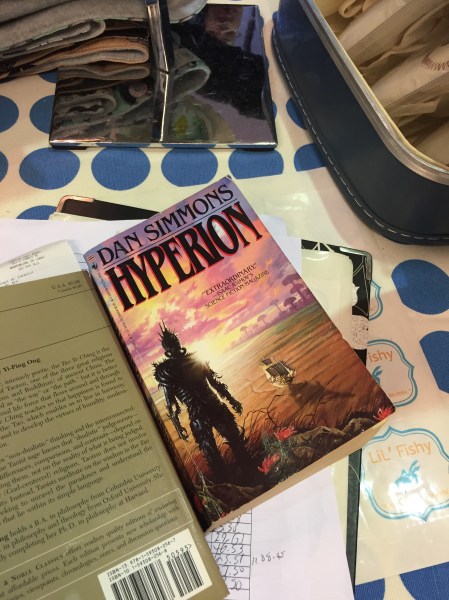
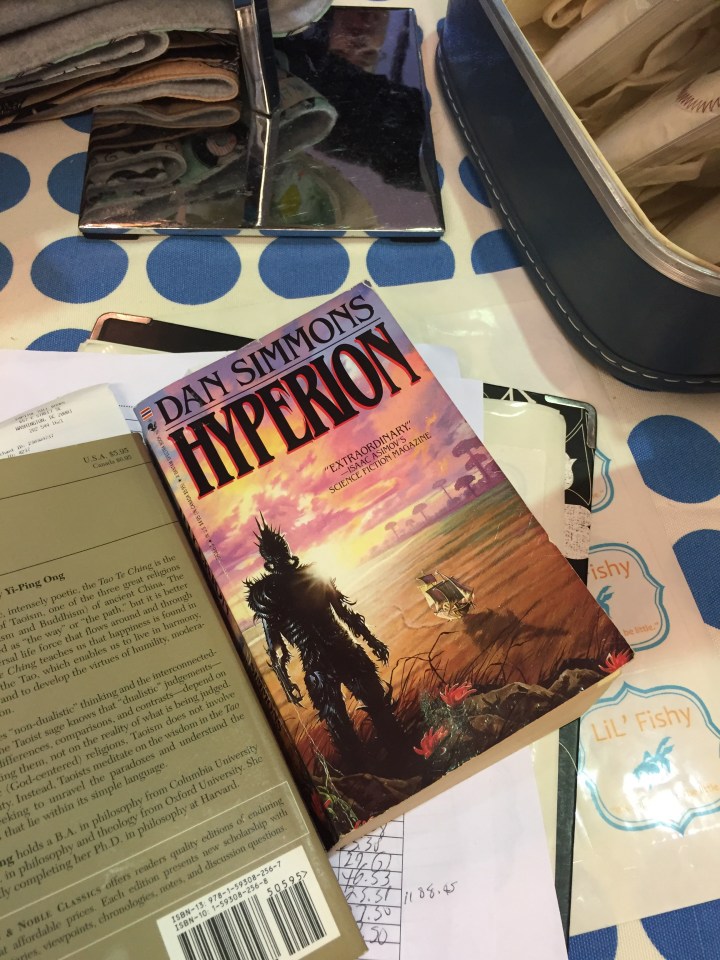
I swear that I didn’t know it was part of a series. I knew he wrote other books about the planet Hyperion, but I really thought this was a self-contained story. Feeling a little betrayed.

But it’s an excellent and intelligent space opera. Keats comes up a lot and he plays with Chaucer’s pilgrims (though much grimmer and with less sex and comedy).

The world is well realized (though it’s actually a vast universe) and the layers and multiplying plots are exciting rather than frustrating, overdone, or contrived. Really, if it didn’t require me to read a second book, I’d call it an unmitigated success.

I’m Back, I’m Not Back


I’ve been away, first thinking only about the election and then contemplating the aftermath.

It’s not a happy aftermath. My wife is an immigrant and a person of color. I have low income family members who depend on Obamacare. All reasons to fear for the well being of people I love.

So, in what do we take solace?

I’ve been reading Cicero’s De Officiis in a lovely little miniature hardback edition. I love those books, on a tactile level, like the original Modern Library editions from the teens, twenties and thirties. This isn’t one of those, but the same principle. Also, just reading a literate account of how to be decent person in society. While some is specific to the society of the late Republican/early Imperial Rome, most is not. And in a post-Trump world, it seems both relevant and terribly sad. But perhaps Cicero, who wrote this after being forced into a sort of exile for his support for the norms of the Republic would relate. Though I still don’t see this as the end of democracy in America. A touch of class, too, in Cicero. Not that kind of class (though he’s very classy), but socio-economic class. And jealousy. On my part. Cicero can retire to his villa, send his son to study abroad (he’s learning from a Greek philosopher in Athens), and spend his days writing awesome things like De Officiis.

I was in my study the other day. Actually, if I’m being honest, I was video chatting my way through a Dungeons & Dragons game (thankfully, we’re meeting in person next week; sometimes, technology is a hindrance to play, a statement that you should take several ways). While waiting for technology to right itself or else during lulls in the action, I found my eyes wandering around to all my books. Honestly, I’ve got some pretty awesome books.

Among them, James Lasdun’s The Horned Man, I book that I read many years and deeply enjoyed and I felt compelled to reread upon seeing it on my shelf. Like Cicero, maybe I’m looking for parallels. In this case, an unreliable narrator who quickly constructs a strange and inexplicable conspiracy. So how does this relate? Trump, the unreliable narrator spinning his improbable narratives? Me, trapped in a world created by people who see conspiracies in the quotidià of modern life? Or am I the narrator, feeling a strange noose tighten for reasons I can’t understand (bear to understand?)?

Wordworth’s The Prelude which is one of the highlights of western civilization, but which, thankfully, has nothing to with Trump. Or does it? I just called it one of the highlights of western civilization and doesn’t that relate to Trump making his closest presidential adviser a man tied to a racist, separatist, apartheidist, ethno-european nationalist movement? That doesn’t make Wordsworth particularly racist (though I’m sure he was, being a man of his erea), but am I merely taking a more highbrow kind of comfort in the same white mythologies as Trump’s supporters?

I picked up Kenneth Rexroth and Ikoko Atsumi’s translated text, Women Poets of Japan and found myself less enthralled than I remember. While waiting in line to vote, I was reading The Book Genji and the titular Prince Genji and the beau monde in which moved frequently communicated via poems, but a quick, returning glance at that once favored collection of Japanese poetry left me itchy for something else. If that something else was a white, male poet (Wordsworth), does it make my reaction more fraught?


Chessmen Of Mars


book-chessmenofmarsI’ll admit, I’ve been reading free copies of these novels on my Nook, but I think that Chessmen of Mars is the last of Edgar Rice Burroughs’ Mars (or Barsoom) novels that’s in the public domain and while I’m sure it’s possible to find a free copy anyway, it’s a moral point no to, though that seems shallow, since I took advantage to read the others for free, isn’t it? But let’s not make the perfect be the enemy of the good, now shall we?

Like many of his novels set on the dying planet of Barsoom (known to us, as Mars), Chessmen feels like two long, connected short stories. The daughter of John Carter and Dejah Thoris runs away and her airship crashes among yet another previously unknown subset of Martians, the kaldane and their rykor… well, it’s complicated. The kaldane are oversized human heads that walk on little  spiders and who mount themselves on headless human bodies called rykor, seize hold of the spinal column, and use them as their bodies. Burroughs doesn’t have Lovecraft nor Carter’s feel for imparting the horror felt by a character, but he does a decent job of showing how horrified the princess is (and her lovesick rescuer who is, naturally, also a fierce and chivalrous warrior).

When the two more or less human protagonists escape (along with their new friend, one of the walking heads and his stolen rykor), they wind up in a sort of lost and primitive kingdom where a game similar to chess is played, only with… well, you can guess. Yes, the pieces are actually people, fighting on a giant board.

Will Tara of Heliun and Gahan of Gathol escape? Will they find true love together? Will the villainous king (or jeddak) be replaced by his much nicer and braver vassal? Will there be an addendum explaining the (non-fatal) rules of Martian chess?

Well, um, yeah.

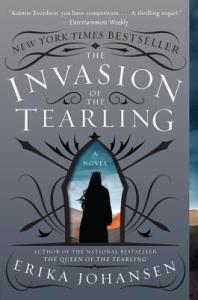
‘Invasion Of The Tearling’ By Erika Johansen


9780062290410Maybe not as good as the first book in the trilogy, but still very good. The world building is nicely realized and it’s both good and important that it’s a book with a female protagonist that was written by a female author. It shouldn’t be, but I hope we can all agree that full gender equality hasn’t been reached yet, so anything that breaks up the boys club is positive.

The other week, I was visiting my new grandniece (yes, I’m old; I can already feel the icy hand of death clutching at my still, but barely beating heart; I can only pray that when the reaper comes for me, he finds wearing nothing but a pair of ruby encrusted spurs and listening to Jefferson Airplane’s classic album, Surrealistic Pillow), and my nephew-in-law showed me one of the books the infant had been given. It was an ABCs of famous American women and ‘U’ was for Ursula K. Le Guin. I explained that she was a famous and great feminist writer, best (though not exclusively) known for writing very thoughtful fantasy and science fiction.

That has nothing to do with The Invasion of the Tearling, but feminism in the genre had been on mind and that’s why.

We are in a fantasy world, with an invasion and a young queen, but the most interesting part are visions/flashbacks to how people from ‘our’ world wound up in this fantasy landscape. There’s a messianic revolutionary named William Tear and a world of corporate control created by a former president – a far right ideologue. It’s tempting to read Donald Trump into him, but he’s actually more of a Reagan-era figure. More Christian right than meandering, narcissistic fascism. The revolutionary movement grew out of the Occupy movement and it does feel real enough, but the Calvinistic, ‘chosen ones’ nature of the people who will escape to the new world (better world, they call it) is disquieting. There’s a single mention that they are not actually moving in place, but in time (to the future? the past?).

Our heroine fends off the evil queen (actually, she gets a three year truce), but quite clearly releases some more horrible evil into the world, so there’s that. I’ll check the library to see if they have the third book available.


‘The Riddle-Master Of Hed’ By Patricia McKillip


9780441005963This is actually a trilogy, but when I was younger, I read the first book, but a good bit of it, I didn’t quite follow, though the opening stuck with me. Then, my mother sent me up a box of my books from her home and, among them, was an aging paperback copy of the first book, which I re-read while visiting a good friend in Chicago.

As it turns out, the only way to really read it now is to buy a reprint in an omnibus volume. Of course, I’m writing this because I’ve finally finished said volume.

McKillip is lovely, delicate writer, with a soft touch that is similar to Ursula K. LeGuin. I don’t think it would surprise any reader of Riddle-Master that it feels very similar in tone to the Earthsea novels (including being more than a little feminist, even though the hero of Riddle-Master is male – though so was the protagonist of two of three original Earthsea novels).

The story, which gets too complicated to really summarize here, struggles after the first book. Things don’t feel properly explained and everything rushes towards to a conclusion that, while not exactly deus ex machina, does not feel properly earned.

The coolest idea, undoubtedly, are the importance of riddles to the culture of the world. When the story begins, magic is gone – or, at least, wizards are gone. But a connection to that former world is maintained through the study of ancient lore. These ‘riddles’ are almost never actually riddles, but more like trivia from antiquity. The theme of these riddles as being vital secrets for understanding one’s self, one’s world, and one’s predicament is consistent throughout and I never ceased to find the concept rewarding.

What I most took away is a desire to re-read another one of her books, The Forgotten Beasts of Eld. I think I was living in Florida when I read it. I remember being in my mother’s car and reading it after she had bought it for me at a used bookstore.

Fifty Years Ago Today, The First Episode of ‘Star Trek’ Aired


I took that picture of Captain James Tiberius Kirk’s uniform at the Smithsonian’s Air and Space Museum on the Mall. And no, I’m not going to get into a discussion about Kirk’s middle name. But I should note that this is a uniform worn by Chris Pine, not by the eternally awesome William Shatner, though, after watching Star Trek: Beyond, which was the best of the ‘new’ Star Trek‘s and, dare I say, in the top fifty percent of all Star Trek movies, not to mention a rollicking good time, I now have a much better appreciation of Pine as Kirk, or how he has grown into the role. Real Star Trek fans will also have realized that Shatner could never have fit into that uniform, even at his youthful and swashbuckling best.

But that original series was just… awesome. And Wrath of Khan was one of the best movies of all time (I haven’t forgiven the first reboot movie from trivializing the motives that drove Kirk to cheat on the Kobayashi Maru simulator; the reboot made it a sort of joke, but in Khan, Kirk admitted that the simulation, which was intended to be training for how to deal with failure, triggered in him a deep feeling, beyond just being unable to accept no-win situations, but a terrible fear of failure).

So, not exactly happy birthday. But happy something. And thank you, Gene Roddenberry.

Amber


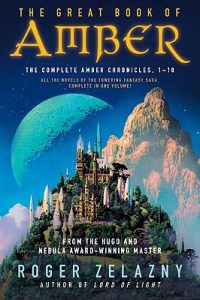
9780380809066Some years ago, I bought The Great Book of Amber at a used bookstore. The Amber books were one of those books I remember seeing on shelves in used bookstores when browsing for sci fi and fantasy as a kid, but were not ones that I read at the time.

These collection actually contains ten books and I only read the first five, but that first five contains the initial, extended story line of how Corwin saved Amber and possibly the entire known universe from… well, let’s just it’s a complicated plot.

The setting is interesting: the ‘real’ world is Amber and what we know as ‘Earth’ is one of many (limitless?) ‘shadows’ of Amber, some of which were created by the disappeared king of Amber and his many children. There is also the ‘Courts of Chaos,’ which is very poorly described and explained and winds up sounding very much like something from Michael Moorcock (Moorcock and Zelazny were both part of a new wave of British fantasy).

The hero, Corwin, embarks on a swashbuckling journey quest, which is thrilling, but, as you can probably guess, not as engrossing to me as it might have been. There are those who swear by these books. For me, I was totally gripped at the noirish mystery with which opened, with an amnesiac Corwin waking up in a mental hospital on ‘Earth’ and trying to figure out what the heck is going on, but once he learned, it became less interesting to me.

Nonetheless, better writing than most and not sorry I read it.

Supermarket Fantasy


I came across that term in an interview with the sound artist, Allen Mozek, and I instantly knew what he meant.

As a child, I remember that my mother would take me into this one, huge (it seemed to me) store. I think that it was a grocery store, but it might also have been something like a Target (though probably not a Target; maybe a Montgomery Ward). In that store was an enormous (again, it seemed so to me as a child) row of books and magazines. I loved best these hardback books that were mostly science fiction illustrations, like cover art for books and magazines. But that also had paperback fantasy and science fiction.

Recently, we visited my family in rural Arkansas. There was an old fashioned drug store that used to have a wire rack filled with cheap paperbacks.

Also, I can remember when supermarkets used to have books. I know that many still do, but back in the day, they were both cheaper and more varied.

I loved those supermarket fantasies. I wanted them all. I would read the backs of each one and pore over the covers with awe. Mozek is a little dismissive of them, but I am still engaged in an archaeology of those memories (hence, my love of Ace Doubles).

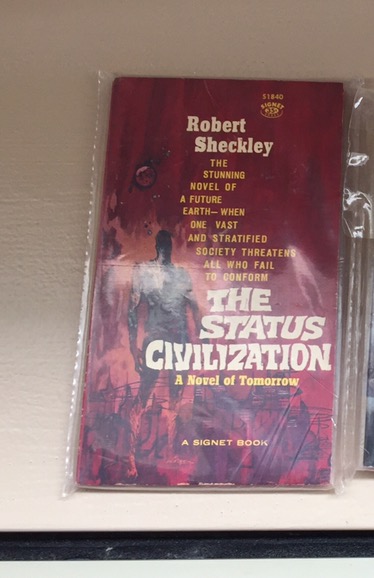
The Status Civilization


This 1960 novel by Robert Sheckley reminds me of a later book by Frank Herbert, of Dune fame. Herbert also wrote a novel about a place called Dorsai, which distilled ideas in some other of his books (including Dune) about an environment which hardens men into living weapons. After reading The Status Civilization, I have to think that Herbert read it, too. Now, don’t get me wrong – there is a reason Herbert is still widely read and this novel, maybe not so much. Herbert had a gift for world building, while Sheckley’s scenario is more tendentious.

In short, a man wakes up with his memories mostly wiped and learns he’s on a prison ship to take him to Omega – basically, a planet-wide prison. There is a surprisingly well-organized government, but it’s literally based around semi-legalized murder and the literal worship of Evil (always with a capital E). Our hero, like many heroes, proves not to be bad guy (he was sentenced for murder, but didn’t really do it) and also surprisingly physically adept and a pretty good fighter and killer for a non-murdering kind of guy.

The interesting bit is when he makes it back to Earth and finds a society which has been inculcated to extreme self-regulation. In fact, he realizes that he turned himself in for the murder, knowing he didn’t commit it, but also knowing that the ‘evidence’ suggested he did. There’s a weird, not terribly well done internal struggle (visualized through the recreation of his earlier battles, but with inner, ‘Earth’ self being the antagonist) where he tries to stop himself from turning himself in again.

It ends with him realizing he has to warn the incoming Omegans before they get their memories back and their conditioning and just wind up sending themselves back to Omega.

Ok.

The story is nicely paced and feels very full, despite being only a little over one hundred pages long and for the avid sci fi reader, there’s plenty to be had, especially if you are interested in some antecedents to a modern sci fi trope.


Aldair In Albion


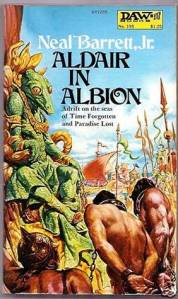
Aldair in AlbionI was in Chicago a few months ago and used a few free minutes to walk from my hotel to the nearest, open bookstore (I forget the name). Whenever I’m in a new city, I like to visit a local, non-chain bookstore and buy a book. It’s just a thing I do.
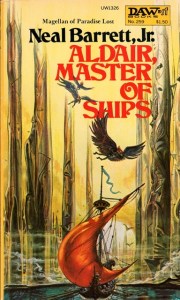
While browing an old fashioned metal wire turn rack (like they used to have on drugstores, stocked with things like Doc Savage novels and Harlequin romances), I saw Aldair, Master of Ships. It looked cool, so I bought it, but later realized it was a second book in a series.

So, here we are, reading the first book, Aldair in Albion.

It’s nothing groundbreaking, but does offer a nice, new twist.

The world is similar to late Republic/early Imperial Rome, with various people’s given names similar to things like Gaulish tribe (the Venicii) and the Vikings (Vikonen), but all filtered through a Robert E. Howard-esque, Hyperborean sensibility. But while not state outright, the author quickly lets us know that the characters are not human. They aren’t properly described, because the third person limited perspective of Aldair, via the narrative, already knows what people look like. But words like ‘pelt’ and ‘snout’ are dropped, as well as the fact that Aldair’s girlfriend, as it were, has more than the usual (for a human) number of nipples.

AldairMasterofShipsA reader of very basic knowledge will peg this as a post-apocalyptic novel, where animals have evolved and become dominant and the titular Albion is clearly England.

But, after 200 pages of standard, but generally exciting fantasy adventure, we get an interesting twist in the final five pages. No sign of a nuclear explosion, but rather, humans apparently genetically engineered the various humanoid peoples from animals (Aldair is descended from cows), dropped them in sci-fi style sleeper pods that opened all over the world. No word of where humans are, but the whole thing looks more like an experiment and Aldair commits himself to helping the genetically modified peoples of the world build their future, having been disgusted by humans.