The Star Mill


Emil Petaja asks the reader an important question: what if Finland was populated by secret space wizards?
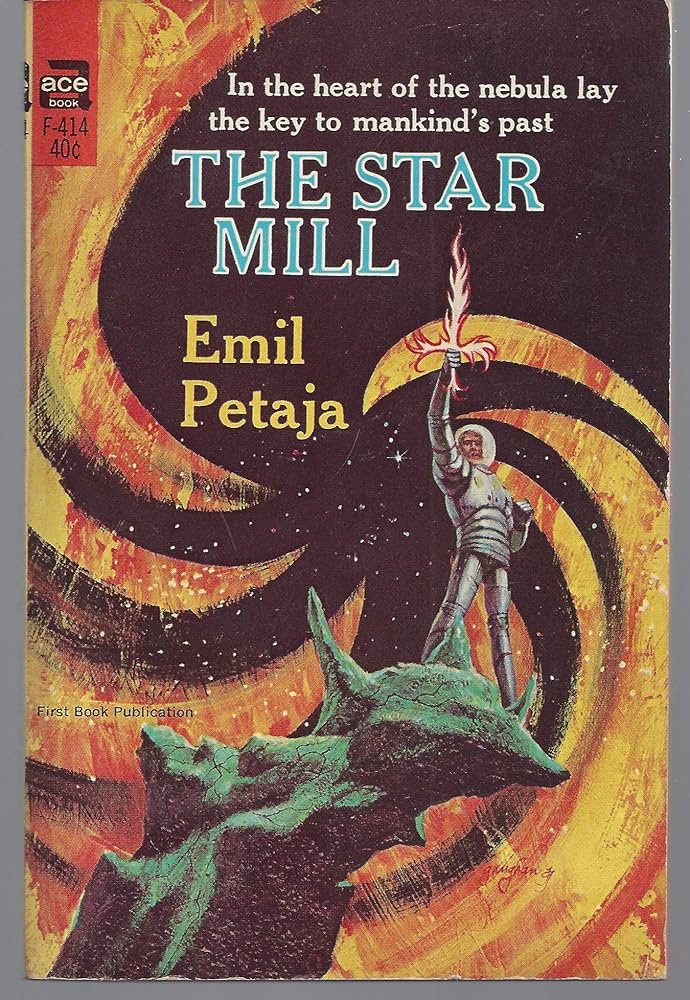
Yes, that’s right. This book is that bats–t crazy. It starts out like a classic silver age science fiction novel, with a lost spaceman who has survived this cosmic zone of death called the Black Storm. The Storm is growing and it disintegrates everything it touches. Even the crew of the ship that picks up our intrepid spaceman (who is, we will learn later, named Ilmaren) slowly and painfully melts into atomic nothingness just from having been near things that were in or near the Black Storm. He blames himself (as do most people in the first half of the book), but later it is off-handedly said that it couldn’t be him, but maybe his spacesuit was contanimated? Felt like there was some more detail we could have gotten there, but by that time, we are off to the land of the space wizards who descended from the people of modern day Finland. Mostly, they live like gnomish wizards underground, but once a year they come up and party (protected by an illusion, so normies don’t discover them) like it’s approximately 1000 CE.

You will be surprised to learn that Ilmaren is actually a chosen savior of the galaxy who must journey to land of goblins, elves, and hell hounds, created by an evil witch who got herself a Star Mill due to… well, it’s a long complicated retelling of Finnish mythology that is barely even metaphor, apparently. Anyway, Ilmaren saves the die by traveling through a tapestry using space magic and destroys the Star Mill (though not the witch! she escapes!) using a science magic… um… light saber, I guess. It’s really not clear. He’s sort of trapped in the little space witch world, but he seemed hopeful, so I guess it’s a happy ending. And we are meant to assume that the Black Storm will not destroy the entire universe anymore, so, job well done.

King Solomon’s Mines


I love this sort of book and hate myself a little for loving them. Featuring the surprisingly not indefatigable Allan Quatermain, King Solomon’s Mines is what the term “rip-roaring adventure” was made for. Brisk and exciting, but also depressingly racist.

Quatermain is actually a somewhat nervous elephant hunter in his middle age, living in Africa, with a son in medical school back in England. He is recruited to help a wealthy aristocrat find his lost brother – lost looking for – can you guess? – the biblical King Solomon’s lost African diamond mines. Accompanied by Naval officer, recently mustered out, and an African man, they cross mountains, nearly starve (the description of the journey is pretty exciting), and then discover a sort of lost civilization. A militaristic African nation in a hidden valley, past nearly impassable mountains. Of course, they find the mines, but only after their friend reveals himself to be exiled son of the nation’s former king and they win a subsequent civil war.

They find the mines, of course, grab some diamonds and… well, you see, the naval officer had fallen in love with a beautiful woman and she dies saving them and Quatermain utters one of the most disgusting things I’ve heard since someone said that there were good people on both sides of clash around the white supremacist march in Charlottesville, Virginia. He thinks that it might be good thing she died, since it could never have worked, her being African and him being White. Just… really unnecessary.

They return and randomly happen upon the long lost brother, living in shack in the middle of nowhere after he hurt his leg and couldn’t complete his journey.

H. Rider Haggard also wrote She, another rip-roaring adventure. It’s in the same vein as A. Merritt (using a first initial seemed to be a thing) and Edgar Rice Burroughs and even Arthur Conan Doyle’s non-Sherlock adventures and is in this tradition of late nineteenth and early twentieth century pulp adventures, some edging closer to horror and others towards science fiction and others are just fun adventures. This genre is one of my delights, despite the flaws.

Baptism Of Fire


I am done with these Witcher novels. I’m enjoying the Netflix series. I tried playing the video game, but just wasn’t up for learning anything new on that front.

I will simply repeat what I’ve said before: the titular Witcher, aka, Gerald of Rivia, is much better as the star of short stories than as the protagonist of a novel.

The Time Of Contempt


The second novel of the Witcher series, it’s better than Blood of Elves, but not as good as Last Wish nor Sword of Destiny, which were a short story collections. If you’re watching the series, the second season diverges strongly from the books (the first season pulled heavily from the short stories), though viewers of both will pick up on something that was mentioned at the end of the second season and is clearly foreshadowed in the book (though I might not have guessed had I not seen the series).

One interesting thing is that the titular Witcher, Geralt of Rivia, is made smaller. He is badly injured by the end and is also portrayed as being relatively small compared to the power wielded by wizards (including his sometimes lover, Yennefer).

‘The Second Shooter’ By Nick Mamatas


I can’t remember where I read about this novel. I think it was a Washington Post piece by one of their book reviewers, in a round-up piece. But I was inspired to put it on hold at the library and here we are.

Did I like it?

No.

Did I dislike it?

No.

Did I think it devolved towards the end into a poorly explained morass of occultism under a rationalistic veneer?

Yes.

The most interesting part was point of view character (the novel was written in third person limited) of Michael Karras, a writer of leftist and usually conspiratorial books for a small, left wing press. He had a bit of the air of a journalist about him and you are inclined to think of him as being a reasonably smart guy. And he was. But somewhere along the line, you are reminded that he’s also a conspiracy theorist kind of guy and you think back and wonder if you missed things because he’s far less reliable than you initially assume. Oh, and he kills himself at the end after taking an uzi from a guy in an invisibility cloak in hopes, one assumes, that by doing so, his semi-mystical status will make the world better, which, in the epilogue, doesn’t seem to have worked.

Ninefox Gambit


After reading this science fiction novel and then recommending it to a friend (I won’t say it was great writing, though perhaps it is better in the original, but it’s good writing and I just found it very fascinating), he immediately noted the en media res factor, with Lee tossing into a well thought out, but very outre science fiction universe and society. Mathematics based around calendars can, apparently, affect reality in some way that winds up wreaking havoc on technology based around other ‘calendrical’ systems. It’s like if the presence of a vinyl record player caused your all your iTunes songs to either blow up your phone or play nothing but ‘Baby Shark’ at ear splitting volume.

He also commented on how this society placed an emphasis on the wearing of gloves and how that was also part of the society of the Radch Empire in the amazing novel, Ancillary Justice.

This got me thinking and I eventually decided that Frank Herbert’s Dune was the forerunner of all this. The culture and the social and technological mores of that universe were detailed, well thought out, and completely alien to us. While Ninefox Gambit is no Dune, I can see the lineage.

Swords Of Mars


I was, at first, excited that Burroughs had returned to the original hero of the Mars (or Barsoom) stories: John Carter.

Read more

Studying With Miss Bishop: Memoirs From A Young Writer’s Life


I am a fan of Gioia, but more as a figure than a poet (though his translation of Dante is superb and that, too, is poetry). I enjoyed his novella length essay on the Catholic writer in contemporary times and felt he was one of our best Poet Laureates in terms of actually promoting poetry (I love the poetry of Charles Wright, but he was marvelously disinterested as Poet Laureate). I was pleased to read that he was a young fan of Edgar Rice Burroughs and got his start reading At the Earth’s Core (the first of his Pellucidar books).

Beyond our shared love, this is a lovely little book. I wish that he had delved more into his own experiences around class and race, but I also recognize that this is not that kind of book.

He examines how his interactions (mainly as a young poet) with five poets and writers affected him. While he notes a funny encounter with a drunk James Dickey (who resented a negative review that Gioia wrote), the reminiscences are by and large fond and positive.

My personal favorite was the chapter about the classicist, Robert Fitzgerald (I loved his translation of The Aeneid), but section on Ronald Perry, an apparently talented, but mostly unknown poet, is the most affecting. It is a beautiful meditation on mortality, in the end. Perry’s literary reputation was small and his memory limited, most likely, by the lifespan of those who knew him. Most writers will not be remembered.

Rhythm Of War


I am officially tired of reading long, unfinished series of fantasy/science fiction novels, with each and every novel being longer than the last. I think this one clocked in at 1300 odd pages. Are you better than War and Peace? No? Then consider tightening your narrative.

Ok.

It wasn’t that bad, I was just ‘over’ this fourth book in the so-called Stormlight Archive about five hundred pages short of finishing it. Which, before you ask, I did finish it.

Sanderson does still write some great action sequences. He has characters (one in particular) who can fly (that’s technically not what he’s doing, but close enough without explaining an unnecessarily complicated magical system) and does a good job at depicting combat in multiple dimensions.

At least, if the author is try to his word, this particular storyline will end with the next book.

The Prisoner Of Zenda


What a great book. I can’t even guess how many times I read this during my school days. A dozen times, at least.

When this article from the Post came out, praising it as a lost classic, I knew I had to revisit it.

And it’s just as good. Thrilling, romantic, brisk. Some fascinating twists and turns. In some ways, it reminded me of my beloved planetary romances, wherein, despite the presence of advanced weaponry, folks still use swords. Similarly, despite there being revolvers and despite seeming to take place in the 1870s or 1880s, characters consistently choose to use swords instead of guns. Why? Because it’s cooler, that’s why! What a silly question.

As the hero says, when asked if he intends to use a gun when surprising a group of six ruffians, “No; steel for me.”

Steel, indeed. Duels, seductions, disguises, nighttime raids. What more can you ask for?