Ezra Pound: Canto LXIII


The Sixty-Third Canto, short though it is, confused me greatly.

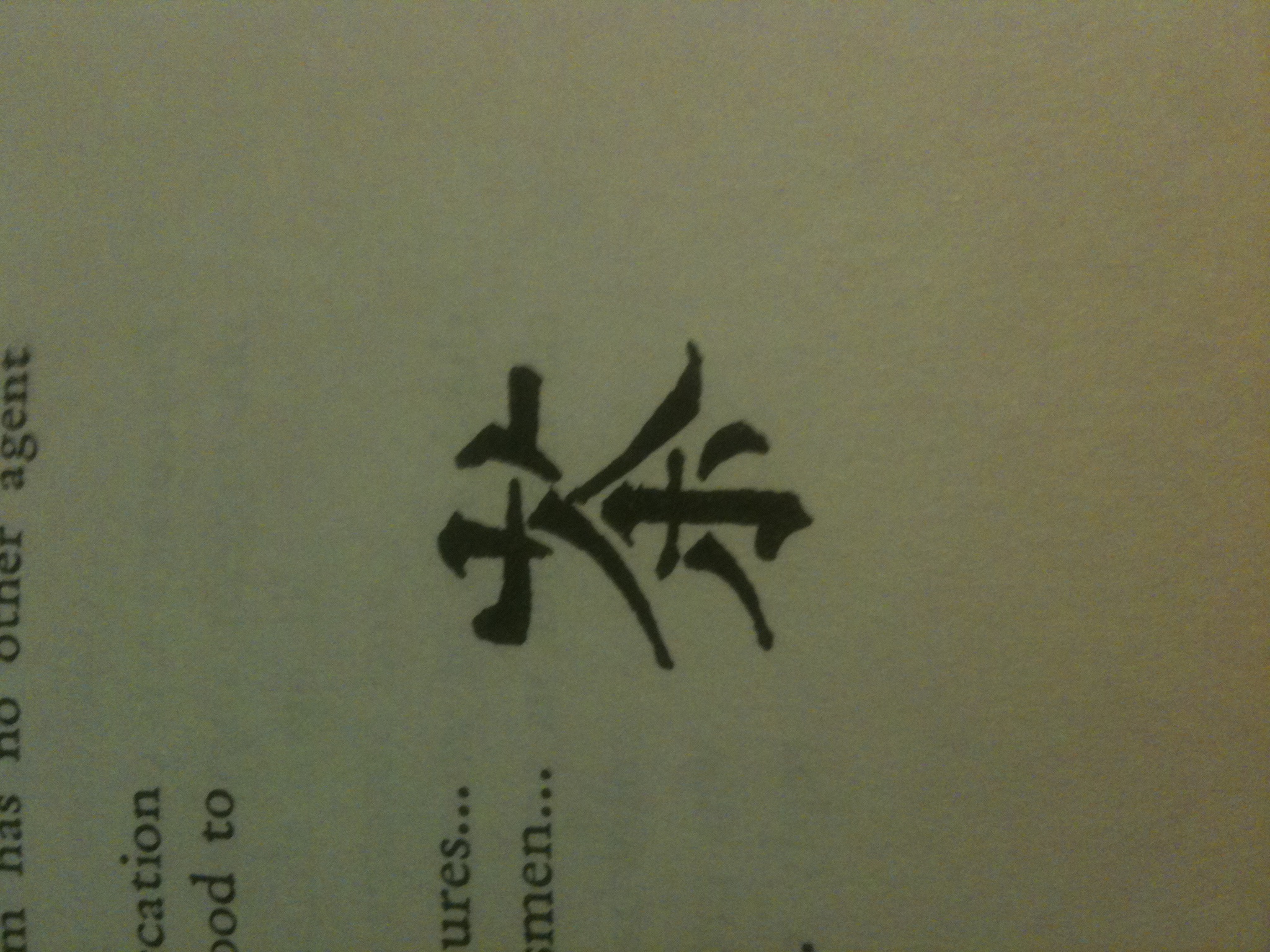
In the first place, we have abandoned China. Well, mostly. There is the Chinese character (pictured) which Pound inserts something less than 2/3 of the way into the Canto.

So far as I can tell, it is the diary or correspondence of  a lawyer (that much is mentioned: …So that I/believe no lawyer ever did so much business/for so little profit as I did during the 17 years that I practiced) commenting on the various things he has read recently – from history to current news to literature.

Byron and Shakespeare are mentioned (Timon of Athens, specifically, in the latter case). Jefferson, Adams (pere et fils), Franklin.
Readability Versus Literary Quality


I want to thank British poet Andrew Motion for making this point, that the dichotomy between literary quality and readability is almost entirely a false one.

War and Peace is not a good book because it’s beautifully written but well-night unreadable. No, it’s a damn fine read.

Even so-called difficult books, if well written, are also readable and enjoyable. In different ways than other books, perhaps, but then again, the best selling and very readable Guns, Germs and Steel is readable and enjoyable in a different than The Hobbit.

I’m not reading The Cantos because they’re boring and unreadable. Yes, they are often difficult, but it is not painful to have one’s view expanded and one’s mind challenged. Or rather, if it is, then you are a sad, sad person.

Great literature is great literature for many reasons, none of them are ‘unreadable’ nor ‘providing no pleasure in the reading of it.’

Here’s another bit of (not misplaced) grousing about the direction of the Man Booker Prize.

Ezra Pound: Canto LXII


This Canto returns to the western world. Specifically, Revolutionary America.

It begins as if by a (presumably) pro-British governor, but the ‘narrator’ seems to change. This can only be determined by subject matter as the voice does not change much (though it does get colloquial in its spelling in parts).

The subject matters moves to discussions of attempting to secure funding and support for the Revolution from various European powers, including the French and also Dutch banking houses. Surprisingly, he shows little venom towards those Amsterdam banks.

There is an odd lines: in consideration of endocrine human emotions

Correct me if I’m wrong, but I don’t think an 18th century speaker would even know of the endocrine system, much less of the affect of hormones and glands on human emotion.

An accident or a deliberate anachronism by Pound?

He also includes a Chinese character (see picture) near the beginning of this (fairly long) Canto. What does it mean? And what did Pound intend by including it, despite having left China, so to speak.

Ezra Pound: Canto LXI


This Canto contains a lot of talk about taxation, something the finance obsessed Pound often harps on.

But a little more interesting to me is something briefly touched on in the last couple of Cantos – what one might call the ‘Christian problem’ (though Pound consistently spells it ‘Xtian’ in this Chinese themed sections).

‘You Christers wanna have foot on two boats
                 and when them boats pull apart
you will d/n well git a wettin’ ‘ said a court mandarin
tellin’ ’em.

Ezra Pound: Canto LX


The Sixtieth Canto continues with the theme of a cosmopolitan and worldly China, but from a first person perspective, as if by a Chinese official. Nonetheless, the language is very American colloquial. For example, the Dutch are described as ‘poifik tigurs‘ (“perfect tigers”).

Referencing the previous Canto, four Jesuit fathers are given credit for introducing Galileo to China (though that seems odd, since this is supposed to be the year 1693).

Ironically, the narrator ends by musing if China should not, in fact, begin to close itself off from the West.

Ezra Pound: Canto LIX


The Chinese history involved in this Canto struck me as bearing interpretation as a rejoinder to the misperception of China as being a closed and insular society that was later forced open by Western powers.

Within the Fifty-Ninth Canto are diplomatic meetings with the Tsarist Russia, the reading of Galileo’s works, and an emperor playing Bach (‘who played the spinet on Johnnie Bach’s birthday‘).

The opening struck me a little:

De libro CHI-KING sic censeo
wrote the young MANCHU, CHUN TCHI,
less a work of the mind than of affects
brought forth from the inner nature
here sung in these odes

The phrase ‘less a work of the mind than of affects‘ struck me as something I wished to have thought of, as an apt description, not so much of books, than of certain people.

P.S. I have  kept my promise to read and write about three Cantos but I will publish them over the course of three days (perhaps giving me time to get off my butt and read some more over the next couple of days and start to seriously catch up).

Pledge To Read Some More ‘Cantos’


I haven’t read a new Canto in some time, I know. And I don’t have a good excuse.

But, my significant other is leaving town for a little while and I pledge to use that time to read and write about at least three more Cantos before Monday.

Gertrude Stein’s (Fascist?) Politics


This article touches on an issue I’ve been grappling with for some time.

We are used to our towering cultural figures being a–holes (does anyone seriously think that being Beethoven’s girlfriend was anything less than a living hell, for example?).

But we still struggle with when these figures support morally repellent political views.

And it is true that many figures of early twentieth modernism were seduced by fascism and anti-semitism.

Pound, of course, I have spoken about a great deal.

Nobel Prize winner Knut Hamsun is another.

At the article above focuses on Gertrude Stein.

And no, I still don’t have a pat answer to the  dilemma.

Pound’s Correspondence


I did not know this, but the publisher, New Directions (which has done great and unselfish work in keeping the writings of Pound and other twentieth century alive and in print for decades), has been publishing volumes of Ezra Pound’s correspondence, with each volume being dedicated to his letters to a particular person.

The article that alerted me to this focused on the publication of his letters to his parents.

It’s odd seeing the idiosyncrasies of the Cantos appear in the excerpts of these letter, especially his occasional offbeat spelling. I had taken it for an effort to reflect a broader colloquial language, but now I don’t wonder if it isn’t just a particular tic of Pound to have his own, private written language.

And the sentences varying between short, incomplete fragments and long sentences containing only vaguely connected thoughts in its clauses.

You can also see Pound’s obsession with money – mainly inspired by his lack of it (though his parents were apparently generous in supporting their self-proclaimed ‘genius’ son).

Ezra Pound: Canto LVIII


This one bounces around a bit, making the narrative (such as it is) hard to follow.

The Canto‘s opening setting is Japan under the Shogunate. But it gets confusing from there. Firstly, it appears to be, at least in part, about the early trading contacts with Europe. Certainly, there is some conversation about the introduction of Christianity to the island:

And because of the hauteur of
         Portagoose prelates, they drove the Xtians out of the Japan
till were none of that sect in the  Island

But it quickly moves back the mainland, with switches between Korea (‘Corea’) and China (and the ‘Tartars’ get mentioned again – though I have been assuming that this word is used simply to refer to those viewed as barbarians by the Chinese).

The intermittent story of a Père Ricci and his work in the East (the historical Ricci was a Jesuit Father) also features, though in a very fragmentary fashion.